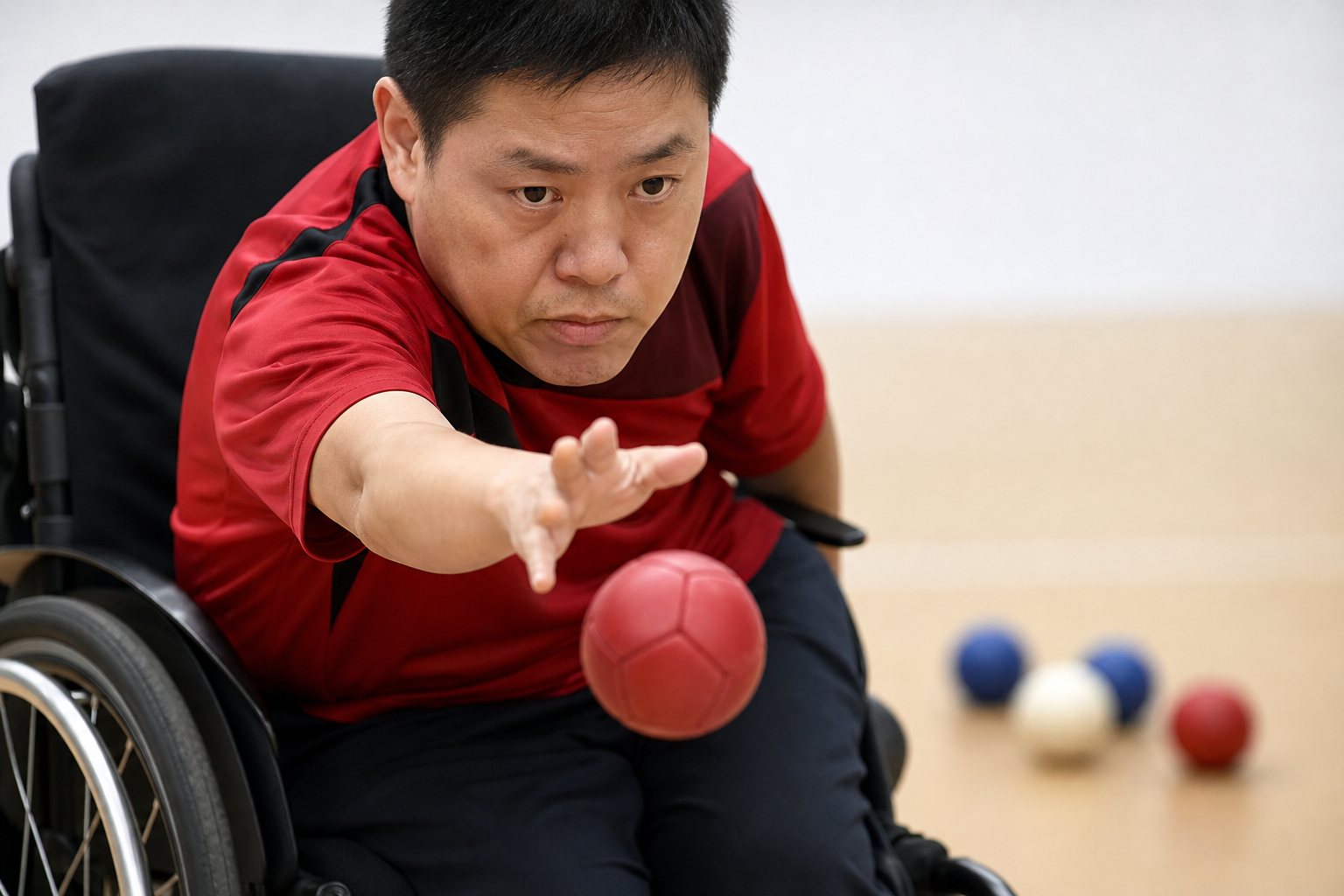
The jack has stopped just short of the line, the opponent has two balls left, and the clock is running. In boccia, matches are often decided by how a player handles the next thirty seconds, not by a hard shot. Mental training for boccia means practising attention, routines and calm decisions so you can deliver your best throw or ramp release under pressure. It is separate from mental health care, and no technique can guarantee a score.
Quick answer: The skills with the most support for precision sports are a fixed pre-throw routine, calm breathing, short cue words, simple goals and a plan for what to do after a bad end. The USOPC describes boccia as testing coordination, accuracy, concentration and strategy, and a small 2026 study of 11 Paralympic boccia players found mental fatigue did not significantly reduce accuracy at 3, 6 or 9 metres. No technique guarantees performance. See a doctor or licensed mental health professional if anxiety, low mood, loss of interest, sleep trouble or exhaustion are affecting daily life; in the US, call or text 988 at any time.
Back to the boccia hub. Rules and timing are on the skills and rules page; the physical side is on the training page.
Why boccia is a mental game
Boccia combines a closed-skill delivery (you start the movement yourself) with a tactical opponent, a timer and, in pairs and teams, teammates to coordinate with. In a team match each player throws two balls per end across six ends, according to World Boccia, so a lapse can be followed quickly by a chance to respond. Time limits per end are listed by the USOPC from four to seven minutes, depending on class and format, so pace is part of the challenge.
Focus and attention
Focus means returning to the task, not never being distracted. A 2026 study of 11 Paralympic boccia players (six with cerebral palsy) tested accuracy at 3, 6 and 9 metres after a mentally tiring task and found no significant effect on accuracy. It is small, and it does not mean concentration is unimportant, but it suggests that experienced players can keep their delivery steady when tired. Practical ideas coaches often use:
- One-word cues: a short word such as “smooth” or “release” to bring attention back.
- Focus on one controllable thing: the ball, the target or the release, not the scoreboard.
- Reset after distractions: a breath, a look at the jack, then start your routine again.
Pre-throw routines
A routine is a fixed sequence you repeat before each delivery: check the position, look at the target, breathe, say your cue, and go. We found no boccia-specific trial of routines, so treat this as a general sport-psychology habit to try, not a proven fix. Make your routine fit your class: a BC3 athlete working with a ramp and an assistant might agree on signals; a BC1 athlete may build in a step for chair adjustment.
Confidence, goals and motivation
- Set process goals: “keep my release the same” or “use my full time” are more in your control than “win this end.”
- Keep a simple log: note what worked after each session so confidence rests on evidence, not mood.
- Break the year into steps: short-term targets (a distance, a class milestone) and a season target agreed with your coach.
- Remember why you play. A 2026 study of 19 Team USA Paralympic athletes described benefits including improved self-acceptance, resilience and belonging, as well as challenges such as financial strain, travel and balancing sport with work or study. Motivation is easier to protect when the sport fits your life.
Imagery and visualisation
Imagery means rehearsing a throw or a match in your mind. Many athletes use it, and it is often combined with relaxation. We found no boccia-specific imagery trials, so use it as a low-cost practice tool: picture your routine, the ball leaving, the way it stops near the jack. Keep it short and calm, and stop if it increases worry.
Handling pressure and setbacks
Everyone misses. A plan helps: take a breath, name what happened in neutral words (“short by a hand”), choose the next action and begin your routine. After a match, review one thing that worked and one thing to change, with your coach, rather than replaying every ball. Our injuries page and recovery page also cover how fatigue and sleep affect how you feel.
Tactics, decisions and teamwork
Tactical decisions in boccia include whether to draw close, hit the jack or block. Make them simply: ask what the opponent can do next and what you have left to throw. In pairs and teams, agree on roles and on how to communicate between throws. Sport assistants in BC1 and BC3 are part of the team: practise signals, because in BC3 the assistant sits with their back to the court and eyes averted from play, according to World Boccia. Team matches are 6 ends with 2 balls each per player, so teammates have to trust each other’s roles.
Competition preparation
Visit the venue if you can, check the court and timer, and keep your routine the same as in practice. Pack what you need, follow your medical plan and ask the organisers about access in advance. Our rules page lists the formats and times you may meet.
Mental health is different from mental performance
Mental skills training aims to help you perform. Anxiety, depression, disordered eating, burnout and trauma are health matters, and they need a qualified professional, not a mental skills tip. Para athletes face their own stresses; the 2026 Team USA qualitative study described financial strain, healthcare access, travel and chronic injury management among them. The IOC has published a Sport Mental Health Assessment Tool (SMHAT-1) and Recognition Tool (SMHRT-1) for use by clinicians and sport staff, and an evidence-informed framework for mental wellbeing in elite sport has been published for organisations. If you or someone you know is in crisis in the US, call or text 988 (the 988 Suicide and Crisis Lifeline, free and available at all hours, with chat at 988lifeline.org). Outside the US, use your local emergency number or crisis line. The Association for Applied Sport Psychology publishes resources for finding a sport psychologist.
Boccia mental training FAQs
How do I stay calm when the timer is running?
Build a short routine and practise it at game pace until it feels automatic. Breathing and a cue word are common tools. None guarantee results.
Does being tired affect boccia accuracy?
In a 2026 study of 11 Paralympic players, mental fatigue did not significantly reduce accuracy at 3, 6 or 9 metres. That is a small study, so rest and sleep still matter.
Can imagery help my game?
Many athletes use it, but we found no boccia-specific trials. Try it as a short practice habit and see whether it helps you.
What if I freeze under pressure?
Go back to your routine, one breath, one cue, one throw. If worry is constant or affects daily life, talk to a mental health professional.
Where can I get mental health support?
Start with your doctor or a licensed mental health professional. In the US, call or text 988 at any time.
Sources
- USOPC: Sport overview, boccia
- World Boccia: about boccia
- Mental fatigue and accuracy in Paralympic boccia players (PubMed)
- Team USA Paralympic athletes’ experiences: qualitative study (PubMed)
- IOC Sport Mental Health Assessment Tool 1 and Recognition Tool 1 (PubMed)
- Evidence-informed framework to promote mental wellbeing in elite sport (PubMed)
- 988 Suicide and Crisis Lifeline
- Association for Applied Sport Psychology: resources
General information for education only, not medical advice. It does not replace a doctor, physical therapist, athletic trainer or classifier who knows you. See our editorial policy for how we write and source our pages.