This article contains affiliate links: if you buy through them we may earn a commission, at no extra cost to you. Read our affiliate disclosure.
In a boccia hall, the gear tells you who is who. One player unpacks a case of red and blue leather balls, another sets up a ramp that has been adjusted to the millimetre for her, and a third simply checks that his water bottle is where he can reach it. Boccia gear is mostly simple, but the important parts, the ramp, the seating and the assistive devices, are personal. This page explains what matters, what the rules say, and where we stop short of recommending products because the right choice depends on your body and class.
Quick answer: Boccia equipment for play is a set of six red balls, six blue balls and one white jack, plus a measuring device, timing equipment, scoreboard and colour indicator (USOPC). Ramps, chutes and assistive head, arm or mouth devices are permitted and are fitted to the athlete and class. Get advice from a coach, therapist or occupational therapist before buying. We do not recommend specific ramps, chairs or cushions. See a clinician for any skin, pain or positioning problem that equipment seems to cause.
Back to the boccia hub. Rules and classes are on the skills and rules page; safety ideas are on the injury prevention page.
What the sport requires
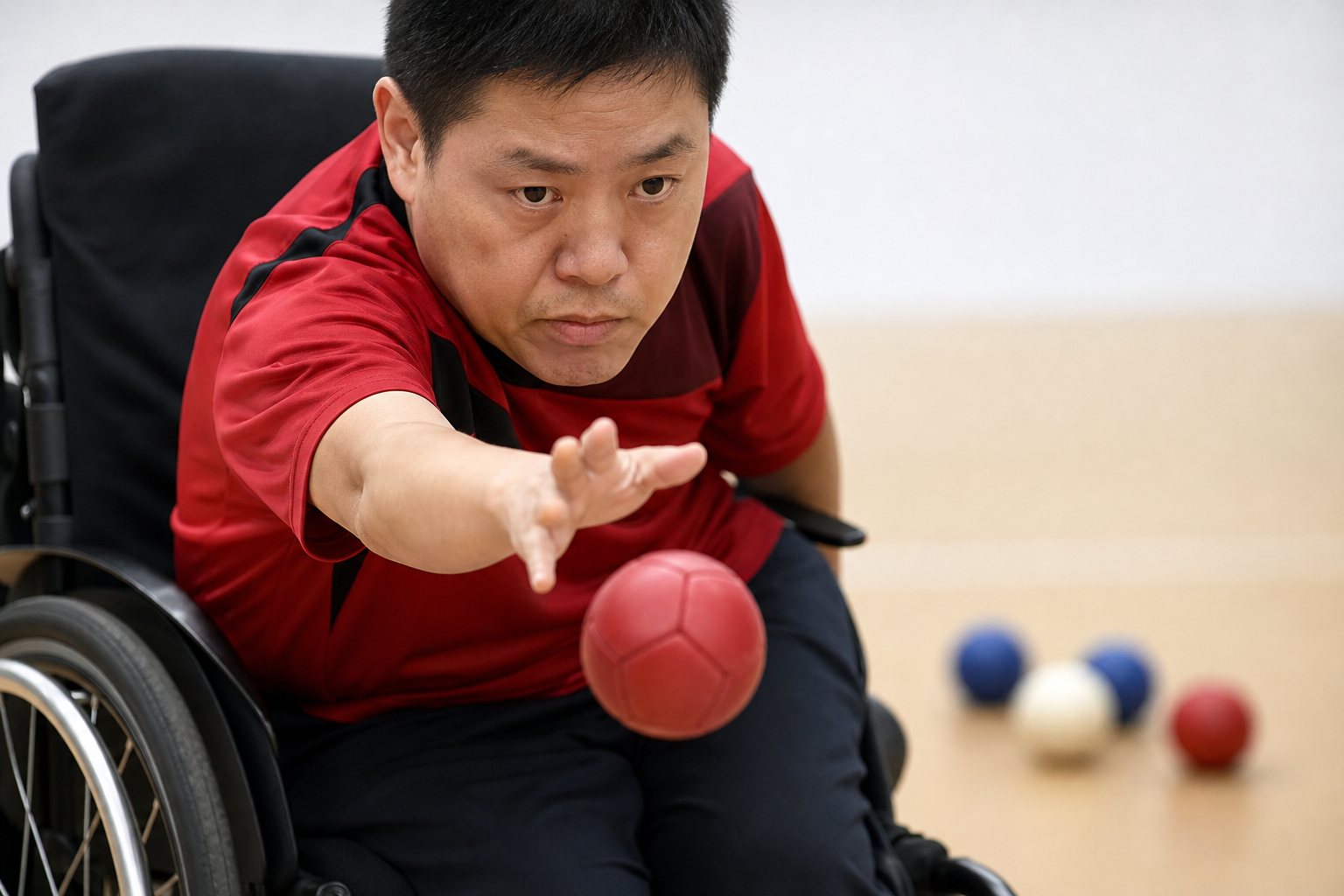
- Balls and jack: World Boccia lists balls at about 275 g with a 270 mm circumference, and Boccia UK says they are leather with plastic granules inside, so they roll but do not bounce. A set is six red, six blue and one white jack.
- Court: 12.5 m by 6 m with 2 m of clear space around it, with throwing boxes and a V-shaped line for the jack (World Boccia).
- Match equipment: a measuring device, timing equipment, scoreboard and colour indicator (USOPC).
- Ramps and assistive devices: chutes, ramps and assistive head, arm or mouth aids are permitted (USOPC). In the BC3 class an athlete uses an assistive device such as a ramp, and an assistant may help while keeping their back to the court (World Boccia).
- Rulebook: equipment details are in the World Boccia rulebook (English 2025-2028 edition, version 1.2.1 as listed on its rules page). Check it, or your national federation, before changing a setup for competition.
Ramps and assistive devices
A ramp is not a one-size product. Height, angle, the way the ball is released and how the athlete triggers it all depend on the person’s movement, and the equipment must comply with the rules for that class. Practical points:
- Try before you buy. Clubs and national organisations often have equipment to borrow.
- Have a therapist or coach involved in the set-up, and bring the athlete and assistant to the fitting.
- Look for stability: a device that wobbles, shifts or rubs is a problem for accuracy and comfort.
- Inspect regularly: loose parts, worn pads and cracked plastic should be fixed before matches.
- Do not rely on maker claims about performance. We are not aware of an independent boccia equipment standard, so compare devices with your coach and the rulebook, not with marketing.
Chair, seating and positioning
Comfort and stable positioning matter for hours of play. Seating also affects the skin: a 2026 scoping review of pressure-injury prevention in disability sport found only ten sources and said the sport-specific evidence was limited, so your medical team’s advice comes first. Ask an occupational therapist or seating specialist about cushions, supports and straps. We do not recommend specific chairs or cushions.
Balls and care
Keep balls clean and dry, store them out of the sun, and check them for damage. If a ball is worn or unevenly weighted, tell the referee or organiser. Do not rely on a cheap toy set for competition; look for sets built for boccia and ask your club or national federation what is accepted.
Everyday extras
Two simple extras are not boccia-specific, but they fit many athletes: a bottle you can reach (a long day can mean few breaks) and a resistance band set for light arm and shoulder work that a clinician has approved. A 2026 study of 30 wheelchair para-athletes found large upper-limb asymmetry among boccia players, which is why strength work should be planned with a therapist. A band is only a tool, so do not start a programme on your own.

Nalgene Sustain 32 oz Bottle
- 32 oz, wide mouth
- BPA-free Tritan
- Easy to refill

THERABAND Resistance Band Beginner Kit
- 3 latex bands
- Yellow, red, green
- For light strength work
$11.99 at Amazon, as of Nov 17, 2026 01:07 UTC
Check price on AmazonThe Nalgene 32 oz bottle is a wide-mouth bottle that is easy to refill; check that you can open and drink from it comfortably. The THERABAND beginner kit has three latex bands, so skip it if you have a latex allergy. If you want more on bands, our training page explains how strength work fits in. These links are affiliate links, and the product details come from the listings, not from our own testing.
Buying checklist
1. Check the rulebook or ask your national federation if the item is allowed in your class.
2. Involve your coach, therapist or occupational therapist.
3. Try before you buy when you can.
4. Look at how it fits your body and chair, not just the specification.
5. Keep receipts and return details.
6. Plan to inspect the item regularly.
Boccia gear FAQs
What do I need to start playing boccia?
Often nothing: many clubs have balls and ramps to try. Ask a local adaptive sports organisation or club first.
Do I have to use a ramp?
No. Only some athletes use one. In the BC3 class, athletes use an assistive device such as a ramp; BC1, BC2 and BC4 athletes throw (or kick in BC1).
What kind of balls does boccia use?
Leather balls with plastic granules inside, listed by World Boccia at about 275 g with a 270 mm circumference. Sets contain six red, six blue and a white jack.
Which wheelchair or cushion is best?
We do not recommend specific products. Ask an occupational therapist or seating specialist.
Are the product links sponsored?
They are Amazon affiliate links; the product details come from the listings.
Sources
- World Boccia: about boccia
- World Boccia: rules
- USOPC: Sport overview, boccia
- Boccia UK: about boccia
- Pressure injury prevention in disability sport: scoping review (PubMed)
- Upper-limb asymmetry in wheelchair para-athletes (PubMed)
General information for education only, not medical advice. It does not replace a doctor, physical therapist, athletic trainer or classifier who knows you. See our editorial policy for how we write and source our pages.