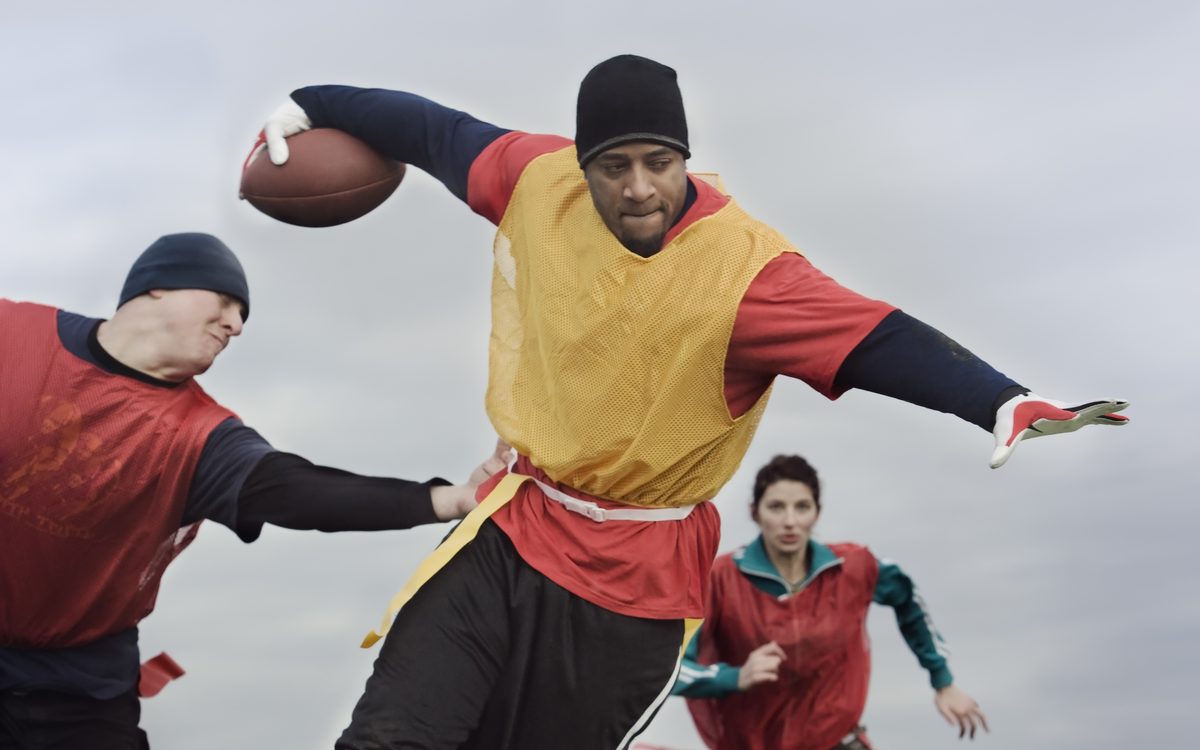
Second game of a summer tournament, the grass still wet, and a receiver plants her foot to cut back for the ball. Nobody is near her, and her knee still takes the load. Flag football injury prevention means the habits around a player, a proper warm-up, strength and landing practice, a gradual build-up, heat care and the right gear, that aim to lower the chance of getting hurt. Flag has far fewer head impacts than tackle, but it is not injury-free, and prevention lowers the odds without promising anything.
Quick answer: The best-supported steps for flag players are a dynamic warm-up before games, strength and landing work for the legs, a gradual build-up of running and games, heat acclimatisation, a mouthguard, and a plan for rest. Most evidence comes from other sports, so these are sensible habits, not guarantees. See a sports medicine doctor, physical therapist or athletic trainer if pain stays in one spot, or after a knee that gave way. Call 911 for concussion danger signs or signs of heat illness.
General information, not medical advice. This page is about lowering risk. What the injuries look like is on our flag football injuries guide, so we do not repeat it. Hub: flag football.
Warm up before the whistle
We did not find a published injury-prevention warm-up program tested in flag football players. The best-known program in field sports is FIFA 11+, a structured warm-up for soccer. A 2017 meta-analysis (Thorborg and colleagues, British Journal of Sports Medicine) found it reduced injuries by 39% in soccer players, and a 2018 review of the 11+ Kids version in 3,895 players aged 9 to 13 reported a 48% reduction (Rossler and colleagues, Sports Medicine). Those results are for soccer. Flag football has similar movements, but we cannot say the same effect applies. A reasonable flag warm-up borrows the idea: jog, then dynamic stretches, then skipping, shuffling, short accelerations and a few catches before the first play. Static stretching can wait until after the game.
Cutting, landing and catching technique
The knee is the joint to respect. AAOS says most ACL tears happen without contact, when an athlete pivots, cuts or lands with a straight leg, and that a pop, a knee that gives way or swelling within hours needs a professional. Coaches can teach cutting with the knee over the foot, landing softly on bent knees after a jump to catch, and pulling a flag by getting close and staying low rather than lunging. A 2018 review of reviews (Webster and Hewett, Journal of Orthopaedic Research) found ACL prevention programs cut all ACL injuries by 50% and non-contact ACL injuries in female athletes by 67%. These programs, which combine strength, balance, landing and agility, were not tested in flag football specifically.
Build running and games up gradually
Add speed work and games gradually, not all at once. We found no flag-specific rule of thumb. The American Academy of Pediatrics (Brenner, 2016) recommends one to two days off a week from a main sport and time off in blocks over the year, and a 2015 study of young athletes (Jayanthi and colleagues) found that those who trained more hours a week than their age in years had about twice the odds of a serious overuse injury. Players returning after years away should start with easy sessions. Preseason is a risky window in some sports: an NCAA study of lacrosse found higher injury rates in preseason than in the regular season (D’Alonzo and colleagues, 2021), a reminder that the first week back deserves care.
Strength and conditioning
- Legs and hips. Squats, lunges and hip-hinge work build the muscles that control the knee on landing.
- Hamstrings. AAOS names fatigue, tightness and muscle imbalance as risk factors for hamstring strains in sprinters.
- Ankles. The National Athletic Trainers’ Association (NATA) position statement (Kaminski and colleagues, 2013) says a previous sprain is the most consistent risk factor for another and recommends a balance training program of at least 3 months after a sprain, plus tape or a brace.
- Youth. A 2014 international consensus statement supports supervised, technique-focused strength training for young people.
Weather, heat and surfaces
Flag tournaments often run in summer heat. NATA recommends 7 to 14 days to adjust to hot conditions, and says to call 911 for confusion, collapse or other signs of heat illness. Practical steps are water on hand, shade between games, and a lighter schedule at the start of the season. Wet grass and uneven fields make cutting riskier, so look over the field before warm-up and tell the league about holes. We found no flag-specific study of cleats versus turf shoes. A 2025 study of 128 female lacrosse and soccer players compared conical studs with turf shoes (Cass and colleagues), but it does not give a flag answer. Many leagues do not allow metal cleats, as NFL FLAG notes.
Protective gear and fit
NFL FLAG requires a mouthguard and says it is the only protective gear players wear. A dentist-fitted guard fits best, and a boil-and-bite guard is a common alternative; either should fit securely. Because gloves are optional and shorts must have no pockets, the gear list is short, and fit matters more than extras. Standards versus maker claims: we did not find a published standard that covers flag belts, so belt safety claims come from makers and listings. See our gear guide.
Concussion awareness
The CDC found youth flag players ages 6 to 14 had a median of 8 head impacts in a season, against 378 for tackle players. Concussions can still happen, usually from collisions or falls. The CDC’s HEADS UP program says to recognise the signs, remove the player from play the same day, and let a health care provider decide when to return. Call 911 for danger signs such as repeated vomiting, a seizure or a worsening headache.
Youth specifics
A study of youth tournaments (J Athl Train, 2023) recorded 47 injuries among 1,939 players ages 6 to 12, an injury rate of 5.1 per 1,000 athlete-exposures. Most were bruises from direct contact. Tournament days with many games can add fatigue, so coaches can rotate players and schedule breaks. The study found a higher risk in girls, but only 195 girls took part, so it is a caution, not a conclusion.
What prevention cannot do
No warm-up, brace or drill removes injury risk. Most of the numbers above come from other sports, from observational studies or from a small group of players. Treat them as habits that may help, and listen to pain.
When to see a professional
- Pain that stays in one place, comes back or happens at rest.
- A knee that gave way, a pop, or swelling within hours.
- An ankle you cannot put weight on, or a finger that looks out of shape.
- Any head injury with symptoms, and every danger sign.
Flag football injury prevention FAQs
Is there a warm-up proven to prevent flag football injuries?
We did not find one. FIFA 11+ reduced injuries in soccer players in a 2017 meta-analysis, but that was soccer. A dynamic warm-up with running, cutting and landing is a sensible approach.
Do I need a mouthguard for flag football?
NFL FLAG leagues require one and say it is the only protective gear players wear. Check your own league’s rules.
How can I protect my knees?
Strength, balance and landing training, and learning to cut and land with soft, bent knees. ACL prevention programs have reduced injuries in other sports, but have not been tested in flag football.
How should I handle summer heat?
NATA recommends 7 to 14 days to adapt, water and shade between games. Call 911 for confusion, collapse or other signs of heat illness.
Can flag football cause concussions?
Yes, although the CDC found far fewer head impacts per season in youth flag than in tackle football. Remove the player, and let a health care provider decide on return.
Sources
- Thorborg et al., FIFA 11+ meta-analysis, Br J Sports Med 2017
- Rossler et al., 11+ Kids, Sports Med 2018
- Webster and Hewett, ACL prevention programs, J Orthop Res 2018
- AAOS OrthoInfo, ACL injuries
- AAOS OrthoInfo, hamstring muscle injuries
- NATA ankle sprain position statement (Kaminski 2013)
- NATA, exertional heat illnesses
- AAP, Brenner, 2016
- Jayanthi et al., 2015
- D’Alonzo et al., NCAA lacrosse injury rates, 2021
- Cass et al., conical studs vs turf shoes, 2025
- NFL FLAG, flag football rules
- CDC, comparing head impacts, flag vs tackle
- CDC HEADS UP, signs and symptoms
- Youth flag football tournament injuries, J Athl Train 2023
General information for education only, not medical advice. See a sports medicine doctor, physical therapist or athletic trainer about your own situation. How we write and check our pages is in our editorial policy.