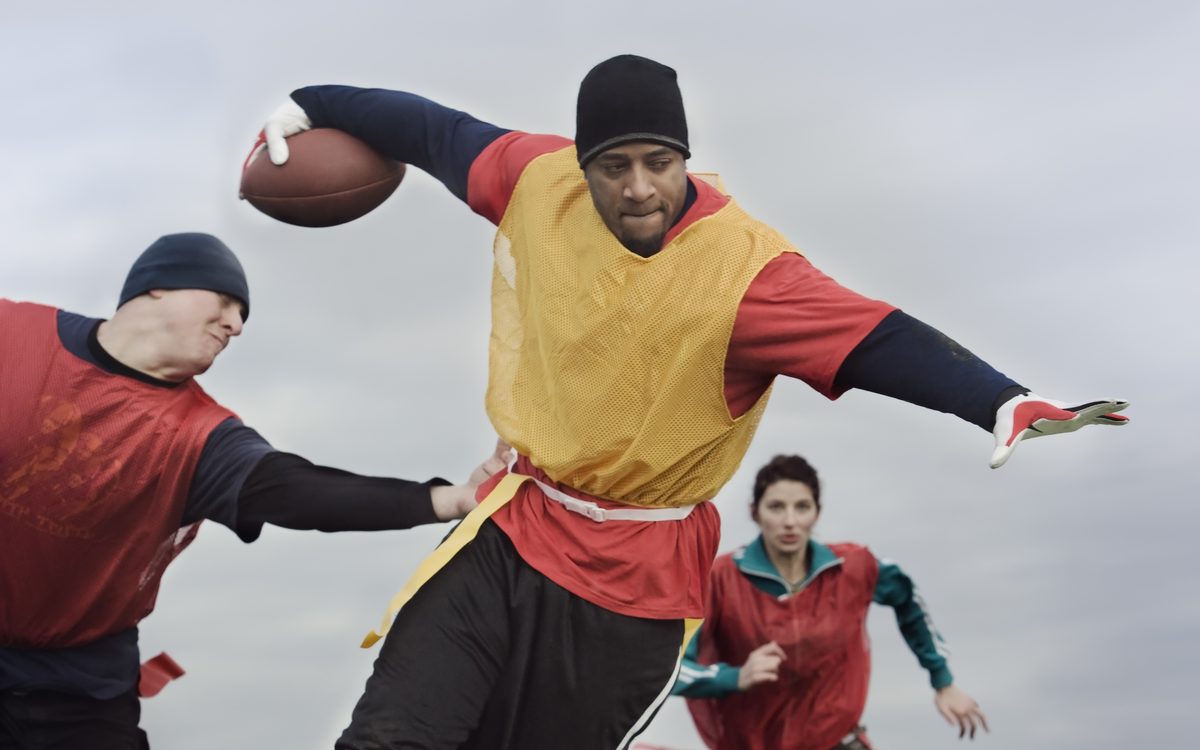
Sunday night after a tournament, legs heavy on the stairs, calves tight from a day of sprints and cuts. You ask the question every player asks: what should I do now? Flag football recovery is everything that helps your body get ready for the next game or practice: sleep, easy movement, eating and drinking, rest days and a sensible schedule. Some of what athletes try is well supported, and some is mostly comfort. This page sorts the two honestly and shows how to tell normal soreness from a possible injury.
Quick answer: Sleep, a rest day and a gradual schedule do the most for recovery. The CDC recommends 9 to 12 hours of sleep for ages 6 to 12, 8 to 10 for teens and at least 7 for adults. Tools such as foam rollers, massage guns and cold baths are optional, and the evidence for them is limited or mixed. Soreness that fades in a day or two is normal. See a sports medicine doctor, physical therapist or athletic trainer for sharp, lasting or one-sided pain.
For training and load, see training. For injuries, see injuries. Hub: flag football.
Sleep first
The CDC recommends 9 to 12 hours of sleep a day for children ages 6 to 12, 8 to 10 hours for teens, and 7 or more hours for adults. For tournament weekends, that means an early night before the first game, not a late one after the last. A regular bedtime, a dark, cool room and less screen time before bed are common advice. If you struggle to sleep for weeks, talk with a doctor.
Load management and rest days
Recovery is partly a schedule. The American Academy of Pediatrics (Brenner, 2016) advises young athletes to take one to two days off a week from their main sport, and time off in blocks across the year. A 2015 study of young athletes (Jayanthi and colleagues) found those who trained more hours a week than their age in years had about twice the odds of a serious overuse injury. That study was not specific to flag football, but the lesson fits: stack a hard training week on top of a tournament weekend, and your body has less time to catch up. Before a multi-game day, keep the days before it light. Afterward, plan an easy day.
Between games on a tournament day
- Keep moving gently. A short walk or easy jog between games keeps legs from tightening up.
- Eat and drink. See nutrition and athlete health for fuel and fluids.
- Get out of the sun. Shade, water and a short rest help in heat. The National Athletic Trainers’ Association (NATA) recommends 7 to 14 days to adjust to hot conditions; call 911 for confusion, collapse or other signs of heat illness.
- Warm up again. If you sat for more than a short break, warm up before the next game.
Mobility and flexibility
Flag players need hips, ankles and hamstrings that move freely for cutting and sprinting. Gentle mobility work, such as leg swings, ankle circles, hip openers and easy stretching after activity, is a common part of an athlete’s routine. We did not find a flag-specific study on stretching, so we treat it as general practice. AAOS lists tightness as one risk factor for hamstring strains, but we cannot promise that stretching prevents them. Stop stretching if you feel sharp pain.
Recovery tools: what the evidence says
Recovery gadgets are popular, and the honest summary is that the evidence ranges from modest to thin.
- Cold-water immersion. A 2026 umbrella review of 15 systematic reviews (Berjisian and colleagues, Sports Medicine – Open) found that it reduced muscle soreness for up to 96 hours and improved muscle power at 24 to 48 hours after hard exercise. It also found that it did not improve strength and might impair strength and muscle gains if used after every training session. The review rated its evidence low to very low certainty, with 10 to 15 minutes at 10 to 15 degrees Celsius among the most effective protocols. It may suit a tournament weekend more than regular strength days. People with heart or circulation conditions should ask a doctor first.
- Foam rollers and massage guns. Many athletes use them because they feel good. We did not review a strong evidence base for either, so we call them comfort tools, not treatment. Our guides: massage guns and recovery tools. Avoid pressing on an injured area.
- Recovery shoes. Cushioned slides are a comfort choice after games. See recovery shoes.
- Compression, saunas and similar. We did not review evidence for these. If you have a heart condition, are pregnant or have another health condition, ask a doctor before using heat or compression devices.
Soreness or injury?
Delayed muscle soreness, the stiff, achy feeling a day or two after hard play, is normal and usually eases as you move. Warning signs of something else: pain that is sharp, one-sided or in a joint, swelling, a pop, pain at rest or at night, pain that does not improve after several days, or numbness. If a body part hurts when you put weight on it, or the swelling is marked, get it checked. AAOS says that for a sprained ankle. After any hit to the head, follow the CDC’s HEADS UP advice and see a health care provider. Our injuries page has the details.
Flag football recovery FAQs
How much sleep do flag football players need?
The CDC recommends 9 to 12 hours for ages 6 to 12, 8 to 10 hours for teens and at least 7 hours for adults.
Do ice baths help recovery?
A 2026 umbrella review found cold-water immersion reduced soreness for up to 96 hours, but rated the evidence low to very low certainty and found it might blunt strength gains if used after every session.
Is foam rolling worth it?
Many players like it, and it may feel good. We did not find strong evidence to cite, so treat it as a comfort tool.
How many rest days do I need?
The American Academy of Pediatrics advises young athletes to take one to two days off a week from their main sport. Adults and older players may need more rest after hard weekends.
How do I know if soreness is an injury?
Normal soreness is widespread and fades in a day or two. Sharp, one-sided, swollen or lasting pain, or pain that happens at rest, should be seen by a clinician.
Sources
- CDC, about sleep
- AAP, Brenner, sports specialization and intensive training, 2016
- Jayanthi et al., sports specialization and overuse injury, 2015
- Berjisian et al., cold-water immersion umbrella review, Sports Med Open 2026
- NATA, exertional heat illnesses
- AAOS OrthoInfo, hamstring muscle injuries
- AAOS OrthoInfo, sprained ankle
- CDC HEADS UP, signs and symptoms
General information for education only, not medical advice. See a sports medicine doctor, physical therapist or athletic trainer about your own situation. How we write and check our pages is in our editorial policy.