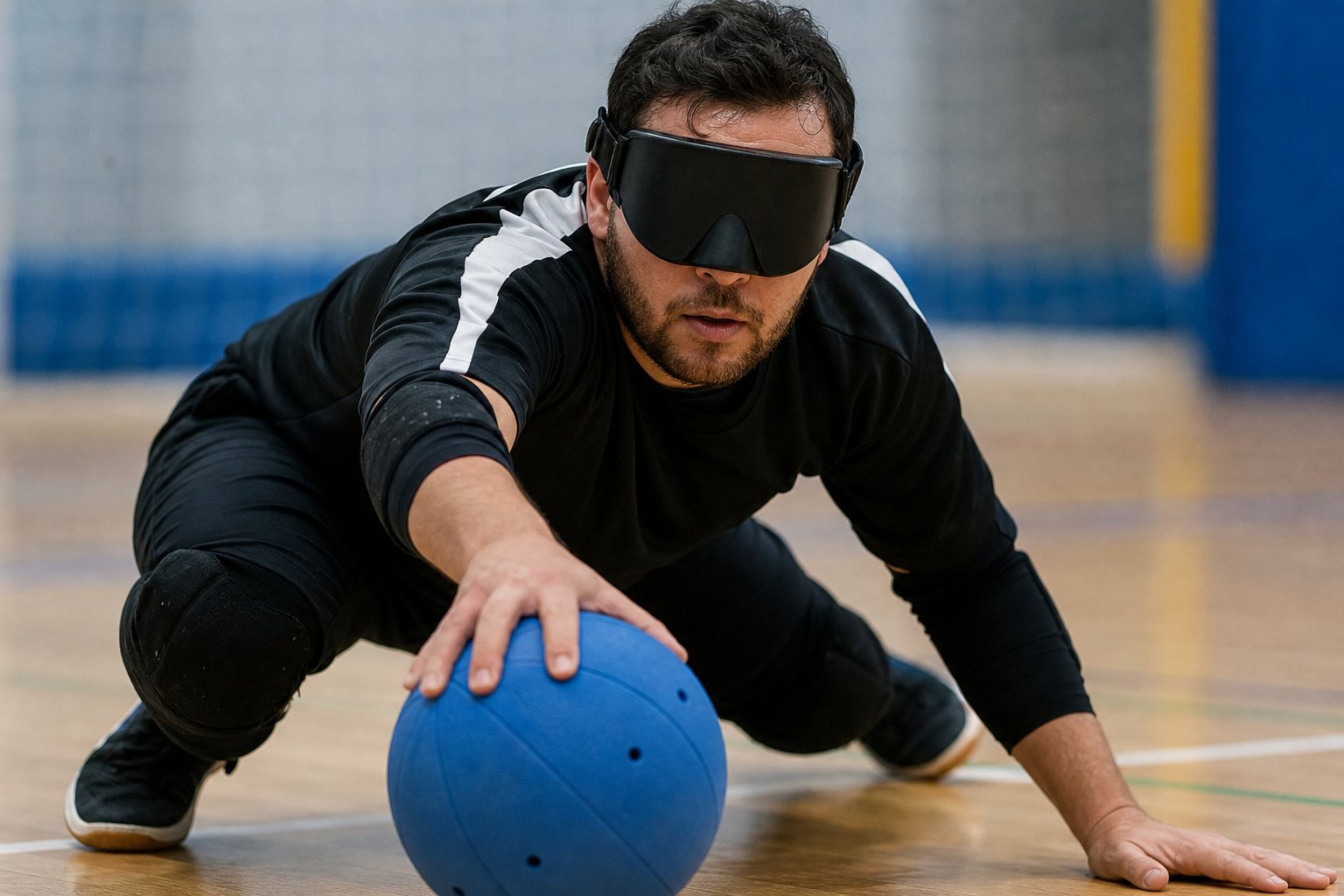
The final whistle of the third game of the day goes, the bell-ball is back in the bag, and everyone’s shoulders and hips are talking. What happens in the next 24 hours, food, sleep, an easy walk, a day off, matters for the next session. Goalball recovery is how a player rebuilds after repeated dives, throws and floor contact, and how they tell normal soreness from an injury that needs attention.
Quick answer: Sleep, enough food and fluids, easy movement and planned rest days are the base of recovery. Of the add-ons, a large 2018 meta-analysis found massage had the best evidence for easing muscle soreness and tiredness, though the outcomes included self-reported soreness and tiredness. Soreness that is general and eases is common after new or hard work; pain that is sharp, in one spot, in a joint, or getting worse is different and deserves a professional look. We found no goalball-specific recovery research.
General information, not medical advice. See also training, injuries and nutrition, or start at the goalball hub.
Sleep comes first
The 2021 expert consensus on sleep and the athlete (Walsh and colleagues, British Journal of Sports Medicine) says elite athletes often have short sleep and poor quality, that stress, anxiety, travel and competition are common causes, and that a one-size-fits-all target such as 7 to 9 hours is unlikely to be ideal, recommending an individualised approach. A 2026 study of 45 Portuguese Paralympic-preparation athletes (Coelho and colleagues, Sports) found sleep duration was positively associated with mental health when training was disrupted. It is not goalball-specific and it is an association, not proof. We found no research on goalball players’ sleep, so tournament travel and late evening games are worth planning around with your coach.
Load management and rest days
Goalball seasons are built around tournaments. After a hard weekend, ease off: the IOC consensus on load and injury (Soligard and colleagues, 2016) names rapid changes in load as an injury risk. Cursiol and colleagues (2022) found that after two or three simulated games in one day, knee-extensor force and voluntary activation had dropped, and that fatigue was linked to fewer throws. For players, that means scheduling a lighter day after multi-game days and not stacking a hard strength session straight after a tournament. A day with no training at all each week is common practice; it is not a figure from a goalball study.
Mobility and flexibility
A review of stretching (Behm and colleagues, 2016) found that long static holds of 60 seconds or more reduced performance when tested right afterwards, while shorter holds and dynamic stretching had smaller effects. It was not about goalball. A practical reading: use movement-based mobility for hips, shoulders and wrists before play, and keep longer stretches for after, when they will not affect your next throw. If a joint feels stiff or unstable in a way that is new, ask a physical therapist rather than stretching through it.
Recovery methods: what the evidence says
Dupuy and colleagues (Frontiers in Physiology, 2018) pooled 99 studies on recovery after exercise. Active recovery, massage, compression garments, water immersion, contrast water therapy and cryotherapy produced small to large decreases in muscle soreness, and massage looked most effective for soreness and perceived fatigue, with compression, massage and water immersion helping perceived fatigue. Massage and cold exposure were strongest for reducing inflammation markers. Those outcomes included self-reported soreness and tiredness, in varied groups, and none of the studies we know of tested goalball players, so treat the findings as modest.
- Food and fluids: refuelling is part of recovery; see our nutrition page.
- Easy movement: a walk or gentle spin is a form of active recovery, which the meta-analysis found had some benefit for soreness.
- Massage, compression and cold: may help how you feel; none is proven to prevent injury or speed up healing of an injury.
- Devices: if you use recovery gadgets, check with a clinician first if you have a medical condition, are pregnant, or use implanted devices.
Soreness versus injury
Delayed onset muscle soreness (DOMS) is familiar to elite and novice athletes alike, according to Cheung and colleagues (Sports Medicine, 2003). It is most common at the start of a season or when returning after a break, and when someone starts a new activity, and exercise that lengthens the muscle under load, like a controlled dive to the floor, causes it more. DOMS can reduce range of motion and shock absorption, and the review warns that returning too soon can raise the risk of further injury. AAOS OrthoInfo says to contact a doctor if symptoms persist.
A simple guide: general tenderness in big muscles that eases over a few days is usually soreness. Pain that stays in one spot, is sharp, is in a joint, wakes you at night, comes with swelling, a loose feeling or numbness, or does not improve belongs with a doctor, physical therapist or athletic trainer. After a head blow, follow the CDC HEADS UP steps on our injuries page.
Recovery for para athletes
Gee and colleagues (Frontiers in Rehabilitation Sciences, 2021) reviewed how IPC impairment types change physiology and wrote that most research covers single impairment types or case reports, and that practitioners need tailored support. For goalball players, the practical point is that visual impairment itself is not a reason to skip standard recovery basics, but a doctor or sports dietitian with para sport experience can tailor them, for example if an eye condition has other health effects.
Goalball recovery: FAQs
How long should I rest after a goalball tournament?
There is no research-based number. Ease the load for a day or two, sleep well, eat and drink enough, and return to training gradually. If pain does not settle, see a professional.
Does massage help after goalball?
A 2018 meta-analysis of 99 studies found massage had the best evidence for lowering muscle soreness and perceived tiredness. The studies were not in goalball players, so treat the effect as modest.
Is muscle soreness normal after goalball?
Yes, especially after a break, a new drill or heavy diving. Soreness that is general and eases is common; sharp, one-spot, joint or worsening pain is not and should be checked.
How much sleep do goalball players need?
The 2021 consensus recommends an individual approach rather than one number for everyone. If you feel tired, sleep badly or your throws are slipping, talk with your coach and a doctor.
Should I stretch before goalball?
Many coaches prefer dynamic, movement-based warm-ups and keep long static stretches for afterwards, because holds of a minute or more reduced performance in a review of studies.
Sources
- Walsh et al., sleep and the athlete: narrative review and 2021 expert consensus, Br J Sports Med 2021
- Coelho et al., mental health predictors in Portuguese Paralympic preparation athletes, Sports 2026
- Soligard et al., IOC consensus on load in sport and risk of injury, Br J Sports Med 2016
- Cursiol et al., three simulated goalball games in one day, Adapt Phys Activ Q 2022
- Behm et al., acute effects of muscle stretching on performance, range of motion and injury incidence, 2016
- Dupuy et al., post-exercise recovery techniques: systematic review with meta-analysis, Front Physiol 2018
- Cheung et al., delayed onset muscle soreness: treatment strategies and performance factors, Sports Med 2003
- Gee et al., physiological considerations to support podium performance in para-athletes, Front Rehabil Sci 2021
- AAOS OrthoInfo, sprains, strains and other soft tissue injuries
- CDC HEADS UP, signs and symptoms
General information for education only, not medical advice. It does not replace a visit with a doctor, physical therapist or athletic trainer. See how we write and check our pages in our editorial policy.