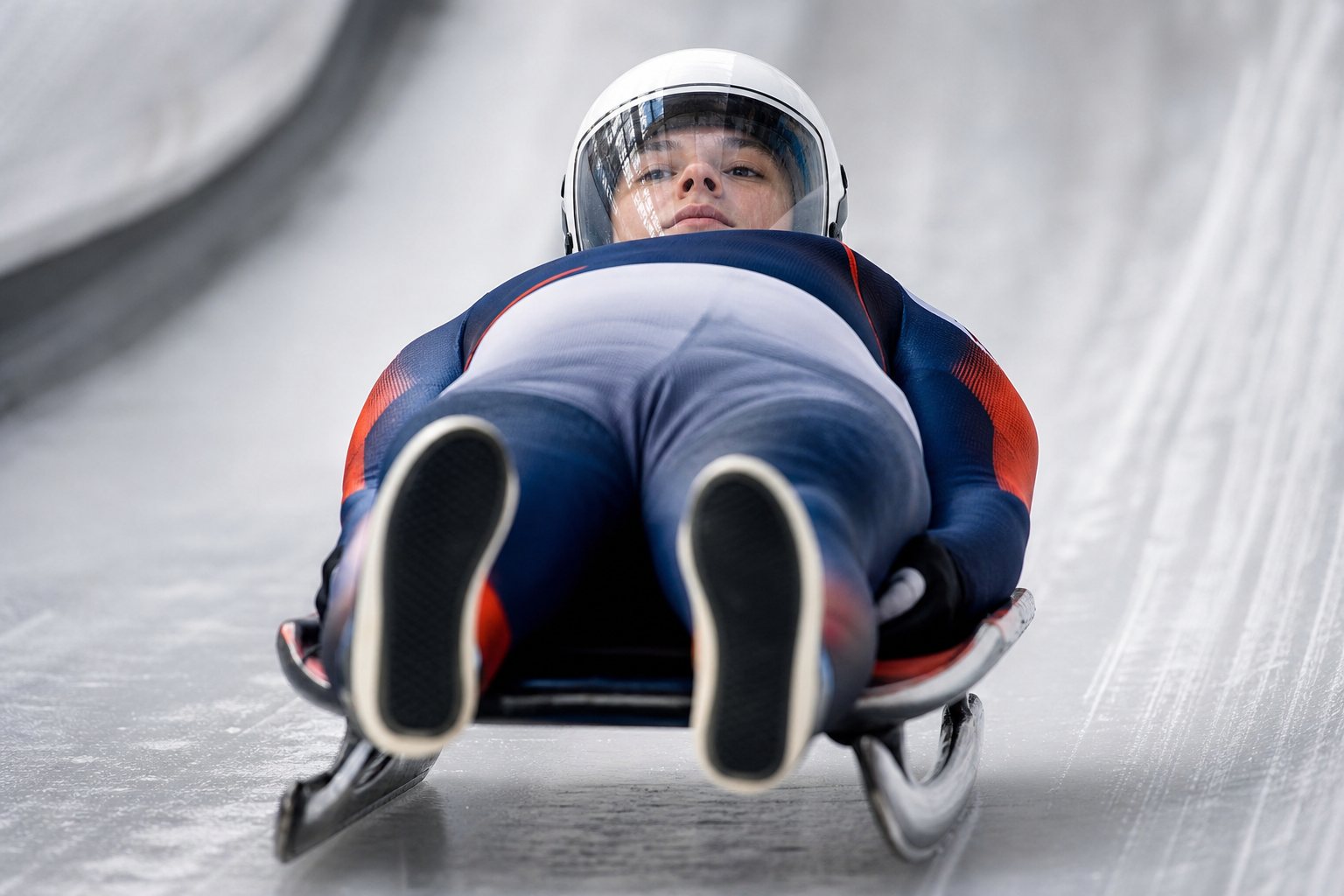
Standing at the top of the track, a slider hears the start beep count down. Hands on the handles. Heartbeat loud. A mistake in the first two seconds cannot be fixed later, and the run lasts under a minute. Mental training in luge is the practice of staying calm, focused and consistent in that moment: routines before the start, imagery of the track, and ways of handling nerves and mistakes. This page covers those skills and keeps them separate from mental health care, which belongs to qualified professionals.
Quick answer: Luge athletes use skills such as imagery, a fixed pre-start routine, simple goals and calm breathing. A 2025 clinical commentary on sliding athletes lists mental imagery and visualization among strategies for performance. We found no luge-specific trials showing which skills work best, and no technique guarantees a result. Anxiety, depression, disordered eating or burnout are health matters: talk to a qualified professional, and in the US call or text 988 in a crisis.
General information, not medical advice. For the sport itself see the rules page and the luge hub.
Confidence and fear
Luge has real crash risk, so a bit of fear is a reasonable response, not a flaw. Confidence in a sliding sport comes from preparation: learning the track step by step, a start that feels familiar, and a coach who sets progression. USA Luge describes a pathway that moves athletes from wheeled sleds to ice at a sanctioned track, which builds familiarity in stages. If fear becomes constant, stops you sleeping or makes you freeze, tell your coach and, if needed, a mental performance consultant or counselor.
Focus: the first seconds and the steering
A 2026 review of Olympic ice sports says luge results are strongly shaped by the start, with the first 15 to 65 metres contributing disproportionately. A narrow, repeatable focus on the start (the same rocking rhythm, the same cue words) is a common use of a pre-start routine. Once the athlete lies back, the sport is about small steering corrections with the calves and shoulders (NBC Olympics), so a calm, soft attention to feel rather than force is what many coaches teach. We did not find research on attention in luge athletes; this describes common coaching practice.
Motivation and goal setting
Long seasons, early mornings and cold tracks can wear down motivation. Goals that you control, such as a clean start, a consistent line through a hard curve or showing up for strength sessions, are easier to hold on to than results that depend on the weather, the ice or other athletes. Write the goal down, check it weekly and adjust. For young sliders the American Academy of Pediatrics (Brenner, 2016) advises time off the main sport each week and several months a year.
Visualization and imagery
The 2025 clinical commentary on bobsled, luge and skeleton athletes (Interdisciplinary Health and Performance Management of the Sliding Athlete) names mental imagery and visualization as strategies to optimise performance outcomes. In luge, track images are practical: a slider can walk the course, watch video, and mentally rehearse each curve in order. A 2025 study built a virtual-reality luge simulator with Austrian Luge Federation experts, who rated its realism between 3 and 4 out of 5; the authors say it could let users learn techniques before real-world trials, but it is an early prototype. Neither source proves that imagery improves race times.
Pre-start routines
- Same order every time. Equipment check, a short breathing sequence, a visual cue for the first curve, then the start rock. The consistency is the point.
- Keep it short and under your control. A routine that takes a minute can fit the real start-house schedule; check with your coach.
- Plan for waiting. The cold and the queue are part of competition. Keep warm (see the prevention page for cold-weather basics) so that nerves are not mixed with shivering.
Handling pressure and setbacks
Singles are decided over several runs on the combined time (FIL), so one poor run does not end the event, which makes a quick reset valuable. A reset can be as simple as a breath, a word and looking at the next piece of track. In the team relay, four sleds run in order and each athlete’s touch pad opens the next gate (NBC Olympics), so a person’s run is also a shared one; a clear team plan about start order helps. In doubles two athletes share a sled; clear, agreed communication is a good idea, though we found no research on it. After a crash or a bad day, talk with a coach, rest and let a professional clear any head injury (see the injuries page).
Competition preparation
Competition-week logistics are covered on the rules page for format, and recovery and sleep habits on the recovery page. Walk or watch the track if allowed, know the schedule and bring warm clothes, snacks and a bottle. Practise the routine in training, not only on race day.
Mental health is not the same as mental performance
Mental skills help performance. Anxiety, depression, disordered eating, sleep problems and burnout are health matters, and the International Olympic Committee consensus statement on mental health in elite athletes (Reardon and colleagues, 2019) says symptoms and disorders are common in elite athletes, can impair performance and raise injury risk, and need proper assessment and management. Seek a licensed professional, such as a sport psychologist, counselor or doctor. The Association for Applied Sport Psychology lists a directory of Certified Mental Performance Consultants. In the US, the 988 Suicide and Crisis Lifeline offers free, confidential support by call or text at any time; if you are in immediate danger, call 911.
Luge FAQs
Is it normal to be scared of luge?
Yes. Luge is fast and crashes happen. Fear that is constant or overwhelming is worth discussing with a coach and a qualified professional.
Does visualization improve luge times?
A 2025 clinical commentary lists imagery and visualization among strategies for sliding athletes, but we found no study proving it improves luge race times.
What is a pre-start routine?
A short, repeated set of actions before the run, such as an equipment check, breathing and a cue for the first curve. Its purpose is consistency, not magic.
How do I recover from a bad run?
Singles are decided over several runs, so a quick reset matters. Talk with your coach; use a breath, a cue and the next piece of track. After a crash, any head injury must be checked by a provider.
Who can help with anxiety or burnout?
A licensed professional such as a sport psychologist, counselor or doctor. AASP lists certified mental performance consultants, and in the US you can call or text 988 in a crisis.
Sources
- Interdisciplinary health and performance management of the sliding athlete (2025)
- Building a realistic virtual luge experience using photogrammetry (2025)
- Olympic Ice Sports: a narrative review (2026)
- Reardon and colleagues: IOC consensus statement on mental health in elite athletes (2019)
- AAP: sports specialization and intensive training (2016)
- NBC Olympics: how Olympic luge works
- FIL: artificial track rules
- USA Luge: Luge 101
- Association for Applied Sport Psychology resources
- 988 Suicide and Crisis Lifeline
General information for education only, not medical advice. It does not replace a visit with a doctor, physical therapist or athletic trainer. See how we write and check our pages in our editorial policy.