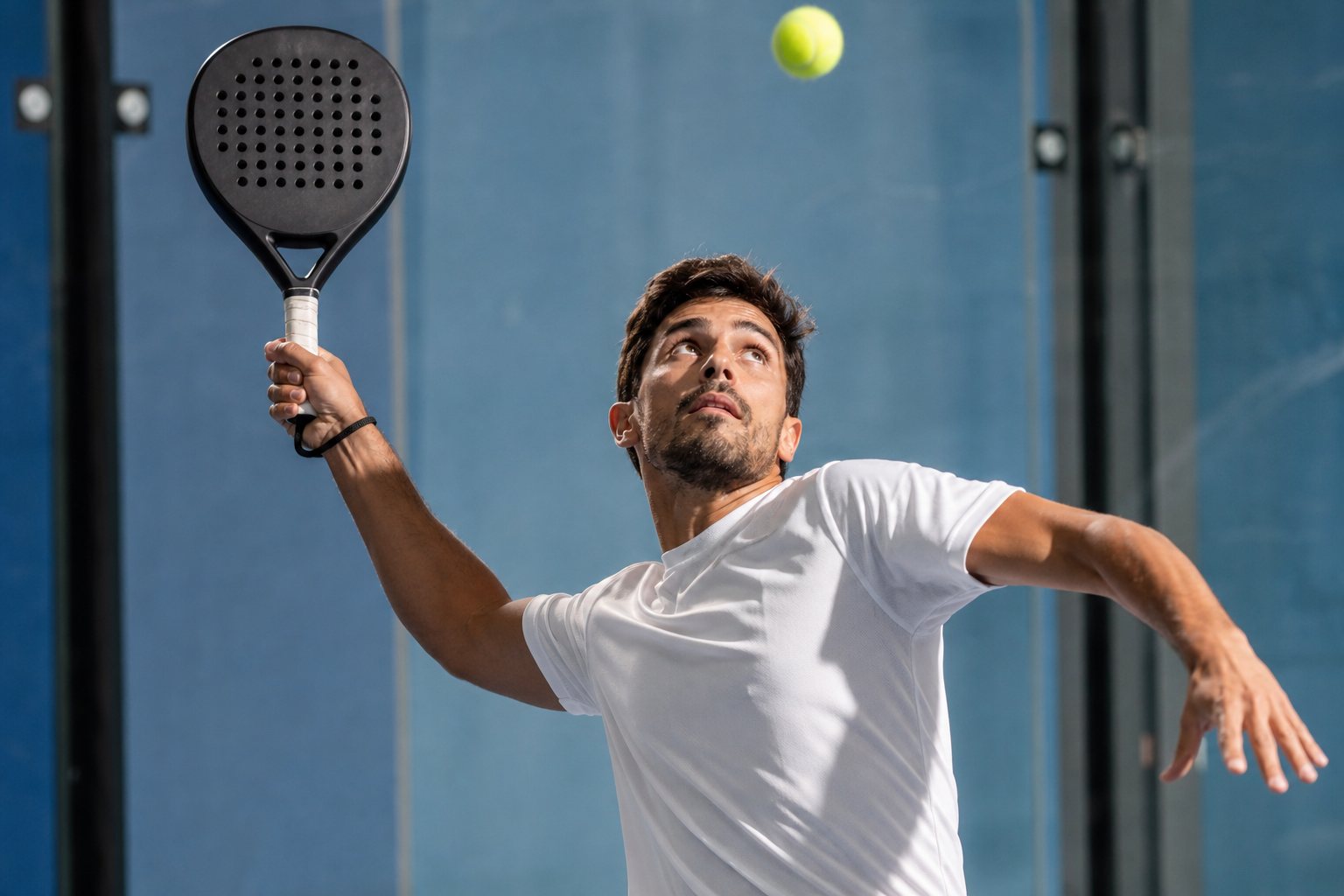
The next morning, your elbow aches when you lift a coffee cup, or your ankle feels thick and tender after a bad landing on the back court. Padel injuries are mostly the kind that build up over many hours of swinging, stopping and jumping, with a smaller share of sudden ones such as sprains and ball strikes. Padel research is young and mainly based on surveys, so the numbers below describe the groups studied, not your club. This page is general information, not a diagnosis, and it does not clear anyone to return to play.
Quick answer: Surveys of padel players describe mostly tendon, muscle and ligament problems, concentrated in the elbow, shoulder, ankle, knee and spine, plus occasional eye injuries from the ball. Recovery depends on the injury and the person, and the rehab principles below are general. See a sports medicine doctor, physical therapist or athletic trainer for lasting pain, swelling, instability or any eye or head injury.
How common are padel injuries?
- Portugal (PMID 41011098). 69.2% of surveyed players had at least one lifetime padel injury, at about 3.4 injuries per 1,000 hours of play. Tendon injuries were 35.6% and muscle injuries 26.1%. The elbow (18.0%), ankle (16.6%), knee (12.5%) and shoulder (10.5%) were most affected, and fatigue or overload was the most named cause.
- Saudi Arabia (PMID 43012253). Of 600 players surveyed, 301 (50.2%) reported at least one padel injury across 513 injury cases. Upper-quadrant injuries made up 44.1%, foot and ankle 22.4%, spine 18.5% and knee 15.0%.
- Women’s padel (PMID 42543029). Among 80 top-100 professional women and 147 amateurs, tendon injuries were 44% to 48% of upper-body injuries. Amateurs reported more injuries per 1,000 hours than professionals (2.69 versus 0.67), and racket shape was the one significant racket factor.
- Madinah (PMID 39997242). Among 305 players, 44.6% of women and 8.2% of men reported an injury. Ligament sprains and muscle strains were the most frequent upper-body injuries in women.
These studies counted injuries differently, so you cannot compare one rate with another. Most rely on players remembering their own injuries.
The main injury patterns
Elbow and shoulder
Lateral elbow pain (often called tennis elbow) is common in racket sports. The American Academy of Orthopaedic Surgeons (AAOS) describes it as an overuse condition of the forearm tendons, with pain on the outside of the elbow, weak grip and sometimes night pain, and says most people are 30 to 50. A pilot study of padel players with lateral elbow pain (PMID 42646895) found reduced shoulder internal rotation and thicker elbow tendon on the sore side. Shoulder problems are also frequent in overhead shots.
Ankle, knee and lower leg
Among 187 amateur players in Saudi Arabia (PMID 42577126), 14.97% had had an ankle sprain, 57% of them from landing, and 42.9% of the sprains had recurred. Three in four reported functional limitation. In 104 players aged 15 to 20 (PMID 41150491), most injuries were overuse injuries and the knee was most affected. A review of padel imaging (PMID 43011443) lists ligament tears, fractures, tendinopathy and stress fractures among the problems seen.
Eyes
In an Italian survey of 583 players (PMID 42010296), 10.3% reported a padel-related eye injury, 92% of those from ball impact, and playing frequency was the only independent factor. An eye injury or sudden change in vision needs a doctor right away.
Head injuries
Falls and collisions with walls, glass or partners can hurt the head. The CDC HEADS UP guidance says to recognize the signs, remove the player from play and let a healthcare provider decide when to return. Do not return the same day.
General principles of rehabilitation
These are general principles from the sources, not a plan for any one injury.
- Get it looked at. The AAOS says treatment for tennis elbow usually involves a team of primary care doctors and physical or occupational therapists, and that roughly 80% to 95% of patients have success with non-surgical treatment.
- Reduce what provokes it. The AAOS describes rest as stopping or cutting down the activities that cause painful symptoms, then specific strengthening exercises with a therapist and, sometimes, a brace.
- Rebuild balance and strength after an ankle sprain. The NATA position statement supports balance and strengthening programmes. In the Saudi ankle study, players who did balance and strengthening work reported better ankle function (PMID 42577126). Recurrence was common, so many players ask a therapist how to finish rehab.
- Return gradually. Returning to full play is a decision for a clinician. There is no universal timeline, and we do not give one.
When to see a professional
- Pain that lingers, worsens or wakes you at night.
- Swelling, bruising you cannot explain or a joint that feels unstable.
- Numbness, tingling or weak grip.
- Any head injury with confusion, repeated vomiting, severe headache or loss of consciousness: call emergency services.
- A direct hit to the eye, vision changes or severe eye pain.
To lower the odds in the first place, see our padel injury prevention page, and for easing back in see recovery and mobility.
Padel injuries FAQs
What is the most common padel injury?
Tendon injuries lead in the surveys (35.6% in Portugal), mostly around the elbow and shoulder, followed by muscle strains. Ankle and knee problems are also common.
Is padel elbow the same as tennis elbow?
It is the same kind of overuse problem on the outside of the elbow, which is called lateral epicondylitis or lateral elbow pain. Padel surveys list the elbow among the most affected sites. See a clinician for diagnosis.
Can the ball really injure my eye?
Yes. In the Italian survey, 10.3% of players reported a padel eye injury, and almost all came from the ball. Seek medical care for an eye injury.
How long will my injury take to heal?
It depends on the injury and the person. We do not give universal times; a clinician can give you an estimate after examining you.
Do I need an X-ray or MRI?
A doctor decides. The imaging review (PMID 43011443) says plain X-rays help find fractures, ultrasound is good for soft tissue and MRI can show subtle bone and soft-tissue injuries.
Sources
- Sport-related injuries in Portuguese padel practitioners, Medicina 2025, PMID 41011098 (PubMed)
- Musculoskeletal injury patterns among padel players in Saudi Arabia, J Back Musculoskelet Rehabil 2026, PMID 43012253 (PubMed)
- Upper-body injury epidemiology in women’s padel, J Sports Sci 2026, PMID 42543029 (PubMed)
- Assessing the spread of padel and the prevalence and causes of injuries, Healthcare 2025, PMID 39997242 (PubMed)
- Shoulder-elbow complex in padel players with lateral elbow tendinopathy, PMID 42646895 (PubMed)
- Ankle sprain in amateur padel players, Front Med 2026, PMID 42577126 (PubMed)
- Training load, injuries and well-being in youth padel players, PMID 41150491 (PubMed)
- Padel tennis: spectrum of injuries and the role of radiological imaging, SA J Radiol 2026, PMID 43011443 (PubMed)
- Ocular injuries in padel, Eye 2026, PMID 42010296 (PubMed)
- AAOS OrthoInfo, Tennis Elbow (Lateral Epicondylitis) (orthoinfo.org)
- NATA position statement on ankle sprains (PMC)
- CDC HEADS UP, what to do after a possible concussion (cdc.gov)
General information for education only, not medical advice. It does not replace a visit with a doctor, physical therapist or athletic trainer. See how we write and check our pages in our editorial policy.