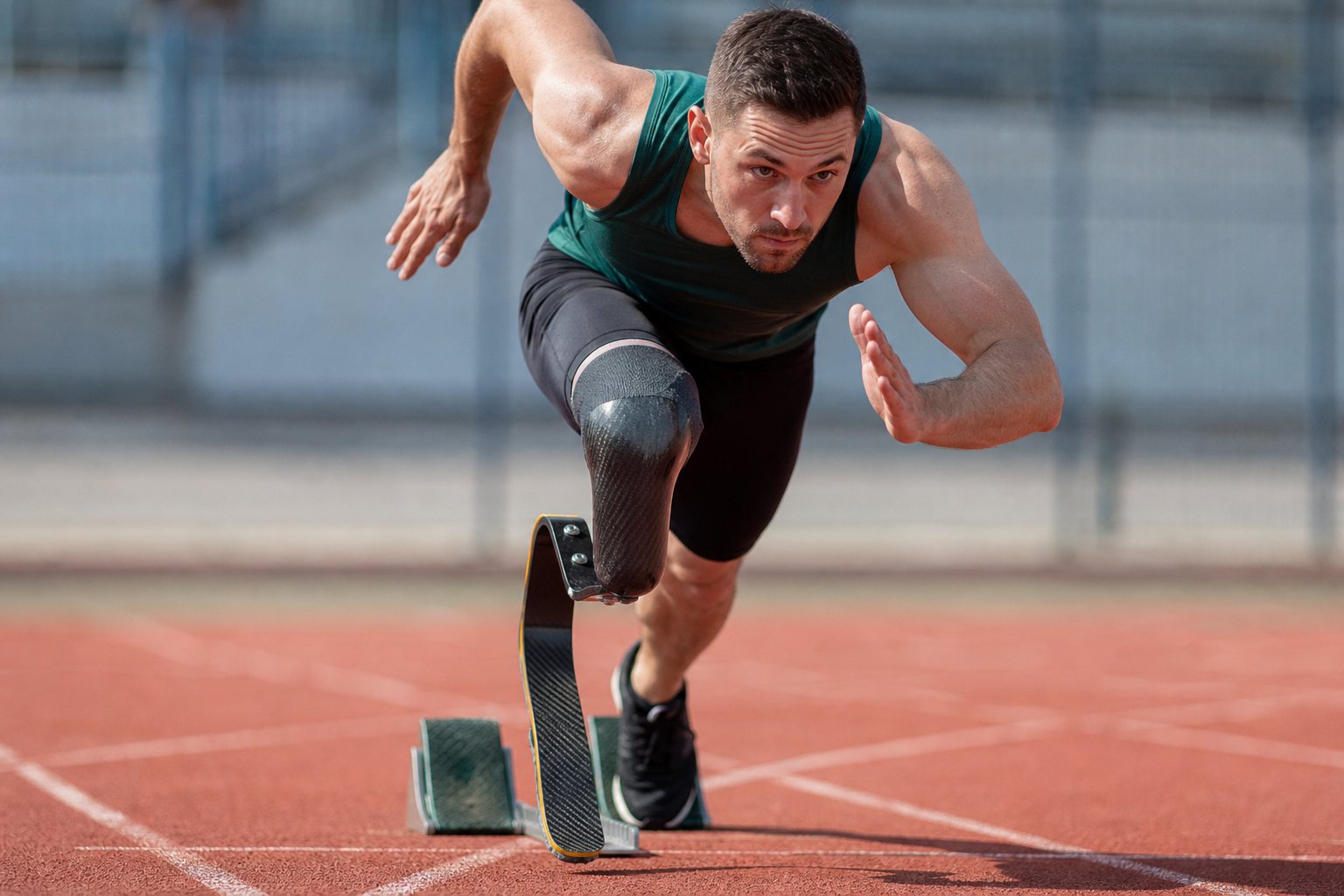
A wheelchair racer finishes a track session, hands tingling, shoulders heavy, and decides to add one more repeat. A guided runner and her guide skip the warm-up because the bus is late. Para athletics injury prevention is the set of habits around training, equipment and the environment that aim to lower the chance of getting hurt. They lower the odds. They cannot promise anything, and the right steps depend on the athlete’s impairment and class.
Quick answer: The best-supported ideas for Para athletes are a gradual build-up in training load, balanced strength work for the shoulders and trunk, a warm-up that suits your event, equipment that fits, and a plan for heat. Evidence specific to Para athletics is thin, so these are sensible habits, not guarantees. See a sports medicine doctor, physical therapist or athletic trainer if pain stays in one place, shows up at rest or changes how you move, and call 911 after a head injury with danger signs.
This page is about lowering risk. What the injuries look like and how rehab works is on our Para athletics injuries page.
Warm-up
We did not find a published injury-prevention warm-up program tested in Para athletics, so there is no named routine to point to. General practice in athletics is to raise the heart rate with easy movement, then do drills that look like the event. A coach who knows your class can set a version that works for a chair, a prosthesis or a guided run. The track and field hub covers the standard sport; treat it as a starting point to adapt, not a ready-made plan.
Technique
Technique is how force is spread across the body. For chair racers, a coach can check push stroke and chair set-up; for throwers, the way force travels through the trunk and arm; for runners on prostheses, the alignment worked out with their prosthetist. Teodoro and colleagues (2024) note that athletes with a vision impairment may face more collision and concussion risk, so agreeing signals with a guide for turns, the finish and stopping is a simple habit that costs nothing. Technique changes should be made slowly and with a coach.
Progressive training load
Blauwet and colleagues (2016) followed 977 athletes at the London 2012 Paralympic athletics competition and found most injuries did not cause time loss, but the shoulder and thigh were hit often. Madaleno and colleagues (2025) followed 102 Para athletes in four sports for a year and found the shoulder complex had the greatest burden, followed by the ankle and knee. These studies point to the places where gradual loading matters.
- Raise load slowly. We found no Para-specific percentage rule, so ask your coach to set steps and to hold a week steady after a jump in volume.
- Take days off. The American Academy of Pediatrics (Brenner, 2016) advises one to two days off a week from the main sport for young athletes.
- Keep a log. Track sessions, hard efforts and pain. A pattern in the log is information to bring to a clinician.
Strength and conditioning
A review of shoulder complaints in wheelchair athletes (PubMed 29161335) found prevalence from 16 to 76 percent and suggested balanced strength training may lower risk, though the studies were of low quality and the best exercises were not defined. A University of Kentucky review on wheelchair racers ties impingement and rotator cuff problems to muscle imbalance and weakness. In plain terms, athletes who push or throw a lot may benefit from working the muscles that pull and stabilise the shoulder blade, not only the pushing muscles. AAOS OrthoInfo has a general page on shoulder injuries in throwers. For ambulant athletes, the thigh was the commonest injury area in the London 2012 study, so thigh strength is a topic to raise with a coach.
Heat, weather and the track
Heat is a recognised risk for some athletes. At the 2015 Para Athletics World Championships, temperatures regularly exceeded cancellation guidelines from the American College of Sports Medicine and athletics, according to Grobler and colleagues (2019). In a survey of 107 Paralympians around Tokyo 2020, 57 percent had earlier had heat-stress symptoms and 9 percent a diagnosis of exertional heat illness (Alkemade and colleagues, 2023). Practical steps are to drink regularly, use shade, cool the body and acclimatise over days; ask your clinician how your impairment affects temperature control. The ACSM consensus statement on exertional heat illness covers recognition and care. Wet or uneven surfaces are a hazard for guided runners and chair users, so check the track and route before a session.
Equipment and fit
Racing chairs, throwing frames and running prostheses are fitted, specialist equipment. Wheelchairs count as sports equipment under World Para Athletics rules, according to Paralympic.org. Fit and set-up should be done by a specialist maker, a prosthetist or a coach with that skill, and checked again as you grow or change. We did not find a standards-body test for racing chairs, so we cannot say which models are safer. See our gear page for what to inspect.
Young athletes
We did not find Para athletics surveillance data for children and teens. The AAP’s advice on rest days (Brenner, 2016) is general, not Para-specific. Young athletes should have coaches who know the class and equipment, and parents should ask about rest days and supervision.
What prevention cannot do
Prevention lowers risk. It does not remove it, and Para athletics injury research is small. The London 2012 athletics rate was 22.1 per 1,000 athlete-days (Blauwet and colleagues, 2016), while BJSM surveillance across all Paralympic sports recorded 5.8 per 1,000 athlete-days at Tokyo 2020 and 8.6 at Paris 2024. Those studies used different methods and sports, so do not compare them directly. They show that injuries happen even at well-run events.
When to see a professional
- Pain in one spot for more than a few days, or pain at rest or at night.
- Numbness, tingling or weakness in hands or feet beyond what is usual for you.
- A change in how a prosthesis, chair or tether feels, or skin problems where equipment touches.
- Any head injury: the CDC HEADS UP program lists headache, dizziness, confusion and balance problems as signs; stop, see a healthcare provider, and call 911 for danger signs such as repeated vomiting or a seizure.
Frequently asked questions
What is the most common Para athletics injury?
It depends on the athlete. In the London 2012 study, ambulant athletes were most often hurt in the thigh and wheelchair and seated athletes in the shoulder and collarbone region (Blauwet and colleagues, 2016).
Does strength training prevent shoulder pain in wheelchair athletes?
A review suggests balanced strength training may lower risk, but the studies were low quality. It is a reasonable habit to discuss with a coach or physical therapist, not a guarantee.
How do I lower my heat risk?
Drink regularly, use shade and cooling, and acclimatise. Ask your clinician how your impairment affects your temperature control.
Should I wear a helmet?
We did not confirm a specific helmet rule or standard for racing wheelchairs here. Check the rulebook for your event and ask your coach.
Are guided runners at higher risk of collisions?
A 2024 review suggests athletes with a vision impairment may be more likely to have a concussion, though the evidence is limited. Practising signals with your guide is a simple step.
Sources
- Blauwet et al. 2016, injuries in Paralympic track and field, London 2012 (PubMed)
- Madaleno et al. 2025, injuries in Para athletes across four sports (PubMed)
- Alkemade et al. 2023, heat and Paralympians, Tokyo 2020 (PubMed)
- Grobler et al. 2019, illness and heat at a Para athletics World Championships (PubMed)
- Teodoro et al. 2024, concussion in Para athletes with vision impairment (PubMed)
- CDC HEADS UP: signs and symptoms
- BJSM 2023: incidence and burden of injury at the Tokyo 2020 Paralympic Games
- Lund University record: injury and illness at the Paris 2024 Paralympic Games (BJSM)
- PubMed: shoulder complaints in wheelchair athletes, review (PMID 29161335)
- University of Kentucky: shoulder function and rehabilitation for the wheelchair racing athlete
- AAP, Brenner 2016, sports specialization and intensive training (PubMed)
- ACSM consensus statement on exertional heat illness, 2023
- OrthoInfo (AAOS): shoulder injuries in the throwing athlete
- Paralympic.org: Paris 2024 introduction to Para athletics
General information for education only, not medical advice. It does not replace a visit with a doctor, physical therapist or athletic trainer who knows Para sport. See how we write and check our pages in our editorial policy. Back to the Para athletics hub or the sports hub.