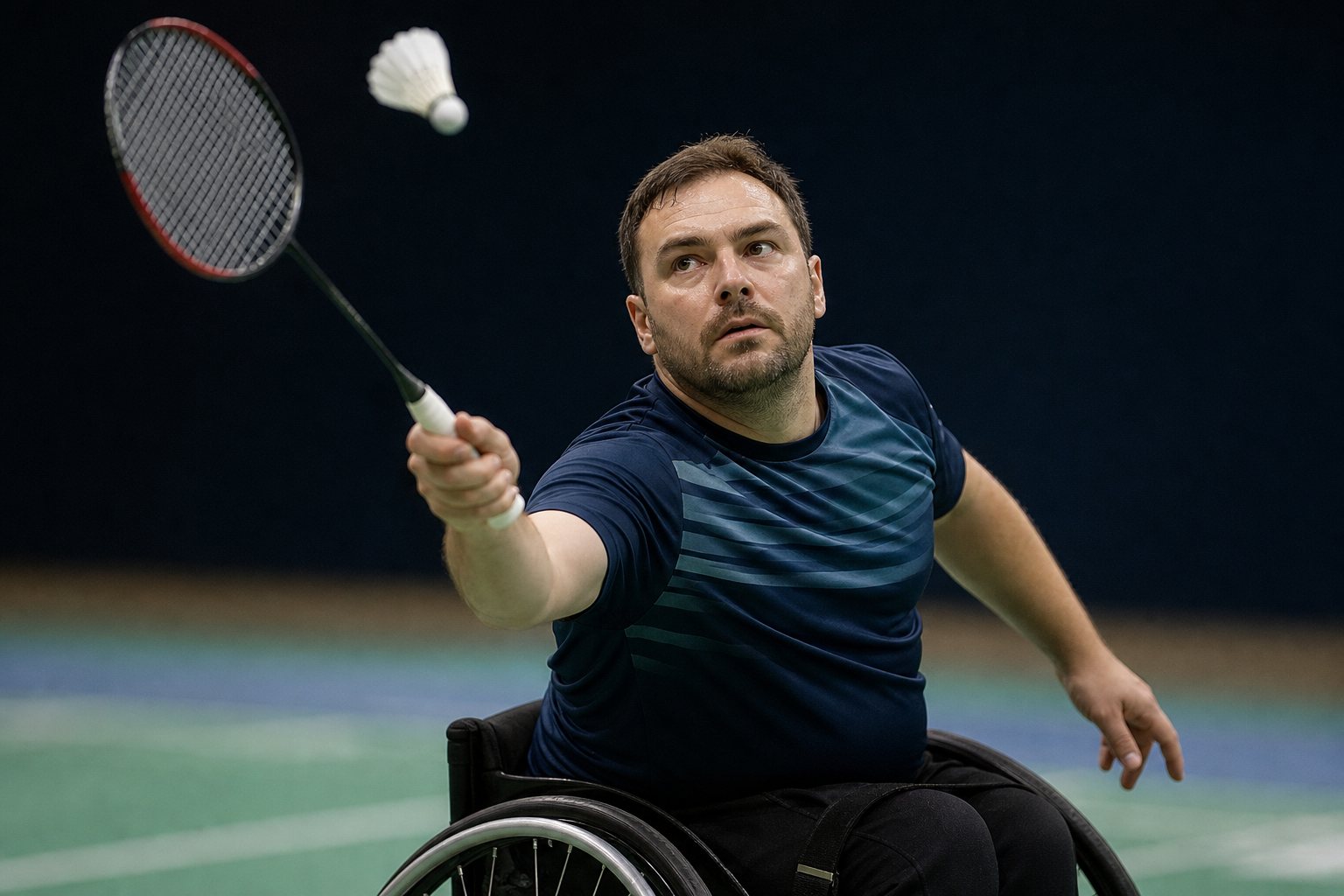
It is 18-all in the third game. The rally has been long, the chair is slick under tired hands, and the next serve will decide who leads. The shuttle is small, the rally is quick, and the mind has about as much time to settle as the body. Para badminton mental training is the practice of building skills such as focus, routines, imagery and goal setting, so that you play closer to your best under pressure. It is different from mental health care, which we cover separately below.
Quick answer: Useful mental skills in a fast sport are a short routine between points, simple goals you control, imagery of the shot you want and a plan for setbacks. Research on mental skills training is mixed, so none of it is a promise of better results. A 2026 IOC consensus statement says mental health symptoms are common in elite athletes and it names elite Para athletes among the specific groups it addresses. If worry, low mood or eating problems last, talk to a qualified professional; in the US you can call or text 988.
General information, not medical or psychological advice. Rules and classes are on our rules page, and training on the training page.
Why the mind matters in a fast game
Standard badminton rallies are short with little rest between them, which is why the mental side is about quick resets rather than long speeches. A 2026 study of 24 national-level badminton players found that at severe fatigue, smash speed dropped 10.6 percent and accuracy dropped 46.1 percent, a speed-accuracy trade-off. It was a study of standard players, but it is a reminder that tired minds and bodies lose precision, and that conditioning and mental routines work together.
Focus and routines between rallies
A routine is a short set of steps repeated before every serve or between rallies. Common coaching practice, not a research finding, is to use three steps: a breath to release the last point, a quick look at the plan for the next one, and one cue word for the first shot. For wheelchair players the routine can include putting the chair in position and checking straps. The value is that you do the same thing at 5-5 and at 20-20.
Goal setting
Set goals you control, such as serving to the target, holding your position or keeping your recovery steps tidy, instead of results you cannot control, such as winning every point. Short weekly goals (for example, three clean third-shot drops per rally pattern in practice) keep training concrete. This is standard sport psychology practice and not a Para badminton finding.
Imagery
A 2026 survey of 111 Turkish Paralympic athletes in several sports, including badminton, measured how much they used imagery with the Sport Imagery Questionnaire. It was a descriptive study that found links between sport experience and imagery use, and it does not show that imagery improves results. A reasonable way to use it is a few minutes before practice or sleep, picturing a serve and the rally pattern you want, in a way that suits you. Visual imagery is not for everyone; some athletes use sound or feeling instead.
Handling pressure
Pressure shows up as a faster heartbeat, tight shoulders and rushing. Ways players often respond, again common practice and not tested in Para badminton, are slower breathing, a loose grip and sticking to the routine. A 2023 meta-analysis of psychological interventions in sport (Reinebo and colleagues) found that effects were not stable after sensitivity analyses, which is why we do not promise that any technique works for everyone. Practice under mild pressure, such as playing games to 21 with a forfeit or a crowd, can make match nerves more familiar.
Setbacks and losing
Everyone loses a game they thought they should win. A simple structure after a match is to note one thing that worked, one thing to change and one practice to do next, then let it go. If a loss lingers for days, or a series of losses brings a sense of hopelessness, that goes beyond a mental performance skill.
Classification nerves
For athletes new to the sport, classification adds its own pressure. USA Badminton says the evaluation, held a day or two before a tournament, includes a physical assessment, a technical assessment and observation in competition, and that you must compete to complete classification. Knowing the steps in advance (see our rules page), arriving rested and treating the evaluation as a normal part of the event can help. The outcome of a classification is not a measure of your worth as a player.
Doubles and communication
In doubles, partners must share a plan. Agree who takes what, and call early. Para doubles pairs may come from different classes within the rules, so clear communication matters more when partners move differently. The details of pairing are in the BWF Para regulations, which we did not open.
Preparing for competition
Pack the night before, check your chair, straps or prosthesis, plan food and fluids (see our nutrition page), and arrive early enough to warm up. We did not find sourced logistics for Para tournaments beyond USA Badminton’s schedule pages, so check the tournament prospectus.
Mental health is not the same as mental performance
A mental skills routine is not treatment. The 2026 IOC consensus statement on mental health in elite athletes says symptoms and disorders are common, can have sport-related causes and can affect performance, and it names elite Para athletes among the specific groups it addresses. A 2026 qualitative study of 19 Team USA Paralympic athletes described improved organisational support, including mental-health services, but also uneven access. If you notice anxiety that does not settle, low mood, loss of interest, sleep trouble, a changed relationship with food or a feeling of burnout, take it to a doctor, psychologist or other qualified professional. In the US the 988 Suicide & Crisis Lifeline can be reached by calling or texting 988, and in an emergency call 911. Outside the US, use your local emergency number.
Para badminton mental training FAQs
How do I stay calm at 20-20?
Use the same routine you use at 5-5: breathe, pick the first shot, play it. Practice the situation in training.
Does visualization work?
A survey of 111 Paralympic athletes found associations between experience and imagery use but does not show that imagery improves results. Many athletes find it useful; try it and see.
What do I do after a bad loss?
Name one thing that worked and one to change, then reset. If a low mood or hopelessness stays, talk to a professional.
Is it normal to be nervous about classification?
Yes. Knowing the steps from USA Badminton and arriving rested helps, but you can also ask the classification manager or your coach.
When is it more than nerves?
If worry, low mood, eating concerns or sleep trouble last or affect daily life, see a qualified professional. In the US, call or text 988 in a crisis.
Sources
- Mental health in elite athletes: IOC consensus statement, 2026 (PubMed)
- Imagery: a study on paralympic athletes, 2026 (PubMed)
- Qualitative investigation of Team USA Paralympic athletes, BMJ Open 2026 (PubMed)
- Wang et al., fatigue and smash performance in national-level badminton players, PLoS One 2026 (PubMed)
- Reinebo et al., psychological interventions in sport, Sports Medicine 2023 (PubMed)
- USA Badminton: Para athletes, classifications
- 988 Suicide & Crisis Lifeline
General information for education only, not medical advice. It does not replace a visit with a doctor or a qualified mental health professional. See how we write and check our pages in our editorial policy. Back to the Para badminton hub and the sports hub.