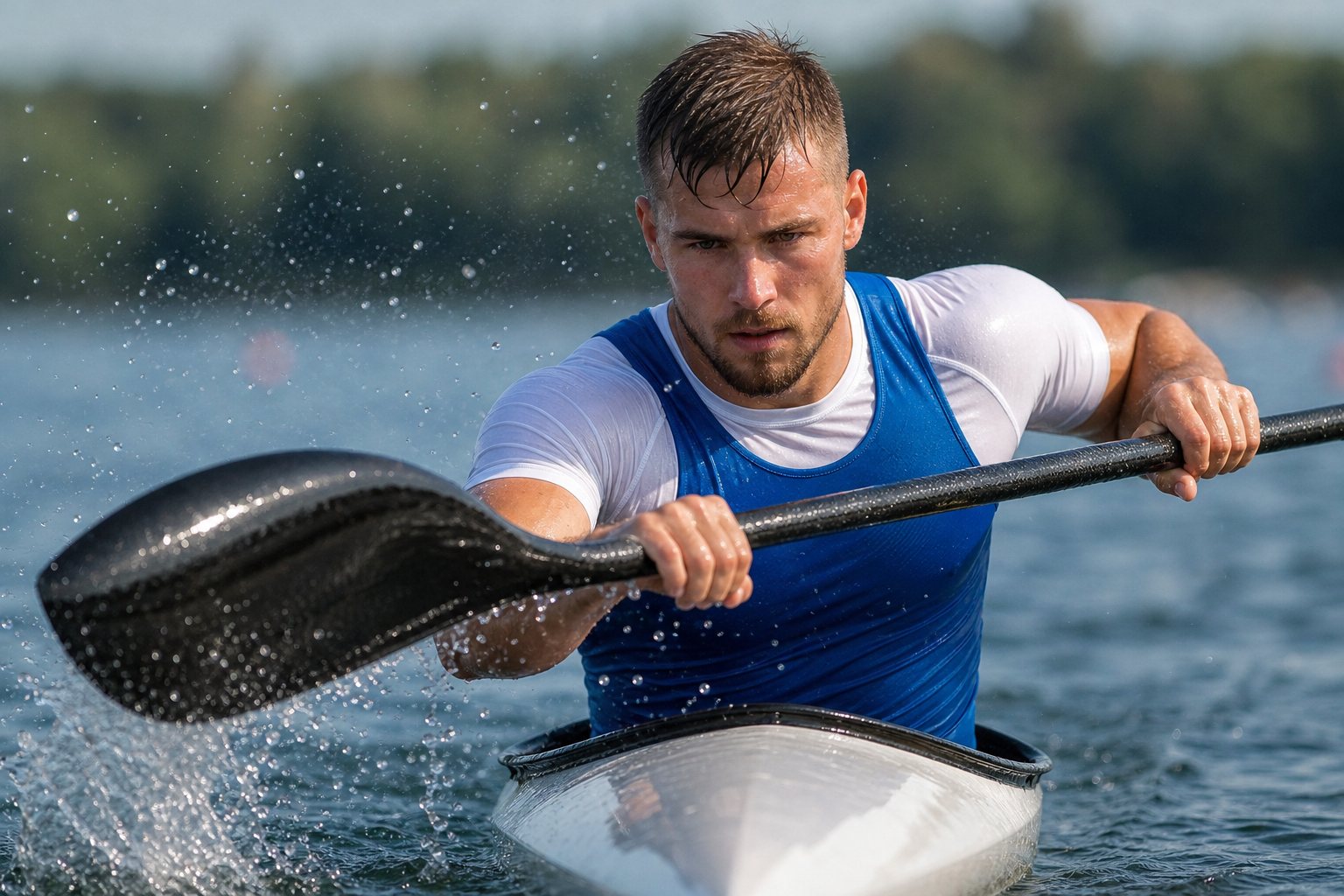
Two minutes before the start the paddlers are lined up in their lanes, the water is still and the starter has not yet said a word. Everything an athlete has trained for comes down to less than a minute, and the mind has to be steady for it. Para canoe mental training is the practice of skills such as focus, routines, imagery and handling pressure so a paddler can perform close to their training in a 200-meter race. It is different from mental health, which is about wellbeing and is covered near the end of this page.
Quick answer: A short sprint leaves little time to fix a bad start, so many paddlers rehearse a routine for the start, keep attention on one or two cues and plan for what to do after a mistake. An Exercise and Sports Science Australia position statement (2026) lists pre-performance routines, attentional strategies, psychological skills training and mindfulness as evidence-based ways to support performance under pressure, but none guarantee results. If anxiety, low mood, disordered eating or burnout is getting in the way of life, see a doctor or licensed mental health professional; in the US the 988 Lifeline is available by call or text.
General information, not medical advice. For the start procedure and rules, see our rules page. Physical preparation is on training, and the sport overview on the Para canoe hub.
Pressure in a 200-meter race
The ESSA position statement on performance under pressure (Schweickle and colleagues 2026, Sports Medicine) says pressure can help or hurt performance, that training environments with pressure can prepare athletes, and that useful strategies include pre-performance routines, implicit attentional strategies, psychological skills training and mindfulness-based approaches. A 2026 meta-analysis of 21 studies (Zeng and colleagues, Psychology of Sport and Exercise) found interventions such as quiet eye training, pre-performance routines, mindfulness and self-talk improved performance under pressure, with larger and more consistent effects in closed-skill sports than in open-skill tasks. Sprint paddling is a repeated, stable movement in a marked lane, which looks closer to the closed-skill tasks, but that is our reading, and no study tested it in Para canoe.
Confidence, motivation and goals
A 2026 qualitative study of 19 Team USA Paralympic athletes in 11 sports (Kossman and colleagues, BMJ Open) described Paralympic participation as shaped by personal, social, organisational and policy influences. Athletes reported challenges including financial strain, travel, chronic injury management and balancing sport with work, education and family, and benefits including physical, psychological and social gains. Many said they learned about Paralympic opportunities late. For a newer paddler, that may mean confidence comes from experience in the boat and support from a club, not from comparing yourself with a national-team athlete. Goal-setting evidence in Para sport is limited, so keep goals simple: process goals such as a clean first five strokes, a repeatable start routine or a steady seat position are within your control, and race times and placings are not.
Focus and the start
The ICF rules give the start a clear structure: boats are lined up and the command is Ready, Set, Go. At Set the boat must not move forward, a false start earns a warning, and a second false start by the same athlete means disqualification. That structure is helpful for routines: breathe, settle the seat, check the paddle, hear Ready, hold at Set and move at Go. Practicing reacting only to the Go signal, and not anticipating it, can be done in training with a coach. In kayak and va’a, paddlers also have to stay inside their lane, so a short attention cue for the line of the lane can help.
Imagery
A 2026 survey of 111 Turkish Paralympic national-team athletes (Topuzoğlu and colleagues, BMC Sports Science, Medicine and Rehabilitation) measured how athletes use imagery and found relationships with sport experience. It is a descriptive survey, so it shows how athletes report using imagery, not that imagery improves performance. Many athletes use imagery to rehearse a race from the athlete’s own point of view, to practice a start, or to prepare for a capsize or a rough day. Use it as an extra, not a replacement for water time.
Before competition: classification and logistics
Para canoe has its own preparation stressors. Athletes must bring forms to classification, including an equipment passport that lists the seat, footrest and adaptations with photos and measurements (ACA), and the boat and equipment used in classification must match what the athlete races in (ICF rules). Sorting this early removes avoidable stress. Travel, new venues and weather also add load; the IOC load statements count psychological load and travel as part of overall load that needs managing.
Setbacks, capsizes and decisions
Under the ICF rules, a capsize during the race is a did-not-finish and a broken paddle cannot be replaced. These rare events are worth rehearsing in a calm way: practice your self-escape under supervision, since the rules ask athletes to prove capsize and self-escape, and agree with your coach on what you will do next. After a poor race, a simple review of what went well, one thing to change and one training action is a common coaching approach, though we found no Para canoe study of it.
Mental health is not the same as mental performance
Routines and imagery are performance tools. Anxiety, depression, disordered eating and burnout are health matters. The 2026 IOC consensus statement on mental health in elite athletes (Reardon and colleagues, British Journal of Sports Medicine) says mental health symptoms and disorders are common among elite athletes, may have sport-related causes, can affect performance and can be treated, and that elite Para athletes are relatively understudied and may have distinct concerns. If low mood, constant worry, changes in eating or sleep or loss of interest are affecting you, talk to a doctor or licensed mental health professional. In the US, the 988 Suicide and Crisis Lifeline is available by call or text, and the Association for Applied Sport Psychology lists resources for finding a sport psychology professional.
Para canoe mental training FAQs
What should I think about at the start of a 200-meter race?
Many coaches suggest one or two simple cues, such as the first strokes or the seat position, practiced until automatic. A pre-performance routine is one of the strategies listed in the ESSA position statement.
Does visualization work?
We found no Para canoe study showing that it improves performance. A survey of Paralympic athletes describes imagery use, not performance gains. It is a safe extra for many athletes, not a guarantee.
How do I deal with nerves?
Rehearse your routine under pressure in training, use breathing or mindfulness if they help you, and talk to a coach. If anxiety is constant or severe, see a licensed professional.
Is mental training different for Para athletes?
The IOC says elite Para athletes may have distinct mental health concerns and are understudied. A sport psychologist who knows Para sport can help adapt the skills to you.
Where can I get help if I am struggling?
Start with a doctor, a licensed mental health professional or a trusted adult. In the US the 988 Lifeline is available by call or text.
Sources
- Schweickle MJ et al. 2026, performance under pressure in sport, ESSA position statement (PubMed)
- Zeng Z et al. 2026, counteracting choking under pressure, meta-analysis (DOI)
- Kossman MK et al. 2026, Team USA Paralympic athletes, qualitative study (DOI)
- Topuzoğlu E et al. 2026, imagery in Paralympic athletes (DOI)
- ICF Paracanoe Competition Rules 2022 (PDF)
- American Canoe Association: Paracanoe
- IOC consensus statement on load in sport and risk of injury, 2016 (PubMed)
- Reardon CL et al. 2026, IOC consensus statement on mental health in elite athletes (PubMed)
- 988 Suicide and Crisis Lifeline; Association for Applied Sport Psychology resources
General information for education only, not medical advice. It does not replace a sports medicine doctor, physical therapist, athletic trainer or a classifier who knows your impairment. See our editorial policy for how we research and write.