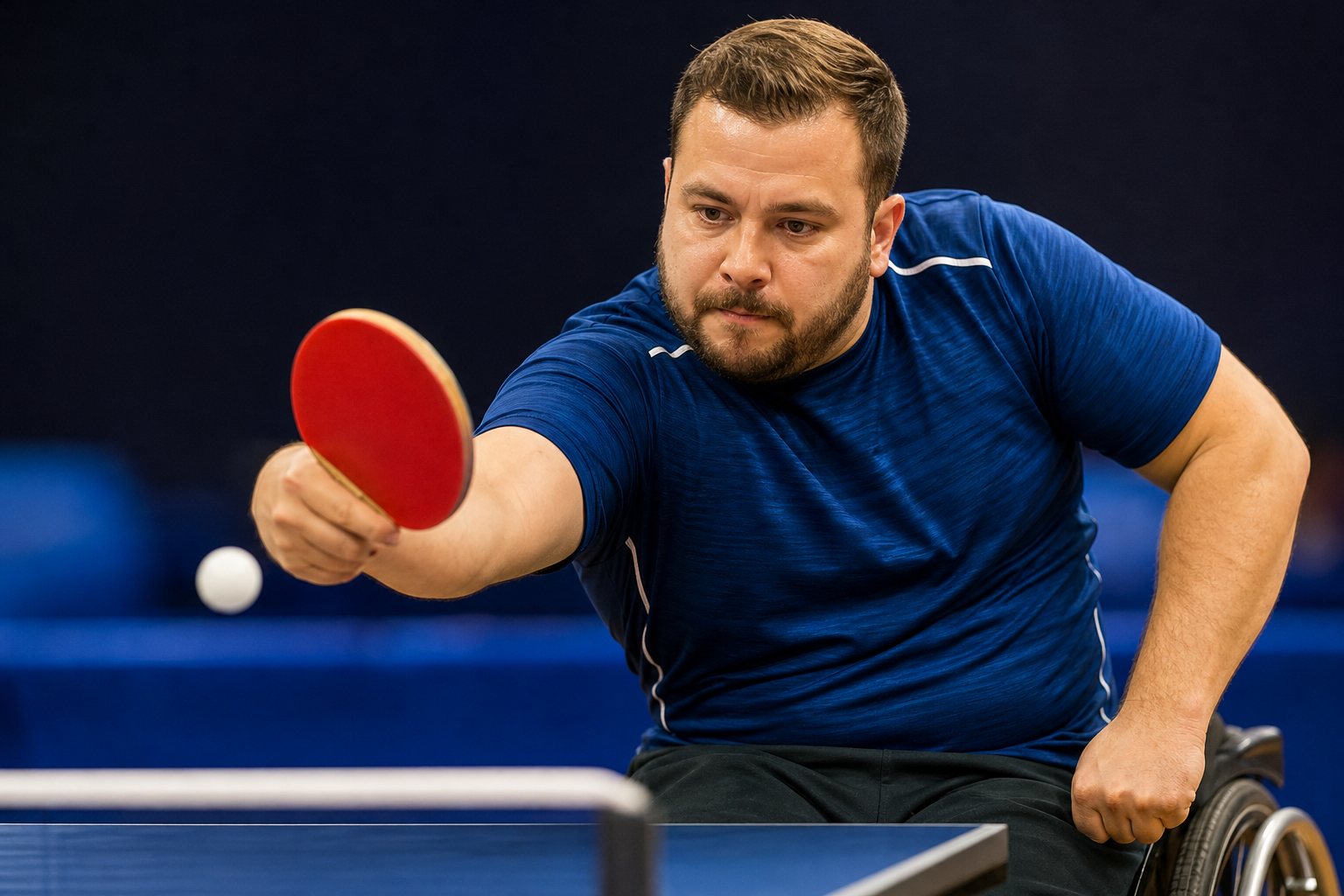
A ball rolls off the table and under a chair mid-rally, and for a second nobody sees it. Para table tennis injury prevention is the set of habits that lower the chance of getting hurt: a warm-up, sensible technique, gradual training, shoulder care, safe chairs and floors, and honest reporting of pain. They lower the odds; they cannot promise anything. What each injury looks like is on our injuries page, so we do not repeat that here.
Quick answer: The best-supported steps are a warm-up before hard play, balanced strength work for the shoulders and trunk, gradual increases in training, a clear floor and a well-maintained chair. Para-specific prevention studies are scarce, so these are sensible habits, not guarantees. See a sports medicine doctor, physical therapist or athletic trainer for pain that persists, wakes you at night or changes how you play, and get urgent care after a head injury with danger signs.
Warm-up
We did not find a published injury-prevention warm-up program tested in para table tennis, so there is no named routine to point to. What follows is general practice rather than a sourced protocol: five minutes of easy movement, gentle arm circles and trunk rotations within your comfortable range, then light strokes and serves before hard rallies. Wheelchair users with limited trunk movement should ask a physical therapist which movements suit them.
Technique and the shoulder
Prevention starts with how the stroke is made. A 2021 sensor study (Yam and colleagues, Sensors) found wheelchair players use movement patterns that differ from able-bodied players, and a 2022 case study of a Class 7 player (Kong and Yam, BMC Sports Science, Medicine and Rehabilitation) found the same at the shoulder. The sensible conclusion is to coach each player’s technique for their body. A questionnaire study of 61 para table tennis players, which we know only from a database listing, found 60.7 percent of injuries involved the upper limb and that the most common cause named was incorrect technique; we could not open the full paper, so treat it as a pointer rather than a finding.
Shoulders matter more when the arms also push a chair. A 2017 systematic review of shoulder complaints in wheelchair athletes (PLOS ONE) found rates from 16 to 76 percent across studies of low quality, and suggested balanced strength training may help. Consortium for Spinal Cord Medicine guidance on preserving the upper limb after spinal cord injury notes that research on preventing pain and injury is limited. Practical points include not relying on the playing arm alone for support, and asking a clinician to check posture and strength.
Training load: building up gradually
Most table tennis injuries in the general literature are overuse injuries. In a 2026 study of 139 national-level junior players (Bonhomme and colleagues, Annals of Medicine and Surgery), 82.6 percent of injuries were overuse. That study was in standing juniors, not para players, but the lesson transfers: raise training time slowly, and add rest after a block of tournaments. No source gives a safe weekly percentage for para players, so work with your coach, and treat pain that builds up over days as a signal to ease off.
Conditioning and strength
Balanced strength work for the shoulder blade muscles, rotator cuff, upper back and trunk is the most common recommendation for athletes who depend on their arms. Standing players may add leg strength and balance work. A physical therapist can choose exercises that fit your impairment and any previous injury, and check technique as you learn them.
Chairs, floors and the playing area
The Paris 2024 injury surveillance (Br J Sports Med, 2026) counted 535 injuries among 4,450 athletes and did not flag table tennis as a high-risk sport, but it covers all sports. The environment is within your control:
- Chair check: brakes, anti-tip devices, straps and wheels or casters before play.
- Floor: keep stray balls off the floor, which is a general safety point rather than a sourced rule. A rolling ball can catch a foot or a caster.
- Space: leave room around the table so chairs can turn without hitting a wall or another table.
- Table: for wheelchair play the legs are set back at least 40 cm so knees and the chair can get under and close to the table, according to the IPC.
- Heat: a Sports Science Exchange review on para sport notes that athletes with spinal cord injury may sweat less below the level of injury and may not feel heat in paralysed areas, so plan fluids, cooler clothing and breaks. Indoor halls are usually temperate, but a hot gym matters.
Skin and pressure areas
Long sessions in a chair are a pressure risk. We did not find table-tennis-specific numbers, but a guideline from the Australian Institute of Sport and Paralympics Australia addresses pressure injuries in para sport, including wheelchair considerations. Follow the seating and skin-check routine your own clinician has taught you, and report red areas that do not fade.
Head and eyes
Falls from a chair can cause a concussion. The CDC’s HEADS UP guidance is to recognize the signs, remove the person from play and let a healthcare provider decide when to return. Eye injuries are rare in table tennis reports we reviewed, but a ball can hit the eye.
What prevention cannot do
None of these habits guarantees you will stay injury-free. Evidence for prevention programs in para sport is thin. When you notice pain that stays in one spot, shows up at rest or changes how you hit, see a sports medicine doctor, physical therapist or athletic trainer rather than playing through.
Para table tennis Injury Prevention FAQs
Is there a warm-up program for para table tennis?
We did not find one published and tested for para table tennis. General dynamic warm-up guidance applies, adjusted to what your body can safely do.
How can wheelchair players protect their shoulders?
Balanced strength training for the shoulder blade and rotator cuff muscles is often recommended, though evidence is of low quality. A physical therapist can set exercises for you.
Do I need to check my chair before play?
It is sensible. Check brakes, anti-tip devices, straps and wheels, and keep the floor free of balls.
Are para table tennis players at high risk of injury?
The Paris 2024 surveillance did not flag table tennis as a high-risk sport, but that data covers all sports, and we found no table-tennis-specific para injury rate.
When should I stop playing and get help?
If pain persists, wakes you at night, grows worse or changes how you play, or after any blow to the head with danger signs. A clinician decides about returning.
Sources
- Yam et al., Sensors 2021 (PMID 34960397)
- Kong and Yam, BMC Sports Sci Med Rehabil 2022 (PMID 35871683)
- Epidemiology of sports injuries in para table tennis (Magiran listing)
- Shoulder complaints in wheelchair athletes: a systematic review, PLOS ONE 2017
- Consortium for Spinal Cord Medicine: preservation of upper limb function (2005)
- Bonhomme et al., Ann Med Surg 2026 (PMID 42583567)
- Injury and illness at the Paris 2024 Paralympic Games (PMID 42103446)
- Gatorade Sports Science Institute: thermoregulatory challenges in para sport
- Australian Institute of Sport: pressure injuries in para sport (guideline PDF)
- CDC HEADS UP: signs and symptoms
- Paralympic.org: 10 things to know about Para table tennis
General information for education only, not medical advice. See our editorial policy. More: the para table tennis hub, rules and getting started, injuries, recovery, the table tennis hub and the sports hub.