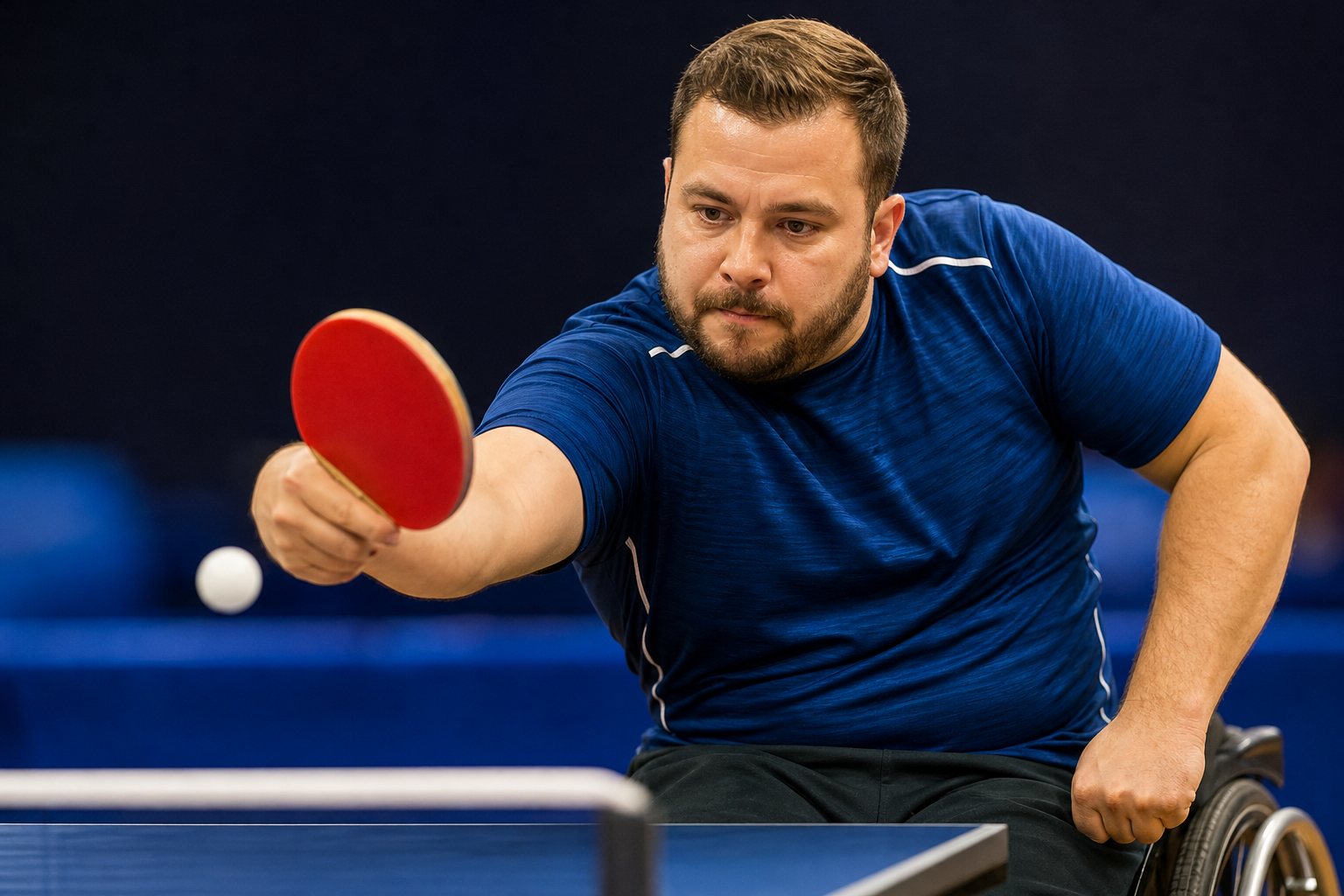
It is late on the last day of a tournament. Your shoulders feel heavy, your focus has gone soft after eight hours in the hall, and the drive home is ahead. Para table tennis recovery is what you do between matches, sessions and seasons to let your body and brain refresh: sleep, food and fluid, easier days, gentle mobility and, sometimes, tools. It matters because table tennis is a sport of fine control, and tired players lose control. This page covers what the evidence says and where it is weak. For injuries, see our injuries page.
Quick answer: Sleep, enough food and fluid, easier days after hard blocks and gentle mobility work are the foundations. Evidence for gadgets and cold water is mixed and mostly from non-para athletes. If you have spinal cord injury or reduced sensation, ask your clinician before using heat, cold or compression. Soreness that fades in a day or two is normal; pain that stays, sharpens or changes how you play needs a professional.
Why recovery matters in a precision sport
Fatigue changes how a player moves. In a 2025 study of 19 elite male table tennis players (Chen and colleagues, BMC Sports Science, Medicine and Rehabilitation), fatigue reduced shoulder proprioception, the sense of where the joint is, in both hands, and forehand hitting accuracy fell. A 2024 study of 12 elite male players (Lu and colleagues, Sensors) found that fatigue lowered calf muscle activity and heel lift. Those players were standing, not para athletes, but the lesson is useful: late in a long day, expect your precision to slip and protect yourself with rest and fuel.
Sleep
The CDC says adults need at least 7 hours of sleep a night and teenagers 8 to 10 hours. Para athletes can face extra barriers, and medical conditions can interrupt sleep, so talk with your doctor about spasms, bladder needs or pain that wake you. Simple habits help most athletes: a regular bedtime, a cool dark room and a wind-down away from screens. For travel across time zones, a 2021 review (Janse van Rensburg and colleagues, Sports Medicine) estimates that body clocks adjust about 1 day per time zone eastward and about half a day per zone westward.
Load management
Recovery begins in the training plan. Build in an easier week after hard blocks and tournaments, and keep at least one full rest day. A 2022 scoping review of table tennis injuries (Medicina) listed overtraining and poor rest after injury among risk factors. If your arms also move your chair, count that load too, and ask a physical therapist to look at the total. There is no sourced weekly limit for para players, so use your coach and clinician rather than a number from the internet.
Food and fluid after play
An ACSM, Academy of Nutrition and Dietetics and Dietitians of Canada position stand (2016) says that when recovery time is short, athletes should eat carbohydrate with some protein soon after exercise, and replace fluid losses (it suggests 125 to 150 percent of the weight lost). It was written for athletes in general. A 2026 mini-review of table tennis nutrition (Wang and colleagues, Frontiers in Nutrition) mentions milk as a carbohydrate-and-protein recovery option. Individual needs differ with impairment, so see our nutrition page and consider a sports dietitian.
Mobility and flexibility
A 2018 study (Zemkova and colleagues) found that 11 wheelchair table tennis players turned the trunk more slowly than 13 able-bodied athletes, which the authors linked to limited trunk rotation. Mobility work should respect your impairment. As general practice, many players use easy shoulder, chest, neck and upper-back movements after play, hold stretches gently without pain, and ask a physical therapist which positions are right for them. Seated players can also change position regularly and take pressure off the seat, following their own clinician’s advice.
Recovery methods: what the evidence says
Evidence for many recovery tools is modest, and almost none is para-specific.
- Cold water: a 2016 review (Machado and colleagues) found cold water immersion slightly better than passive rest for soreness, but a 2015 study (Roberts and colleagues) found that regular cold water use after strength training reduced gains. With reduced sensation or impaired temperature control, cold immersion needs medical advice first.
- Compression: a 2018 meta-analysis of 99 studies (Dupuy and colleagues) found compression reduced muscle soreness and perceived fatigue. Check with a clinician if you have circulation or sensation problems.
- Foam rollers and massage tools: they feel good to many athletes, but we found no para table tennis evidence. Avoid bony spots and the front of the neck, and stop if it hurts (general safety advice).
- Heat and cooling: the Sports Science Exchange review reports that cooling the upper body, such as hand cooling, lowered core temperature by about 0.5 degrees C in a hand-cycling study, which is a comfort and safety matter in hot halls rather than a recovery boost.
Soreness or injury?
Muscle soreness is usually dull, spread across a muscle group, and eases within a day or two. Warning signs of injury are sharp or catching pain, pain at rest or at night, swelling, numbness, weakness, or a change in how you hit. If in doubt, see a sports medicine doctor, physical therapist or athletic trainer. Check skin, especially pressure areas, after each long session.
Para table tennis Recovery and Mobility FAQs
How much sleep does a para table tennis player need?
The CDC says adults need at least 7 hours and teenagers 8 to 10. Medical conditions can change sleep, so speak to your doctor about problems.
Do ice baths help recovery?
Evidence is mixed: a 2016 review found a small benefit for soreness, and a 2015 study found they can reduce strength gains. With impaired sensation or temperature control, ask a clinician before trying one.
How do I recover between matches?
Sip fluids, eat a familiar snack with carbohydrate, move gently and keep cool. Sports dietitians can tailor this to your impairment.
Is muscle soreness normal?
Mild soreness that fades in a day or two is common after hard play. Sharp pain, pain at rest or numbness should be checked.
Do I need recovery gadgets?
No. Sleep, food, fluid and easier days do most of the work. Tools are optional comfort items.
Sources
- Chen et al., BMC Sports Sci Med Rehabil 2025 (PMID 40652224)
- Lu et al., Sensors 2024 (PMID 39460001)
- CDC: about sleep
- Gatorade Sports Science Institute: thermoregulatory challenges in para sport
- Janse van Rensburg et al., Sports Med 2021 (PMC8279034)
- Scoping review of table tennis injuries, Medicina 2022 (PMID 35629989)
- ACSM, AND and DC position stand on nutrition and athletic performance, 2016 (PMID 26891166)
- Wang, Shen and Gao, Front Nutr 2026 (PMID 42434404)
- Zemkova et al., Int J Sports Med 2018 (PMID 30452067)
- Machado et al., Sports Med 2016 (PMID 26581833)
- Roberts et al., J Physiol 2015 (PMID 26174323)
- Dupuy et al., Front Physiol 2018 (PMID 29755363)
General information for education only, not medical advice. See our editorial policy. More: the para table tennis hub, injury prevention, recovery, the table tennis hub and the sports hub.