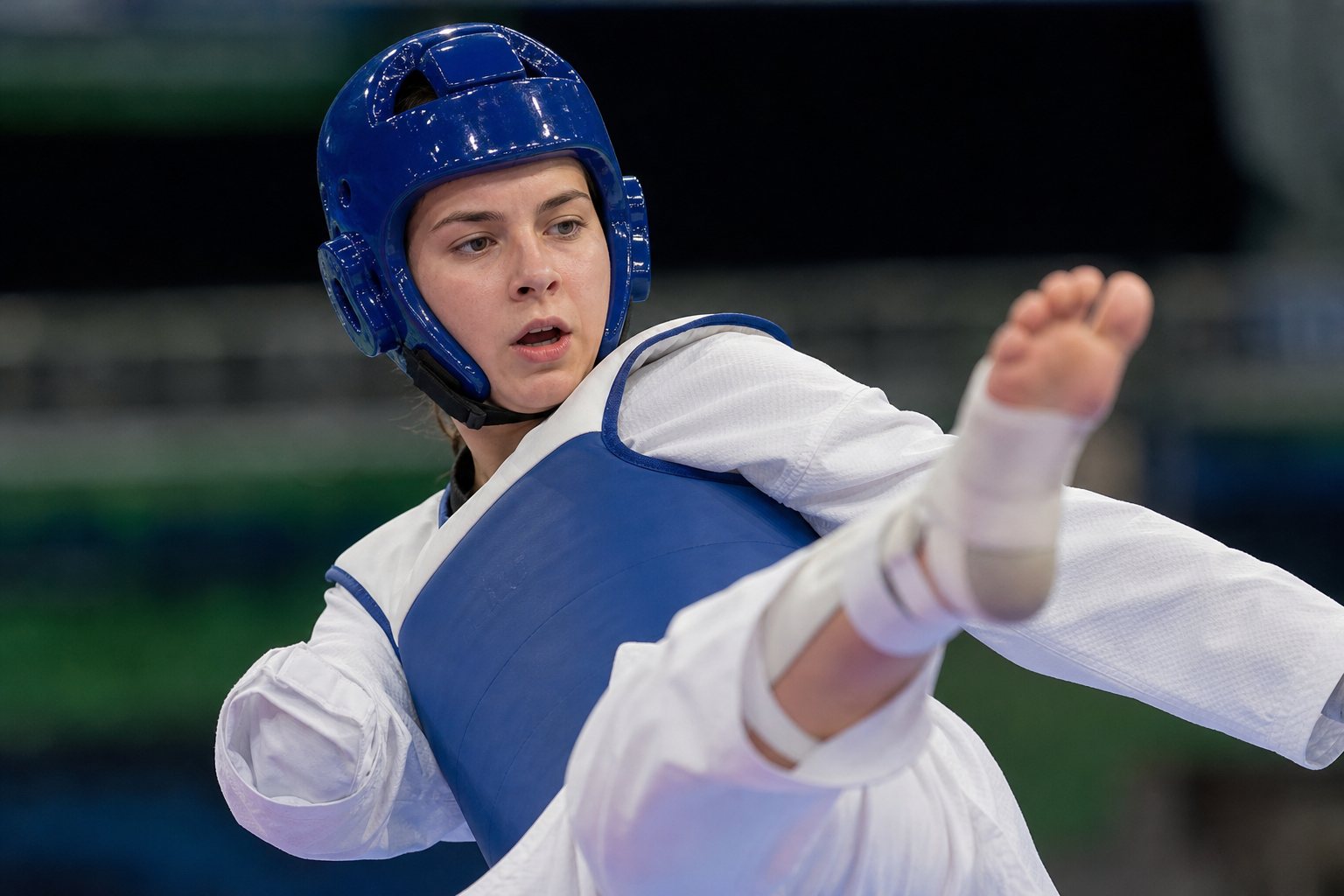
A new athlete walks into a dojang for the first time. One sleeve of the uniform hangs empty below the elbow, and the coach has a simple question: “What do you want to be able to do in a year?” For many people the answer is “compete.” Para taekwondo is taekwondo adapted for athletes with an eligible impairment, and the part that is on the Paralympic program is kyorugi, full-contact sparring in which fighters score with kicks to the trunk. This page explains how a match works, how classification works and how a beginner gets started. For the bigger picture, see the Para taekwondo hub.
Quick answer: In Para taekwondo kyorugi, fighters score with foot techniques to the electronic trunk protector (2 points, or 4 for a turning or spinning kick); head contact is banned. Under World Taekwondo (WT) rules in force from October 2025, the kyorugi classes at world and Paralympic level are K41 and K44, and every international athlete must be classified first. To start, find a taekwondo club with a coach willing to adapt, ask a doctor about your own health, and contact your national taekwondo federation about classification.
General information, not medical advice. This is a full-contact sport, so talk with a sports medicine doctor, physical therapist or athletic trainer before you begin if you have any concern about your health or your impairment. Rules change; always check the current WT rulebook.
How a kyorugi match works
The contest area is 8 m by 8 m, surrounded by a larger safety area, on a WT-recognized elastic, non-slip mat (WT Para Taekwondo Competition Rules, Articles 3 and 7). The standard contest is three rounds of two minutes with a one-minute rest. If the score is tied, a one-minute Golden Round follows. The Technical Delegate of an event may change this, for example to one five-minute round with a timeout, so read the event outline. The IPC described a single bout of up to five minutes for Paris 2024, so formats do differ between events.
What scores and what does not
- Two points for a valid foot technique to the trunk protector (any part of the foot below the ankle bone).
- Four points for a valid turning or spinning technique; the electronic protector confirms the hit and judges confirm the turn.
- Punches to the trunk are allowed but never score.
- Head contact is prohibited. Everything above the collarbone is off limits, and kicks below the waist are penalized.
- Gam-jeom penalties (falling, stepping out, stalling, grabbing, unsafe play) give the opponent one point; ten of them lose the match.
A fighter wins on points, by referee stop, by knockdown, by penalty or by disqualification. The rules list the protective equipment every contestant wears: a WT-approved uniform, trunk protector, head protector with face guard, groin guard, forearm and shin guards, sensing socks and a mouth guard. Our gear page goes into the details.
Skills a beginner learns first
This part is general taekwondo coaching practice, not a Para-specific rule. Beginners usually start with a fighting stance, footwork, balance on one leg, and the basic kicks: front kick, roundhouse (turning) kick, side kick and back kick. Because punches do not score in Para kyorugi, many athletes build their game on kicks, timing and distance. A research study of 78 matches from the Tokyo 2020 Paralympics (Park and colleagues, 2024, Journal of Sports Sciences) found that winners had higher kick-to-score ratios than non-winners. That points to accuracy over volume, an idea coaches teach early. See our training page for how those skills fit into a week.
Classification in plain words
Classification decides who is eligible and groups athletes who face similar limits. WT’s Athlete Classification Rules (as of 24 August 2023) describe three eligible impairment types for kyorugi: limb deficiency (for example an amputation or a congenital shortening), impaired muscle power from peripheral nerve injuries only (brain or spinal cord conditions are not eligible), and impaired passive range of movement such as a stiff or fused joint. The minimum criteria are written in terms of the arms.
- K44: for example a single amputation through or above the wrist, or both arms impaired below the elbow, with at least one arm meeting the minimum criteria.
- K41: for example both arms amputated above or through the elbow.
- New athletes start as “K40, status New” until a classification panel has assessed them. That assessment includes a medical check and a technical check of balance and safety.
Older articles also mention K42 and K43 classes. The current WT rules list only K41 and K44 for world and Paralympic kyorugi, so go by those two. A research study of 556 classified athletes (Davalli and colleagues, 2021) found K44 to be the largest class, about 61 percent. Athletes found “Not Eligible” or with classification “not complete” cannot compete. The classification rules also say the national federation must send the Medical Diagnostic Form at least four weeks before an event, and event documents may set their own deadline.
Poomsae (forms) classes
Poomsae is judged patterns instead of contact. WT’s classification rules group poomsae classes by impairment: visual (P10), intellectual (P20), neurological (P30), physical (P40), assistive devices (P50), deaf (P60) and short stature (P70). We did not find poomsae on the Paris 2024 or LA28 Paralympic programs, so treat it as a path to WT championships.
Who can compete, and how to start
- Age: WT-promoted Para championships require contestants to be at least 16 in the calendar year of the event.
- Rank and license: at WT-promoted events athletes need a recognized Para Dan, a WT Geup from 5 to 1, or a WT Global Athlete License (open tournaments are exempt from some of these rules).
- Weight: five weight categories for men (58, 63, 70, 80 and over 80 kg) and women (47, 52, 57, 65 and over 65 kg), with a weigh-in the day before.
- Clubs: most people begin at a regular taekwondo school or adaptive sports program, with belts and light drills before any sparring. See the taekwondo hub for the standard path.
- National federation: in the United States, contact USA Taekwondo about Para programs. A USA Taekwondo Para selection document for 2026 said unclassified athletes had to be classified at the 2026 US Open in March 2026; we could only read this in a search summary, so ask the federation for the current process.
Levels and the Paralympic picture
Para taekwondo debuted at the Paralympic Games in Tokyo 2020. At Paris 2024 the events were K44 only, with 10 medal events (five men’s and five women’s), according to the IPC. The IPC lists the sport on the LA28 program for 15 to 27 August 2028 with 10 events; we could not confirm which classes LA28 will use. Official rulebook and classification documents are published by World Taekwondo (worldtaekwondo.org), which has the current versions.
Frequently asked questions
Is punching allowed in Para taekwondo?
Yes, a straight punch to the trunk is a permitted technique, but it does not score. Hits to the head are prohibited and penalized.
What are the Para taekwondo classes?
For kyorugi at world and Paralympic level, WT rules in force from October 2025 list K41 and K44. Poomsae has P classes for visual, intellectual, neurological, physical, assistive-device, deaf and short-stature athletes.
How old do I have to be to compete?
WT-promoted Para championships require athletes to be at least 16 in the year of the event. Local clubs and open events may set their own rules, so ask the organizer.
Do I need to be classified before I compete?
At WT-recognized international events, yes. New athletes submit a Medical Diagnostic Form through their national federation and are assessed before competing. Athletes found not eligible cannot compete in Para kyorugi.
How long is a match?
The standard is three two-minute rounds with a one-minute rest and a one-minute Golden Round if tied. Event organizers can change this, so check the event outline.
Sources
- World Taekwondo, Para Taekwondo Competition Rules in force as of 23 October 2025 (copy hosted by the Dutch federation)
- World Taekwondo, Athlete Classification Rules as of 24 August 2023
- IPC, Paris 2024 introduction to Para taekwondo
- IPC, LA28 medal event program and athlete quotas
- Park et al., tactical and technical factors in Para taekwondo at Tokyo 2020, J Sports Sci 2024 (PubMed)
- Davalli et al., types and severity of impairments of para taekwondo athletes, J Sports Med Phys Fitness 2021 (PubMed)
- IPC, Para taekwondo
General information for education only, not medical advice. It does not replace a visit with a doctor, physical therapist or athletic trainer. See how we write and check our pages in our editorial policy.