This article contains affiliate links: if you buy through them we may earn a commission, at no extra cost to you. Read our affiliate disclosure.
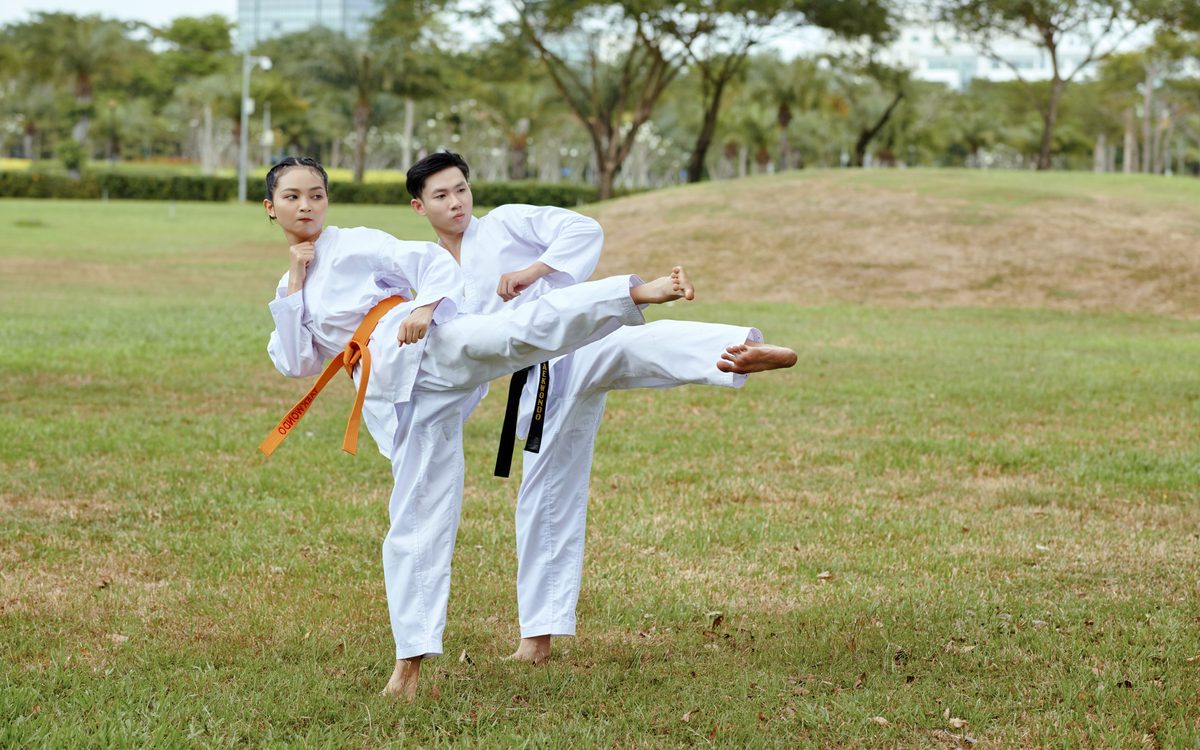
Two athletes circle on an eight-sided mat, their chest protectors flashing red and blue. One feints low, then whips a turning kick around the other’s guard and smacks the head guard. A buzzer sounds, a number jumps on the scoreboard, and the arena groans. That is taekwondo (also written tae kwon do, and often shortened to TKD), the Korean martial art whose sparring form, kyorugi, is one of the fastest, kick-heavy sports at the Olympic Games.
Taekwondo guides: what do you need?
New to taekwondo? Start with the first card. Everything here is general education, not medical advice.
History & Origins of Taekwondo
Taekwondo is a Korean martial art and sport. Older Korean fighting traditions are often cited as its roots, but how far back the lineage goes is debated, and styles and schools developed in the 20th century, so we keep to the documented modern history. Olympedia notes that World Taekwondo, the world federation, was formed in Seoul in 1973 and was recognized by the IOC in 1980.
Search results describing the Kukkiwon (the Seoul headquarters) say the first World Taekwondo Championships were held there in May 1973, and that the federation, then called the World Taekwondo Federation, took the name World Taekwondo in 2017; we did not open the federation’s own history page, so those details are marked “commonly cited”. Taekwondo was contested at the World Games from 1981 to 1993, was a demonstration sport at the Olympics in 1988 (Seoul) and 1992 (Barcelona), and became a full medal sport at Sydney 2000. The Olympics hold four weight classes per gender; the World Championships hold eight. Learn how scoring works on our rules page.
- 1973: World Taekwondo (then the WTF) formed in Seoul; first World Championships commonly cited as May 1973.
- 1980: IOC recognizes the federation (Olympedia).
- 1981-1993: taekwondo is contested at the World Games (Olympedia).
- 1988 and 1992: demonstration sport at the Seoul and Barcelona Olympics (Olympedia).
- 2000: full Olympic medal sport at Sydney (Olympedia).
- 2017 (commonly cited): federation renamed World Taekwondo.
Sources: Olympedia, taekwondo (read 2026-11-13); World Taekwondo 50th anniversary book (found in search, not opened).
Recent Olympic Champions
Scope: gold medallists at the last two Olympic Games only, not the World Championships or Grand Prix. Rows read on Olympedia on 2026-11-13.
| Weight class | Paris 2024 gold | Tokyo 2020 gold |
|---|---|---|
| Men -58 kg | Park Tae-jun (KOR) | Vito Dell’Aquila (ITA) |
| Men -68 kg | Ulugbek Rashitov (UZB) | Ulugbek Rashitov (UZB) |
| Men -80 kg | Firas Katoussi (TUN) | Maksim Khramtsov (ROC) |
| Men +80 kg | Arian Salimi (IRI) | Vladislav Larin (ROC) |
| Women -49 kg | Panipak Wongpattanakit (THA) | Panipak Wongpattanakit (THA) |
| Women -57 kg | Kim Yu-jin (KOR) | Anastasija Zolotic (USA) |
| Women -67 kg | Viviana Marton (HUN) | Matea Jelic (CRO) |
| Women +67 kg | Althea Laurin (FRA) | Milica Mandic (SRB) |
Source: Olympedia Paris 2024, Tokyo 2020. Results verified through 2026-11-13. Latest completed Olympic event included: Paris 2024.
Legends of the Sport
Olympic medallists from different eras, in no ranking order. Medal counts are from Olympedia (through Paris 2024).
- Steven Lopez (USA): two Olympic golds and a bronze.
- Hadi Saei (Iran): two Olympic golds and a bronze.
- Hwang Kyung-seon (South Korea): two Olympic golds and a bronze.
- Chen Zhong (China): two Olympic gold medals.
- Wu Jingyu (China): two Olympic gold medals.
- Jade Jones (Great Britain): two Olympic gold medals.
- Panipak Wongpattanakit (Thailand): two golds (Tokyo 2020 and Paris 2024) and a bronze.
- Ulugbek Rashitov (Uzbekistan): two golds (Tokyo 2020 and Paris 2024).
- Milica Mandic (Serbia): two Olympic golds.
Official results and records
- Olympedia: taekwondo at the Olympics
- World Taekwondo publishes World Championships and Grand Prix results on its own site; check it for the latest.
How we keep this current: we re-check facts after each major championship and update this page. Spot an error? See our editorial policy.
This page covers taekwondo for newcomers and parents: how competition works, the two main disciplines, who plays from child classes to the Paralympics, what the sport asks of the body, the injuries to know about, and what gear matters. It is general information, not medical advice.
Taekwondo at a glance
| What it is | A striking martial art and Olympic combat sport known for kicks, practiced in a dobok (uniform) with a belt. |
|---|---|
| How you win (sparring) | Score more points than your opponent over three rounds, or win by a larger lead, a golden-point round if tied, or a disqualification. Hits are registered by electronic scoring protectors (PSS). |
| Disciplines | Kyorugi (sparring) and poomsae (forms). Poomsae is judged on accuracy and presentation, not contact. |
| Participants and levels | Children’s schools, school and college clubs, adult recreational classes, national and world championships, the Olympics and the Paralympics. |
| Age groups (World Taekwondo) | Cadet 12 to 14, junior 15 to 17, senior 17 and older, based on the year of competition. |
| Where it is played | A dojang (school); competition on an octagonal mat about 8 meters across. |
| Governing bodies | World Taekwondo worldwide, also the Paralympic federation for para taekwondo; USA Taekwondo in the United States. |
How taekwondo works
In a World Taekwondo kyorugi match, two athletes fight three rounds of two minutes each, with one minute of rest between rounds. The rules award one point for a valid punch to the trunk protector, two points for a kick to the trunk and three for a kick to the head, and turning kicks (spinning techniques) are doubled: four points to the trunk and six to the head. Penalties are called gam-jeom, and they are counted in the total. If the match is tied after three rounds, a one-minute golden round decides it, and the scores from the first three rounds do not count. In the “best of three rounds” format used at the Olympics, the winner is whoever takes two rounds.
Because contact is registered by electronic protectors and sensing socks, a hit has to be hard enough to register, which pushes athletes toward fast, clean kicks. Beginners in a school class will do something very different from an Olympic match: forms, kicking drills on pads, light controlled sparring, and belt tests moving through the color belts toward black.
Formats and disciplines
Kyorugi is the sparring discipline just described. Poomsae are set patterns of blocks, strikes and kicks, judged on accuracy and presentation rather than contact. USA Taekwondo offers courses, camps and referee training for poomsae as well as for sparring. The LA28 listing for taekwondo covers sparring events only. See the martial arts rules page for how the arts compare.
Who plays taekwondo and at what level
Children and youth
Taekwondo is one of the most common children’s martial arts. The American Academy of Pediatrics says taekwondo injuries are mostly from kicks and that one study found about three times the injury risk of karate, because taekwondo allows full contact. That is why good children’s programs use age-appropriate contact and teach blocking. World Taekwondo splits young athletes into cadets (12 to 14) and juniors (15 to 17); cadet athletes’ head protectors may have a face shield, and competition weight classes for them also take height into account.
Club, school and adult
Most players train at a commercial or community school and join belt tests and local tournaments. USA Taekwondo offers membership for athletes, coaches, referees and clubs, and lists a “how to find a taekwondo school” guide. Adults can start at any age, since classes mix forms, fitness and light sparring.
Olympics
According to Olympics.com, taekwondo was a demonstration sport at Seoul 1988 and became an official medal sport at Sydney 2000, with four weight classes each for men and women. The LA28 organizers list eight taekwondo events for 2028 (four men’s: under 58, 68, 80 and over 80 kilograms; four women’s: under 49, 57, 67 and over 67), best of three rounds on the octagonal mat, at the Los Angeles Convention Center. Check the official LA28 site for dates.
Paralympics
Para taekwondo entered the Paralympic program at Tokyo 2020. Athletes compete in kyorugi against others in the same sport class and weight category. World Taekwondo began developing para kyorugi in 2005 and held the first world championships in 2009 in Baku. Paralympic.org reports 10 medal events at Paris 2024 (five per sex), with 121 athletes from 54 nations. Para taekwondo is on the initial LA28 Paralympic program. See para taekwondo for more.
Physical demands of taekwondo
Taekwondo asks for explosive leg power, hip and hamstring flexibility, balance on one leg and quick footwork. A three-round match of two-minute rounds is made of short bursts with pauses, so athletes need both sprint ability and the aerobic base to repeat it. Core strength supports kicking and spinning, and the standing leg takes much of the load. Athletes in weight classes also carry the pressure of making weight, which is a nutrition and safety issue (see below).
Health and safety in taekwondo
Contact kicking brings its own risks. If you are hurt, see a sports medicine doctor, physical therapist or athletic trainer. This section is general information, not medical advice.
Injury patterns
At the 2017 World Taekwondo Championships (Journal of Athletic Training, 2021), 971 athletes had 13.5 injuries per 100 athletes. About 46.6% were to the lower extremity (knee 19.8%) and 24.4% to the face; contusions made up 33.6%. A 2025 systematic review of high-performance taekwondo found lower-limb injuries, especially to the foot and knee, were most common, mostly contusions followed by sprains and ligament tears, and most injuries caused one to seven days away. In the IOC’s surveillance of three Olympic Games, taekwondo’s competition injury rate was 7.7 per 1,000 minutes of exposure, and 32.5% of injuries meant more than seven days away from competition or training. A review of risk factors points to heavier weight divisions, adolescents and fighters who lack blocking skills.
Head impacts and concussion
Head kicks score the most, so concussion is a real concern. A video analysis of World Taekwondo Championship matches from 2017 to 2019 found concussions at 3.21 per 1,000 games, most often from a roundhouse kick to the face when the athlete did not block. The AAP says there is no evidence that headgear or mouthguards reduce concussion. World Taekwondo’s own competition rules require a venue doctor to assess a head injury (a SCAT5 test within 30 minutes) and impose mandatory suspensions after a significant head trauma: 30 days for seniors, 40 for juniors and 50 for cadets, and longer for repeat concussions. For everyone else, follow the CDC HEADS UP approach: recognize the signs (headache, dizziness, confusion, balance problems), remove the athlete from practice, and have a healthcare provider decide when to return. Call 911 for danger signs such as repeated vomiting, a seizure or one pupil larger than the other.
Protective equipment
World Taekwondo rules require competitors to wear a WT-approved dobok, trunk and head protectors, groin guard, forearm guards, shin guards, gloves, sensing socks if electronic scoring is used, and a mouthguard. The mouthguard must be white or clear, at least 3 mm thick and cover the entire upper teeth, with a special version for athletes with braces. Protective equipment reduces some injuries, such as dental injuries, but it does not make full contact safe; USA Taekwondo also uses modified safety rules for age and belt groups where head contact is not permitted.
Training, recovery and nutrition pointers
Because kicks load the hips, knees and feet, many taekwondo athletes spend time on hip mobility, hamstring flexibility, ankle stability and single-leg strength, and on footwork and timing. Training more than three hours a week at a young age was linked to higher injury risk in the AAP’s martial arts report. See the martial arts training page, the recovery page and nutrition and supplements page. The CDC recommends 9 to 12 hours of sleep for ages 6 to 12, 8 to 10 for teens and at least 7 for adults. After class, many athletes use a foam roller or a massage gun for comfort; those tools are not treatment. Rapid weight cutting is risky, especially for teens; ask a doctor or sports dietitian.
Taekwondo gear
For a first class you need a dobok and belt, and many schools sell their own. If you plan to compete, look for the World Taekwondo approval in the maker’s listing and ask your coach before buying protectors, since tournaments may require approved electronic equipment. Fit matters: protectors that slip or a mouthguard that does not seat well are an annoyance at best. Buy a mouthguard you can bite into comfortably and replace it when it wears down. Separate verified standards (the WT rules above) from marketing claims on listings; “approved” in an Amazon listing is the seller’s statement, so check with your club or the tournament.

Daedo Taekwondo Beginner Uniform
- WT recognized (listing)
- V-neck, pants and belt
- Beginner uniform
$27.99 at Amazon, as of Nov 17, 2026 01:07 UTC
Check price on Amazon
adidas ADI-START II Taekwondo Dobok
- World Taekwondo approved (listing)
- V-neck
- Cotton-blend uniform

Shock Doctor Gel Max Mouthguard
- Boil-and-bite gel-fit liner
- Breathing channels
- Youth and adult
$11.99 at Amazon, as of Nov 17, 2026 01:07 UTC
Check price on AmazonRelated sports and disciplines
Taekwondo sits within martial arts. Its closest neighbors are karate, judo, kickboxing and Muay Thai, and the adaptive version is para taekwondo.
Taekwondo FAQs
What is the difference between taekwondo and karate?
Taekwondo is Korean and focuses on kicks, with full-contact Olympic sparring. Karate is from Okinawa, Japan, and uses hands and feet, with WKF kumite scored by controlled strikes. See our karate page.
Is taekwondo good for kids?
It can build fitness, balance and flexibility, and the AAP says martial arts offer benefits. But taekwondo has more injury risk than non-contact karate, so look for qualified instructors, age-appropriate contact and safety gear, and ask the school about its concussion policy.
How does Olympic taekwondo scoring work?
One point for a punch to the trunk, two for a trunk kick, three for a head kick, with spinning kicks doubled to four and six. Matches are three two-minute rounds, with golden point if tied.
Is taekwondo in the 2028 Olympics?
Yes. LA28 lists eight taekwondo events, and para taekwondo is on the LA28 Paralympic program. Check the official programme for any changes.
Do I need to be flexible to start?
No. Flexibility improves with regular practice, and a good class warms up first. If something hurts or pulls sharply, stop and ask your instructor or a healthcare professional.
Sources
- LA28: Taekwondo
- World Taekwondo: Competition Rules and Interpretation (in force 1 June 2026)
- Olympics.com: Taekwondo
- Paralympic.org: Taekwondo and LA28 Paralympic sport programme
- USA Taekwondo
- American Academy of Pediatrics: Youth Participation and Injury Risk in Martial Arts
- Injuries at the 2017 World Taekwondo Championships (PubMed 33657209)
- Injuries in high-performance taekwondo: systematic review (PubMed 41158919)
- Injuries in Olympic combat sports (PubMed 33219113)
- Concussions in World Taekwondo Championship matches (PubMed 36011947) and taekwondo injury risk factors (PubMed 24247189)
- CDC HEADS UP: signs and symptoms
Keep exploring: the martial arts hub, martial arts injuries, martial arts gear, our recovery tools guide, and every sport on our sports hub.