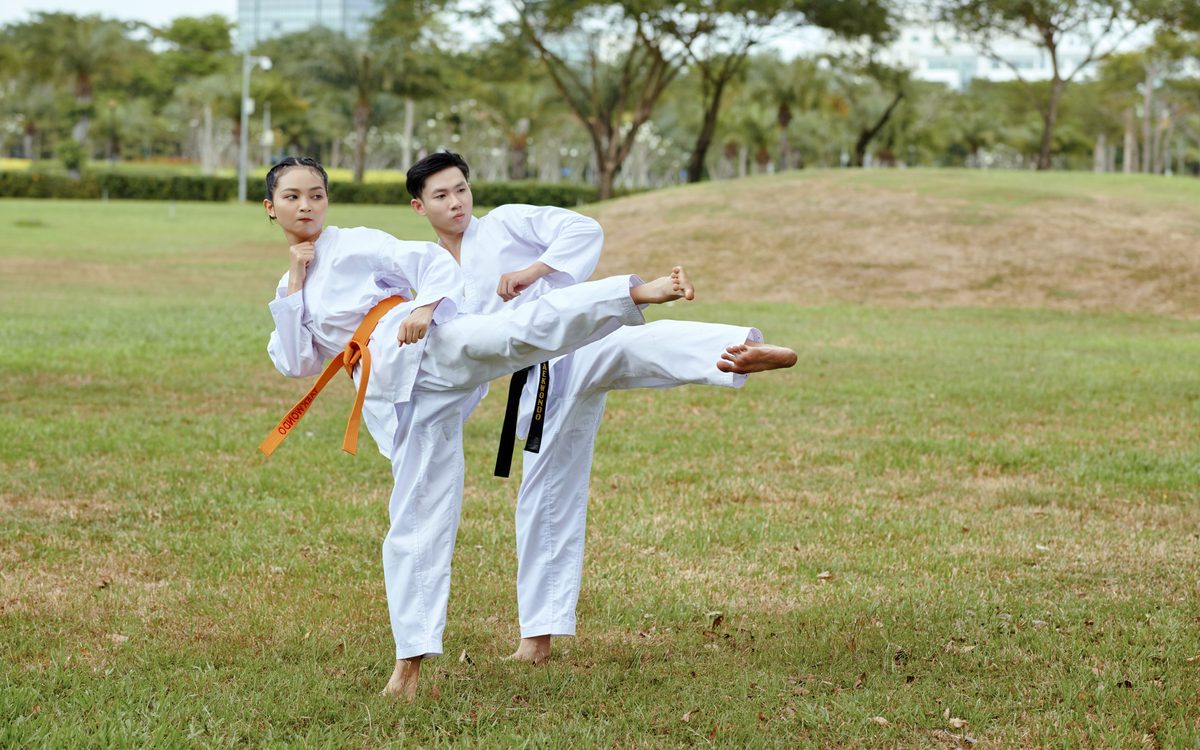
The referee calls the final round and the arena goes quiet. An athlete bounces on her toes, her opponent ahead by one point with seconds left in the final round, and she hears her own heartbeat. Her coach said “stay calm” before the round, and now she has to find out what that means. Taekwondo mental training is the set of skills athletes practise to handle pressure, focus on the next action, bounce back from a lost point or a lost match and prepare in a consistent way, and it sits alongside physical and technical work. It does not guarantee results, and it is not mental health treatment, a difference this page keeps clear. See the taekwondo hub for the sport.
Quick answer: The research on taekwondo mental training is thin, so this page leans on position statements, studies of combat-sport athletes and general sport-psychology practice, and says which is which. What is reasonably well supported: pressure can help or hurt, and athletes can prepare with pre-performance routines, practice under pressure and simple tools such as imagery and goals. None guarantees a win. Anxiety, depression, disordered eating, burnout and self-harm thoughts are health matters for a qualified professional, not performance problems to fix with a technique. In the US you can call or text 988 at any time.
Pressure, confidence and focus
Pressure is not always the enemy. The Exercise and Sports Science Australia position statement on performance under pressure (Schweickle and colleagues, 2026) says pressure can have both helpful and harmful effects on performance, that training environments with implicit learning and deliberate pressure training can prepare athletes, and that evidence-based strategies include pre-performance routines. Confidence in taekwondo comes from preparation: kicks drilled until they are automatic, sparring experience at the right level and a clear picture of what you do well. Self-belief matters too. In a 2025 study of 110 competitive karate, taekwondo and judo athletes (Di Corrado and colleagues), self-efficacy, the belief you can do what the task needs, played a mediating role in the link between imagery and stress, though the study could not show that building confidence reduces stress.
Focus in sparring means placing your attention on the useful cue and letting the rest go: your opponent’s hips, distance, the referee’s calls, not the scoreboard or the crowd. Match studies suggest why this is hard. In elite men at the 2005 World Championships (Bridge and colleagues, 2011), the average fighting action was about 1.7 seconds and preparatory movement about 6.4 seconds, so there are many short windows to decide, reset and refocus. That reading is ours; no source tests it.
Routines, imagery and goals
- Pre-round routines. A short set of repeatable steps, such as a breath, a cue word, a look at your corner and a stance, is the kind of pre-performance routine the ESSA statement lists. Build yours in practice and keep it the same on competition days. The research supports routines in general, not one set of steps.
- Imagery. Picture a kick, a sequence or a poomsae in as much detail as you can, with how it feels and sounds, then rehearse it for a few minutes before sleep or before warming up. The Di Corrado study above looked at imagery and found it linked to stress through self-efficacy, so it may help some athletes. Evidence that it improves taekwondo results is limited.
- Goals. Process goals (how I move my hands to guard, when I reset after a clinch) tend to be easier to control than outcome goals (win the gold). Using both, with a plan for each practice, is common coaching advice, not a taekwondo trial result.
- Motivation. In the Özer study of 209 elite male taekwondo athletes, enjoying the sport went with lower burnout. Keeping a reason to train that is not only results is worth protecting.
Handling setbacks and the golden round
Sparring is a game of mistakes: a missed kick, a conceded point, a bad call. A reset plan helps. Many athletes use a breath, a single word and an immediate focus on the next exchange. The WT rules give one minute of rest between rounds, so there is time for one clear thought, such as one adjustment, not a long argument with yourself. The golden round, a one-minute sudden-death decider if the match is tied, is a natural place to rehearse staying with your plan. In a 2026 study of 379 Olympic combat sport athletes (Kaçay and colleagues), sport mindfulness was linked with more self-compassion and self-compassion with lower burnout. It was a cross-sectional survey, so it shows an association, not a result of training.
Tactics and decisions
Taekwondo is a thinking sport. Athletes read distance, choose when to feint or counter, adapt to a lefty or a taller opponent and manage the lead. Coaches teach this through scenario sparring and video review, which is general practice. For the physical side, see our training page, and for what the rules award, our rules page.
Competition preparation
A written competition plan reduces last-minute decisions: a weigh-in plan agreed with a doctor or dietitian (see the nutrition page), a warm-up routine, the gear checked the night before (see the gear page), and a plan for the wait between matches. Rehearse all of it in training. If you hit your head, report it: in the 2025 Australian survey (Brown and colleagues), over 20 percent of athletes admitted to hiding concussion symptoms, and attitudes, not knowledge, predicted safer reporting intentions. A culture where telling the coach is normal is part of mental readiness.
Young athletes
Weigh-ins and winning can weigh heavily on children and teens. In a 2024 survey of 335 young Croatian taekwondo athletes (Barić and colleagues, average age 14.7), coach pressure on diet and weight and body dissatisfaction were among the predictors of eating-disorder symptoms. Coaches and parents can focus on effort, learning and enjoyment, and keep conversations about weight to a doctor or dietitian.
Mental health is not the same as mental performance
Mental skills training helps athletes perform. Mental health conditions are matters of health. In a 2025 study of 110 Lebanese national-team black belts (Hoteit and colleagues), 14.5 percent were at high risk for anxiety, 13.6 percent reported depression, 24.5 percent had sleep disturbances and 10 percent reported thoughts of self-harm; it was cross-sectional and in one country, so it is not a rate for every athlete, but it shows these issues exist in taekwondo. If you or a teammate feel persistent anxiety, low mood, hopelessness, panic, constant exhaustion, an eating problem or burnout, please talk to a doctor, a licensed mental health professional or a sport psychologist. In the US, call or text 988 (the 988 Suicide and Crisis Lifeline) for crisis support at any hour. The Association for Applied Sport Psychology lists resources for finding a sport psychology professional, and the ANAD helpline supports people with eating concerns.
Taekwondo mental training FAQs
How do I stop being nervous before a taekwondo match?
Some nerves are normal and can help. A set routine, slow breathing, a cue word and rehearsing the match plan can make them easier to use. If anxiety is strong, constant or stops you from competing, a sport psychologist or doctor can help.
Does visualization work for taekwondo?
Imagery is widely used and one study of karate, taekwondo and judo athletes linked it to stress through self-efficacy. We found no taekwondo trial showing it improves results, so treat it as a practice tool, not a promise.
How do I recover mentally after losing a match?
Take a short break, write down one thing to keep and one to change, and talk to a coach or a trusted person. Self-compassion is linked with lower burnout in Olympic combat sport athletes. Ongoing low mood is a reason to see a professional.
How do I stay focused during sparring?
Choose one or two cues, such as distance and your opponent’s hips, and return to them after each exchange. Practise this under realistic pressure in training.
Is burnout a mental performance issue?
It can be both. A 2026 study of elite male taekwondo athletes linked poor sleep with more burnout. Persistent exhaustion, loss of enjoyment or low mood are health issues to take to a doctor or mental health professional.
Sources
- Schweickle MJ et al. 2026, ESSA position statement, Performance Under Pressure in Sport (PubMed 42271117)
- Di Corrado D et al. 2025, mental imagery, self-efficacy and stress in martial arts athletes (PubMed 40040664)
- Bridge CA et al. 2011, activity profile in international taekwondo competition (PubMed 21911860)
- Kaçay Z et al. 2026, mindfulness, self-compassion and burnout in Olympic combat sport athletes (PubMed 42755439)
- Özer et al. 2026, sleep quality, enjoyment and burnout in elite male taekwondo athletes (PubMed 41904524)
- Brown et al. 2025, concussion knowledge, attitudes and behaviours, Australian taekwondo athletes (PubMed 41295792)
- Barić et al. 2024, eating disorders in taekwondo athletes (PubMed 39728855)
- Hoteit et al. 2025, mental health and eating patterns in Lebanese taekwondo players (PubMed 41052051)
- Reardon CL et al. 2026, IOC consensus statement on mental health in elite athletes (PubMed 42580854), a resource for clinicians and teams
- World Taekwondo, Competition Rules and Interpretation (in force 1 June 2026)
- 988 Suicide and Crisis Lifeline
- Association for Applied Sport Psychology, resources
- ANAD eating disorders helpline
General information for education only, not medical advice. It does not replace a sports medicine doctor, physical therapist, athletic trainer, registered dietitian or qualified coach. See our editorial policy for how we research and write.