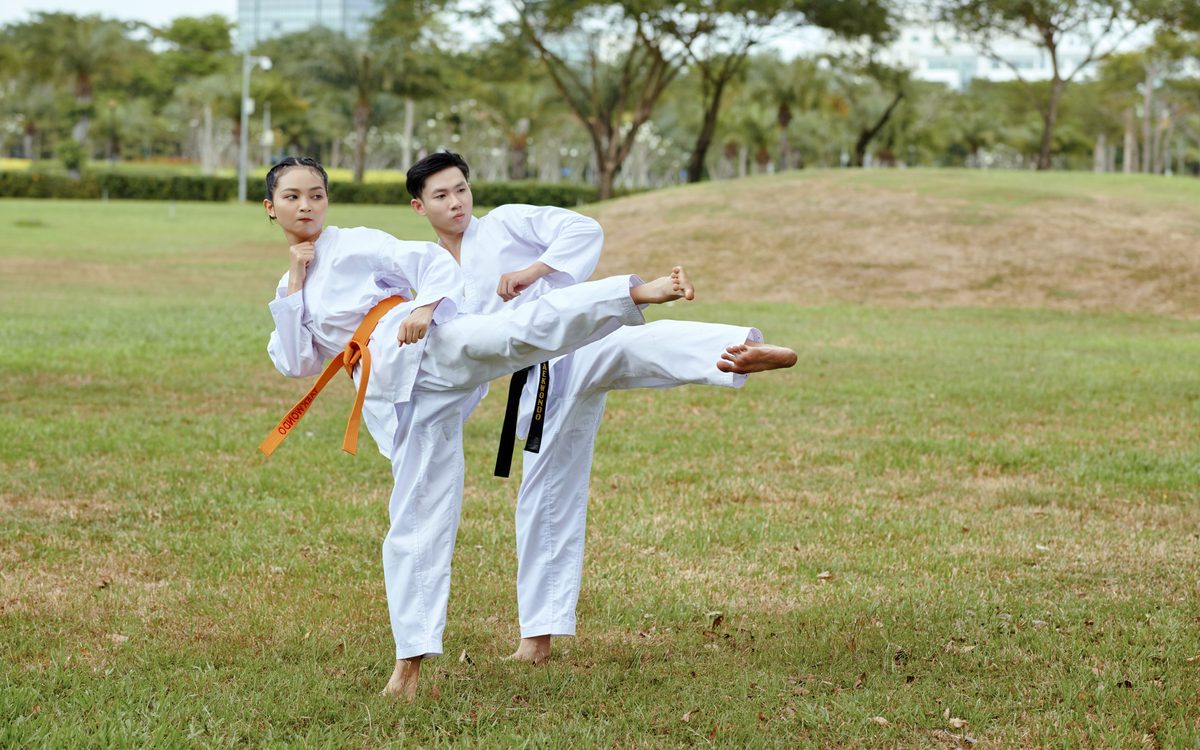
The bell rings at the end of round two. A sparring athlete has spent two minutes in short bursts, a quick step in, a kick, a clinch broken by the referee, then a pause of a few seconds to reset, and now her legs are heavy and she has to do it again. Taekwondo training is the work that gets an athlete ready for that pattern: kicking technique, explosive leg power, an aerobic base to recover between bursts, mobility for high kicks and the skill to read an opponent. This page covers the physical demands and a sensible weekly shape. It does not replace a coach. See the taekwondo hub for the sport overview.
Quick answer: Taekwondo sparring is a repeated-sprint sport: short bursts of kicking and footwork separated by longer pauses, backed by a solid aerobic base. A review in Sports Medicine found international athletes have low body fat, high lower-limb power and flexibility, and moderate to high aerobic fitness. A typical week mixes technique and sparring sessions with two strength or power sessions, some aerobic work and rest days. The specific split below is general coaching practice, not a published prescription. Check with a doctor before starting hard training if you have a health condition.
What the sport asks of the body
Match analyses show how intermittent the sport is. In a study of elite men at the 2005 World Taekwondo Championships (Bridge and colleagues, 2011), the average fighting action lasted about 1.7 seconds, preparatory movement about 6.4 seconds and referee stoppage about 2.8 seconds, with around 28 exchanges and 31 kicks per match. Those numbers come from rules and scoring that have since changed (electronic protectors are now standard), so treat them as a picture of the rhythm, not a current benchmark. A study of Songahm taekwondo competition (Matsushigue and colleagues, 2009) found the average effort time (8 seconds) matched the interval time between efforts, and a post-match blood lactate of 7.5 mmol per litre led the authors to say glycolytic metabolism was not the main energy source; they suggested training with high-intensity bursts and longer rests to restore creatine phosphate. A study of youth cadets (Tornello and colleagues, 2013) found fighting to non-fighting time was about 1:2.
Putting this together, Bridge and colleagues’ 2014 review in Sports Medicine concluded that international athletes have low body fat, a high peak anaerobic power in the lower limbs, moderate to high maximal strength, moderate trunk and hip-flexor endurance, high lower-limb flexibility and moderate to high cardio-respiratory fitness, which supports recovery between consecutive matches. The authors also said more research is needed before specialized conditioning can be set for different groups.
A sensible weekly shape (general coaching practice)
No published source gives one right weekly schedule, so the layout below is a common pattern, not a rule. Adjust it with your coach for age, season and how you recover.
- Skill sessions, 2 to 4 times: kicking drills on pads, footwork, forms and, for those who compete, controlled sparring. This is where most of the technique is built.
- Strength and power, 2 times: squats or lunge variations, hip hinges, calf and single-leg work, plus jumps and landings. Keep these away from the heaviest sparring day.
- Aerobic or interval work, 1 to 2 times: easy running or cycling for a base, plus short repeated bursts that mimic exchanges with rests that are longer than the work.
- Mobility, a few minutes most days: hips, hamstrings, groin and ankles, and trunk work. The ACSM position stand recommends flexibility exercises on at least two days a week.
- At least one full rest day, and more in a heavy week. The AAP recommends one to two days off a week from a main sport for young athletes (Brenner, 2016).
Strength and power
Because kicks are fast, many coaches emphasise power, not only slow strength. A systematic review of plyometric jump training in combat sport athletes (Ojeda-Aravena and colleagues, 2023) pooled 12 studies of 292 participants, mostly under 18 and male, and including taekwondo. Programs lasting 4 to 12 weeks with 2 to 3 sessions a week gave small to moderate gains in maximal strength, jump height, change-of-direction speed and sport-specific performance, with low-to-moderate certainty of evidence. A 2026 randomized study of 24 elite male taekwondo athletes (Yu and colleagues) compared 8 weeks of plyometric training with traditional resistance training, both twice a week on top of normal practice. Plyometrics produced bigger gains in roundhouse kick speed, kick power and reactive strength, but the authors cautioned that several results did not differ between groups after training and that it does not show plyometrics is better for everyone.
The AAP describes well-supervised resistance training for young athletes as safe; learn the lifts and landings from a qualified coach before adding load. Build jump volume gradually; see our injury prevention page.
Aerobic fitness and repeated efforts
A match may be short, but a tournament day can include several. Bridge and colleagues note that an aerobic base helps recovery between bursts and between matches. A practical idea from a 2021 study of 12 black belts (Sant’Ana and colleagues) was to run a session of three 2-minute rounds with a 1-minute rest at a kick frequency matched to each athlete’s anaerobic threshold, which produced heart rates around 179 beats per minute by rounds 2 and 3. That was a single-session study, so it shows what such a drill feels like, not a proven plan.
Flexibility, balance and the standing leg
High kicks need hip and hamstring range, and every kick is a one-legged balance task for the standing leg. A 2025 motion-capture study of 23 male college athletes (Zhang and colleagues) found sparring, forms and demonstration athletes controlled balance differently during the same kick, so training habits shape control. Use dynamic mobility in warm-ups, hold stretches after training when muscles are warm, and add single-leg balance and landing work. No injury-prevention trial in taekwondo exists that we could find; see the injury prevention page for what is and is not known.
Periodisation and monitoring: the basics
Periodisation means planning training in phases: a general base, a more specific build before competition, a short sharpening phase and recovery afterward. It is standard in sport science, but the sources we found for taekwondo were limited, so the common pattern here is general coaching practice. Loads should rise gradually and be tracked. A 2017 study in 12-year-olds (Lupo and colleagues) found that asking young athletes to rate session difficulty on a 0 to 10 scale roughly tracked heart-rate-based load, and the IOC consensus on load (Soligard and colleagues, 2016) recommends monitoring training load to protect athletes from injury and illness. Cutting weight for a weigh-in adds its own stress; see our nutrition page.
For where each skill fits, start with the rules and getting started page. Recovery between sessions is on the recovery page and the mind game on the mental training page.
Taekwondo training FAQs
How many days a week should I train taekwondo?
It depends on age, goals and recovery. Many club students train two to three times a week and competitors more, but no source sets one number. The AAP advises one to two days off a week from a main sport for young athletes, and the AAP martial arts report notes some evidence of more risk above about three hours a week in children.
Do taekwondo athletes need to lift weights?
Evidence from combat-sport reviews supports strength and jump training for power, especially when taught and supervised well. Weights are one tool, not a requirement, and beginners can build a base with body-weight work.
What is the best cardio for taekwondo?
A mix of easy aerobic work for a base and short repeated efforts with rests, matched to the stop-start pattern of sparring. Specific mixes are coaching choices, not proven formulas.
How can I get my kicks higher?
Practice kicking technique, build hip and hamstring mobility with regular, gentle stretching, and strengthen hip and trunk control. Forcing range or bouncing hard can cause strains, so progress slowly. If a muscle or joint hurts sharply, stop and see a professional.
Is taekwondo training different for kids?
Yes. Children should learn from qualified instructors, focus on technique, play and fitness, and delay hard contact until they have skill and maturity, as the AAP martial arts report advises.
Sources
- Bridge CA et al. 2014, Physical and physiological profiles of taekwondo athletes, Sports Medicine (PubMed 24549477)
- Bridge CA et al. 2011, activity profile in international taekwondo competition by weight category (PubMed 21911860)
- Matsushigue KA et al. 2009, Taekwondo: physiological responses and match analysis (PubMed 19528839)
- Tornello F et al. 2013, time-motion analysis of youth Olympic taekwondo combats (PubMed 22592166)
- Ojeda-Aravena A et al. 2023, plyometric jump training in combat sport athletes, meta-analysis (PubMed 36828318)
- Yu et al. 2026, plyometric vs traditional resistance training in elite taekwondo athletes (PubMed 42948177)
- Sant’Ana J et al. 2021, pace training session in taekwondo athletes (PubMed 34413790)
- Zhang et al. 2025, balance and control during kick technique across taekwondo practices (PubMed 39996422)
- Lupo C et al. 2017, session-RPE in youth taekwondo (PubMed 26796074)
- Soligard T et al. 2016, IOC consensus statement on load in sport (PubMed 27535989)
- Garber CE et al. 2011, ACSM position stand on exercise quantity and quality (PubMed 21694556)
- Brenner JS 2016, AAP, Sports specialization and intensive training in young athletes (PubMed 27573090)
- AAP clinical report, Youth Participation and Injury Risk in Martial Arts (2016)
- AAP policy, Resistance Training for Children and Adolescents (2020)
General information for education only, not medical advice. It does not replace a sports medicine doctor, physical therapist, athletic trainer, registered dietitian or qualified coach. See our editorial policy for how we research and write.