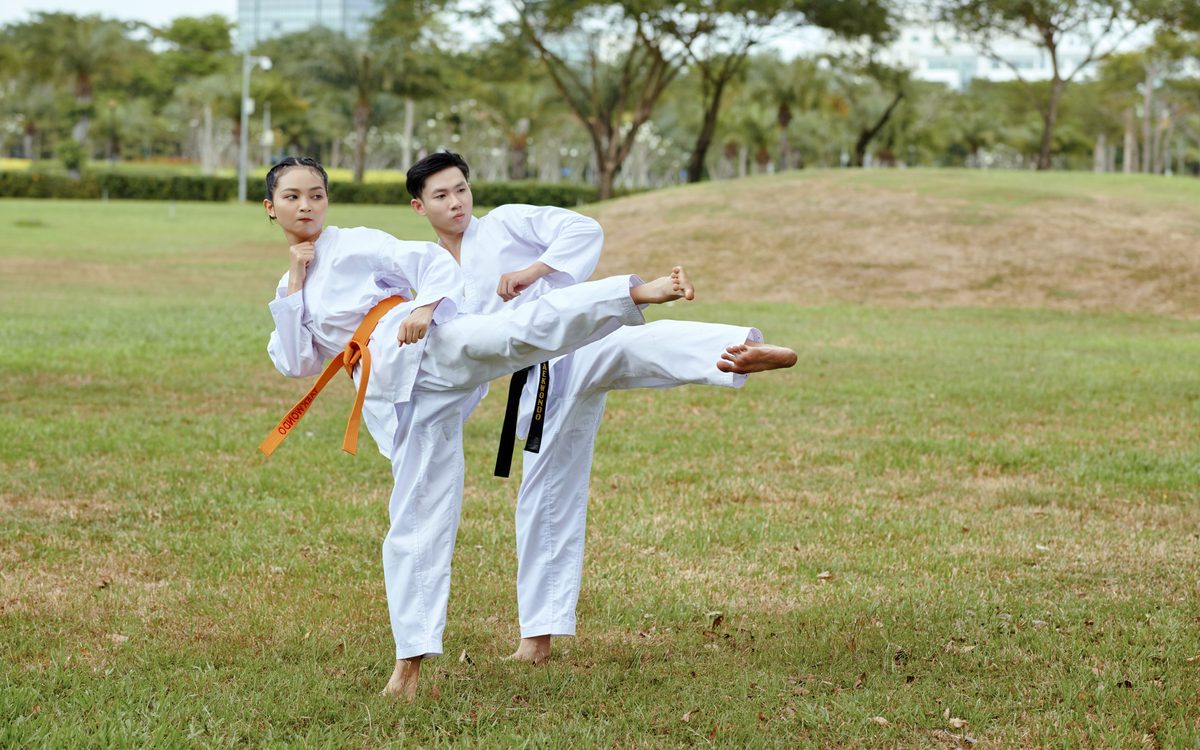
It is the evening before a tournament and a 16-year-old stands on the scale in a school hallway, a few hundred grams from her weight class, with a bottle of water she is afraid to drink. Her coach says “fine”, her friends say “just sweat it off”, and her mother is not sure what to say. Taekwondo is a weight-class sport, so taekwondo nutrition is about more than fuel: it is about eating and drinking enough to train, handling weigh-ins safely and not letting a weight target damage health. This page covers fuel and hydration, weight-class cautions, relative energy deficiency (RED-S), and supplements. See the taekwondo hub for the sport.
Quick answer: Eat enough carbohydrate and protein to support training, drink regularly, and treat weight cutting as a health risk, not a routine. Studies of taekwondo athletes find that most cut weight and that crash methods carry a higher risk of dehydration, and a Korean study found more injuries in weight-loss periods. Few supplements have good evidence, none replaces food, and tested products matter because athletes are responsible for what they take. Ask a doctor or registered dietitian before changing how you eat or trying a supplement. General information, not medical advice.
Fuel and hydration for training
Taekwondo asks for explosive kicks, many short bursts and a solid aerobic base (see our training page), so athletes need enough energy overall, with carbohydrate for the hard work and protein to repair muscle. The joint position stand of the American College of Sports Medicine, the Academy of Nutrition and Dietetics and Dietitians of Canada (2016) gives 1.2 to 2.0 grams of protein per kilogram of body mass per day for athletes, spread through the day, and about 0.25 to 0.3 grams per kilogram after hard exercise. It says to replace fluid at about 1.25 to 1.5 litres for each kilogram of body mass lost. In the International Society of Sports Nutrition (ISSN) 2025 position stand for combat sports, even during a weight cut, intake should not drop below 3.0 to 4.0 grams of carbohydrate, 1.2 to 2.0 grams of protein and 0.5 to 1.0 gram of fat per kilogram per day. A practical plate is a base of grains, potatoes or rice, a palm of lean protein or beans and plenty of fruit and vegetables; that plate is general practice, not a published formula. Hot, crowded training rooms raise sweat loss, so start sessions well hydrated and drink as you go.
Weigh-ins and weight classes
Under World Taekwondo and USA Taekwondo rules, athletes are weighed the day before their competition day, and some events add a random weigh-in on the morning of competition with a tolerance set in the event outline (a 2025 event outline used 5 percent over the class limit). That leaves roughly a day to recover after the scale. Each Olympic class is a limit, so athletes often aim for the next lighter category.
A study of 192 Olympic-style taekwondo competitors (Janiszewska and colleagues, 2020) found three weight-loss patterns: active (47 percent), passive (31 percent) and extreme (22 percent). The extreme group combined about four methods, lost 6.7 percent of body mass on average against 4.3 to 4.5 percent in the others, and all used the methods with the highest risk of severe dehydration. A study of 197 elite Korean athletes (Kim and colleagues, 2023) found 6.88 injuries per 1,000 training hours in weight-loss periods against 3.66 in normal training. A small pilot of five men (Yang and colleagues, 2018) who lost 5 percent over three and a half days found no drop in simulated match performance after 16 hours of recovery, but with five athletes it cannot show that cutting is safe, and the red blood cells changed after the cut before recovering.
The safe-weight-loss advice from sports medicine bodies is gradual. The National Athletic Trainers’ Association position says 1 to 2 pounds a week and no more than about 1.5 percent of body mass a week, and the AAP steers young athletes toward healthy, gradual approaches. A CDC report on wrestlers (MMWR, 1998) linked sauna suits and similar methods to wrestler deaths. The ISSN statement does describe acute water-loss methods for adult combat athletes, but we do not repeat them: they carry real risk, they need supervision and the statement itself says the long-term effects of frequent cuts are unknown. Young athletes should talk to a doctor before any cut. If an athlete is near a limit, the safest options are to compete in a heavier class or have a doctor or dietitian plan a slow change months ahead.
Relative energy deficiency in sport (RED-S)
RED-S, in the International Olympic Committee’s 2023 consensus statement (Mountjoy and colleagues), describes health and performance problems that can follow when an athlete does not take in enough energy for what their body does, in men and women and across many sports. Weight-class and weight-conscious sports carry extra risk. In a 2024 survey of 335 Croatian taekwondo athletes (Barić and colleagues, average age 14.7), eating-disorder symptoms were more common in females, and body dissatisfaction and coach pressure on diet and weight were among the predictors. In a 2025 study of 110 Lebanese black belts (Hoteit and colleagues), 33.6 percent showed disordered-eating patterns and 15.5 percent were at risk of an eating disorder; the study was cross-sectional and in one country, so it does not give a rate for all taekwondo athletes. Warning signs include constant fatigue, repeated injuries, missed periods, frequent illness, mood change and preoccupation with food or weight. These are health matters: take them to a doctor or registered dietitian, not to a coach. The ANAD helpline (anad.org) offers support.
Supplements
Supplements are an area for caution. Our approach follows the positions of the International Olympic Committee, the ISSN and the ACSM that only a few supplements have good evidence, and that food comes first. The ISSN’s 2025 combat-sport statement lists creatine, beta-alanine, beta-hydroxy-beta-methylbutyrate and caffeine as having been shown to help performance or recovery in some settings; that is not a recommendation for any one athlete. We do not give doses beyond a product’s label.
- Third-party testing: A study by a UEFA expert group (PubMed 33097528) of 634 supplements found about 15 percent contained undeclared prohormones, so tested products matter. NSF Certified for Sport and Informed Sport are third-party programs; check the registry for the exact product and batch, because we did not confirm any product for this page.
- Banned substances: Athletes in anti-doping programs are responsible for what they take. The World Anti-Doping Agency publishes the Prohibited List each year (the 2026 list is out), and USADA’s Supplement Connect says no supplement is risk-free and certification lowers, not removes, the risk. Creatine is not on the 2026 list.
- Young athletes: The AAP does not recommend creatine for people under 18 and warns against energy drinks for children and teens.
- Caffeine and stimulants: Not for everyone (sensitivity, heart conditions, pregnancy). Check with a doctor, and never use anything banned in sport.
Next: recovery for sleep and load, and mental training for pressure around weigh-ins.
Taekwondo nutrition FAQs
What should a taekwondo athlete eat before training?
A meal with carbohydrate and some protein two to three hours before, or a light carbohydrate snack closer to the session, is common practice. It is general advice, not from a taekwondo study; test what you tolerate in practice, not at a tournament.
Is cutting weight for taekwondo safe?
Not by default. Studies of taekwondo athletes link crash methods to higher dehydration risk and a Korean study found more injuries in weight-loss periods. Teens especially should talk to a doctor or dietitian.
How much protein do taekwondo athletes need?
The 2016 ACSM, Academy of Nutrition and Dietetics and Dietitians of Canada position stand gives 1.2 to 2.0 grams per kilogram of body mass per day for athletes. Individual needs vary, so ask a dietitian.
Do taekwondo athletes need supplements?
Most do not. Food comes first. If you consider one, choose a third-party-tested product, check banned-substance rules and talk to a doctor or dietitian.
What is RED-S and who is at risk?
It is the IOC’s term for health and performance problems when energy intake is too low for training. Weight-class sports carry extra risk. See a doctor if you notice persistent fatigue, repeated injury or missed periods.
Sources
- Thomas DT et al. 2016, ACSM, AND and DC position stand on nutrition and athletic performance (PubMed 26891166)
- Ricci A et al. 2025, ISSN position stand on nutrition and weight cut strategies for MMA and other combat sports (PubMed 40059405)
- Janiszewska K et al. 2020, pre-competition weight loss models in taekwondo (PubMed 32932611)
- Kim et al. 2023, rapid weight loss and sports injury in elite taekwondo athletes (PubMed 35469548)
- Yang WH et al. 2018, rapid weight reduction in taekwondo athletes, pilot study (PubMed 29698457)
- Barić et al. 2024, eating disorders in taekwondo athletes (PubMed 39728855)
- Hoteit et al. 2025, mental health and eating patterns in Lebanese taekwondo players (PubMed 41052051)
- Mountjoy M et al. 2023, IOC consensus statement on REDs (PubMed 37752011)
- NATA, safe weight loss for the athlete (PMC3419563)
- AAP, weight control and young athletes (PubMed 28827381)
- CDC MMWR 1998;47(6), hypothermia and dehydration-related deaths of wrestlers
- UEFA expert group on supplements (PubMed 33097528)
- USADA Supplement Connect
- WADA 2026 Prohibited List
- AAP, performance-enhancing substances; energy drinks
- World Taekwondo event outline, Wuxi 2025 World Championships (weigh-in rules)
General information for education only, not medical advice. It does not replace a sports medicine doctor, physical therapist, athletic trainer, registered dietitian or qualified coach. See our editorial policy for how we research and write.