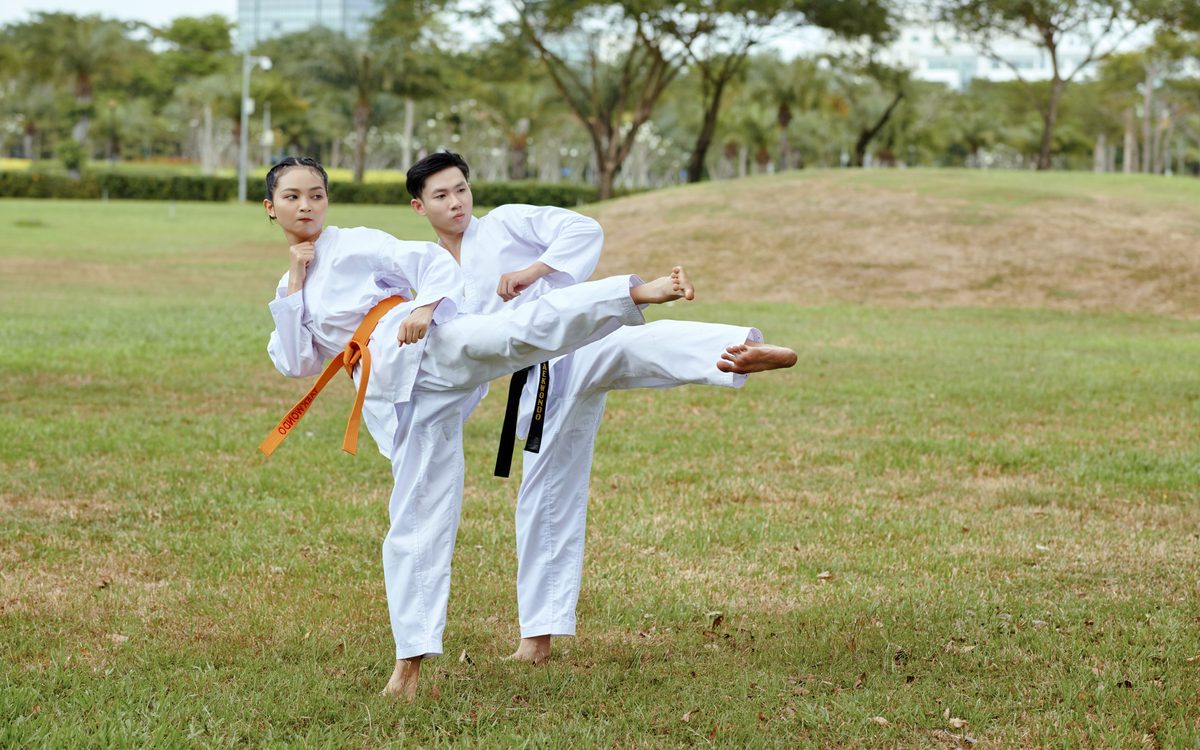
A seven-year-old in a crisp white dobok bows at the edge of the training floor, steps on, and is handed a pad to kick. Across the room an older student is working through a set of forms with her own count, and a teenager is learning how to lace up the chest protector he will wear at his first local tournament. That is a normal evening at a taekwondo school. Taekwondo (also written tae kwon do, or TKD) is a Korean martial art built around kicking, trained as forms (poomsae), sparring (kyorugi) and breaking or demonstration, and it is one of the sports at the Olympic Games. This page is the practical starting guide: how the sport works, how sparring and forms are scored, how a beginner gets started and where the official rulebooks are. For the big picture, see the taekwondo hub.
Quick answer: Taekwondo has two competition tracks. In sparring, two athletes fight three two-minute rounds under World Taekwondo rules and score points for valid kicks and punches to the trunk protector and kicks to the head. In forms, one athlete performs a set pattern that judges mark for accuracy and presentation. A beginner does not need either to start: most people begin in a local school class, learn basic stances, kicks and a first form, and test for belts. Look for a qualified instructor and ask how the school handles contact and concussion. General information, not medical advice.
How taekwondo works
Taekwondo class is usually built in four parts: a warm-up, basic technique (stances, blocks, strikes and kicks, often on pads), a form or pattern practice, and some partner work. Contact sparring comes later and is introduced in steps. The American Academy of Pediatrics (AAP) clinical report on martial arts advises children to learn from qualified instructors and to delay contact and competition until they have the maturity and skill from non-contact practice, and it says teaching blocking matters.
Most schools use a belt system, in which students test for the next rank. Colours and test schedules differ between schools and organizations, so ask yours how it works. Kukkiwon, the Korean certifying body, issues the official dan (black belt) and poom certificates; its system runs from 1st to 9th dan and 1st to 4th poom, and it says only holders of Kukkiwon or World Taekwondo recognized dan and poom ranks may compete in World Taekwondo events.
Sparring (kyorugi): scoring at a glance
The rulebook for Olympic-style sparring is the World Taekwondo (WT) Competition Rules and Interpretation, which was in force from 1 June 2026. As we read it, a senior match is three rounds of two minutes with one minute of rest. A valid punch to the trunk protector scores one point, a valid kick to the trunk two points, and a kick to the head three points, and turning (spinning) kicks earn extra: four points to the trunk and six to the head. Penalties called gam-jeom are counted in the total. If the match is tied after three rounds, a one-minute golden round decides it. Contact is registered by electronic scoring protectors and sensing socks, so a hit has to land with enough force to count.
Age groups under WT rules are cadet (12 to 14), junior (15 to 17) and senior (17 and older), and cadet athletes can use a head protector with a face shield. Competitors are weighed in the day before their competition, and some events also run a random weigh-in on the morning of competition; the allowed tolerance and schedule are set in each event’s outline, so check the one you enter. For the Olympic Games, LA28 lists eight events: four for men (under 58, 68, 80 and over 80 kilograms) and four for women (under 49, 57, 67 and over 67), fought best of three rounds on an octagonal mat. Taekwondo has been an Olympic medal sport since Sydney 2000 according to Olympics.com. Check the official programme for the current Games.
USA Taekwondo (USATKD), the national governing body, publishes its own kyorugi rules for U.S. events. Its 2026 rules use shorter rounds for younger and newer competitors (for example, one-minute rounds for color belts and youth) and modified safety rules for some age and belt groups. Always read the rules of the event you enter, not only the Olympic ones.
Forms (poomsae): scoring at a glance
Forms are choreographed patterns of blocks, strikes, kicks and stances against imaginary opponents. In WT recognized poomsae, a performance is scored out of 10.0 points: 4.0 for accuracy and 6.0 for presentation, according to the WT poomsae competition rules and event documents we read. Small errors cost 0.1 and big errors 0.3 each, and performing the wrong poomsae means a restart with a deduction; the 0.1, 0.3 and restart figures come from an event deduction sheet, so check the current rulebook. Presentation is checked first if scores tie. USATKD offers poomsae courses and referee training as well as sparring.
How a beginner starts
- Find a school. USA Taekwondo members’ clubs are listed on its club locator, and the USATKD site has a getting-started page.
- Watch a class first. Look at how the instructor warms up the group, whether technique is corrected, whether beginners are separated from advanced sparring and whether students wear proper protective gear.
- Ask about the instructor. Many programs list a Kukkiwon dan rank, a USATKD coach membership or both. USATKD coaches must complete a course for the discipline they teach, kyorugi, poomsae or both.
- Ask about safety. What is the school’s concussion policy, when does sparring start, how much contact is allowed at each belt and what gear is required? The AAP report supports asking these questions.
- Start with a trial class. Wear loose clothing, bring water and mention any injury. A uniform can wait. See our taekwondo gear guide for what is needed and when.
Levels: from white belt to the Games
Most people train for fitness, forms and belts at a community school. Tournaments run in tiers: school and club events, state and national championships, and the WT’s international calendar. USATKD says it has events for athletes of every level, including growing color belts, and its athlete membership is aimed at those who want to compete locally, regionally or nationally. Para taekwondo has been part of the Paralympic programme since Tokyo 2020, and the para taekwondo page covers classes and access.
Official rulebooks and where to read more
The official texts are the WT sparring rules (PDF), the WT poomsae rules (PDF) and the USATKD kyorugi rules (PDF).
Taekwondo’s neighbours in the martial arts family are karate, judo and Brazilian jiu-jitsu, and the wider group is on our martial arts hub. Next in this series: training and performance and injury prevention.
Taekwondo rules and getting-started FAQs
How old do you have to be to start taekwondo?
Many schools take children from around age four to six in basic classes, and adults can start at any age. Age is set by the school, not by one rule. WT competition age groups start at cadet (12 to 14), and younger children compete under national or club rules.
How is a taekwondo sparring match won?
By having more points after three rounds, by a golden round if tied, or by the opponent’s disqualification or a referee stoppage, under WT rules. Points are one for a trunk punch, two for a trunk kick and three for a head kick, with higher values for turning kicks.
What is the difference between kyorugi and poomsae?
Kyorugi is sparring with a partner and scored by points from electronic protectors. Poomsae is a solo pattern judged on accuracy and presentation. Many students train both.
Do I need to spar to do taekwondo?
No. Many students practice forms, fitness and self-discipline and never compete. If you do want to spar, a good school introduces contact in stages and uses protective gear.
Is taekwondo in the Olympics and Paralympics?
Taekwondo has been an Olympic medal sport since Sydney 2000 and para taekwondo has been on the Paralympic programme since Tokyo 2020, with both on the LA28 plans. Check the official programme for the current Games.
How do I find a taekwondo school near me?
Try the USA Taekwondo club locator, ask local sports clubs, and visit two or three schools before choosing. Watch a class and ask about instructor credentials, safety rules and concussion policy.
Sources
- World Taekwondo, Competition Rules and Interpretation (in force 1 June 2026)
- World Taekwondo, Poomsae Competition Rules and Interpretation (30 September 2024)
- USA Taekwondo, Kyorugi Rules 2026
- USA Taekwondo, athlete membership
- USA Taekwondo, home and club locator
- Kukkiwon, promotion test (dan and poom)
- LA28, Taekwondo
- Olympics.com, Taekwondo
- Paralympic.org, Taekwondo
- AAP clinical report, Youth Participation and Injury Risk in Martial Arts (Demorest and Koutures, 2016)
General information for education only, not medical advice. It does not replace a sports medicine doctor, physical therapist, athletic trainer, registered dietitian or qualified coach. See our editorial policy for how we research and write.