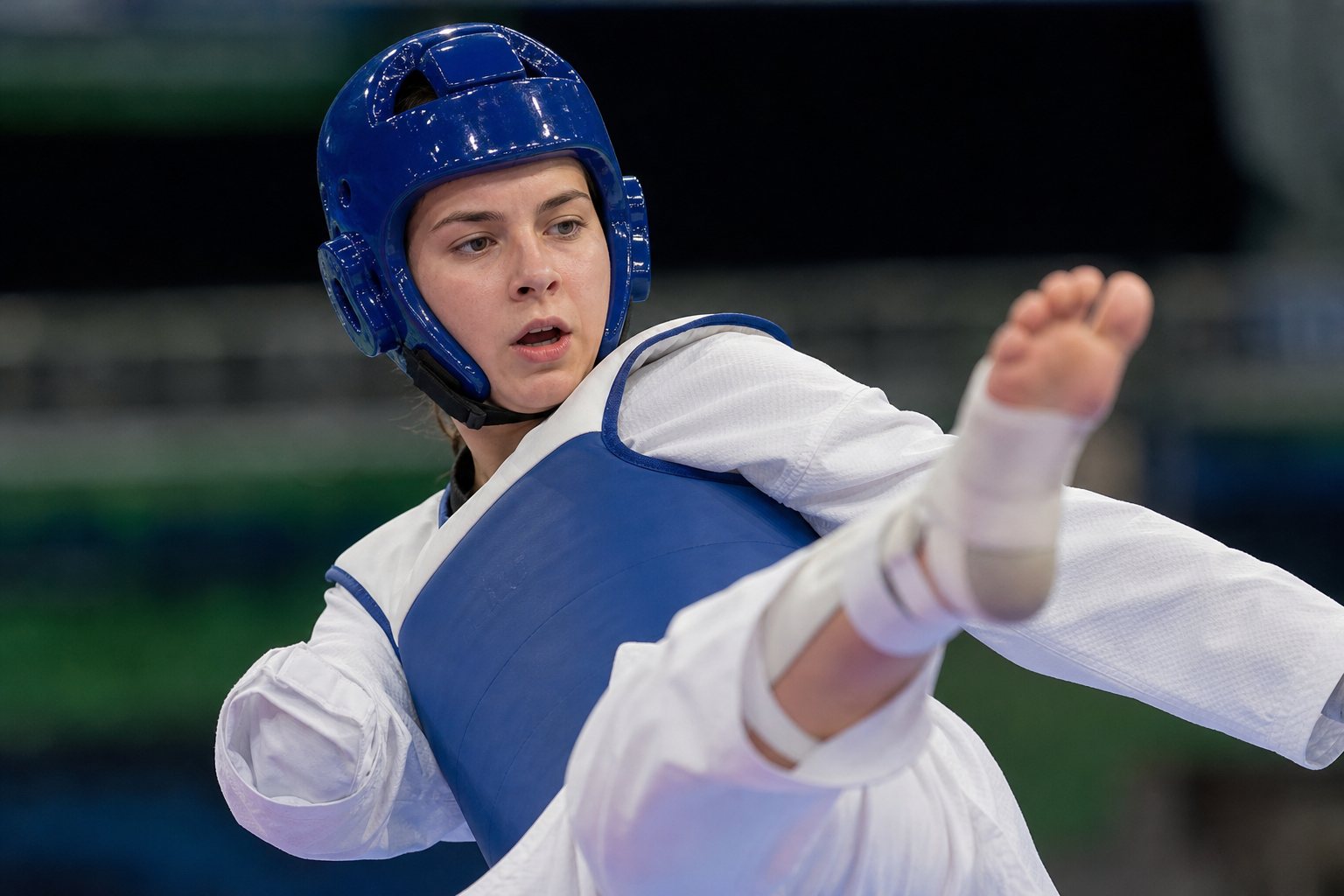
Late in the third round the score is tied, the legs feel heavy, and the coach is shouting one word: “Distance.” The fighter who still has a sharp turning kick, and the balance to land it, is the one who trained for this moment months ago. Para taekwondo training is the planned mix of kicking skill, leg strength, balance, conditioning and rest that prepares an athlete for repeated explosive efforts in a full-contact match.
Quick answer: Para taekwondo is a leg-driven sport, so most training builds kicking technique, single-leg balance, leg power and the stamina to repeat short bursts across three two-minute rounds. We found no peer-reviewed study of the physiological demands of Para taekwondo, so the weekly outline below is general coaching practice, not a tested plan. Work with a coach, and a clinician who knows your impairment, before adding sparring or heavy lifting.
General information, not medical advice. For how the sport is scored and classified, see our rules and getting started page; for the full overview, the Para taekwondo hub.
What the sport demands
The default contest in the WT Para rules is three rounds of two minutes with one-minute rests, plus a one-minute Golden Round if tied, although a Technical Delegate can shorten or lengthen it. That pattern is short, intense efforts with brief recovery. A Tokyo 2020 match analysis (Park and colleagues, 2024) of 78 Paralympic matches found winners landed a higher share of their kicks than non-winners: about 38 percent versus 19 percent for men. Taken at face value, the study suggests that accurate, well-timed kicks matter more than throwing many.
Two other studies speak to the body. In a 2025 cross-sectional study of 9 Para taekwondo athletes with an upper-limb deficiency at or below the elbow, 9 non-disabled taekwondo athletes and 11 sedentary adults, the Para athletes had worse static balance in some tests but better functional balance than the sedentary group (Akinoglu and Kocahan). A 2022 study of 87 athletes in classes K42 to K44 measured simulated blocking reaction times of 0.79 to 0.97 seconds (O’Sullivan and colleagues). Both are small, descriptive studies, so treat them as context, not targets.
A sensible week (general coaching practice)
The outline below is common practice in kicking sports. It is not from a Para taekwondo study. Adjust it with your coach, and with a clinician if you have pain, a prosthesis or a limb that tires quickly.
- Two or three technique sessions: kicking drills on pads, footwork, balance work on one leg, and timing drills with a partner. Quality before speed.
- Two strength sessions: lower-body strength and power (squat and hinge patterns, jumps and landings), plus trunk and shoulder work suited to your impairment.
- One or two conditioning sessions: intervals that copy the match, such as short hard efforts with short rests.
- Limited sparring: hard sparring is where most injuries happen (see our injuries page), so many coaches cap it and keep rounds controlled.
- One or two easy or rest days: see our recovery page.
Skills and technique
Because only foot techniques score and turning kicks are worth four points (against two for a straight kick) in the WT rules, much of the skill work centers on the turning kick and the back kick. A back kick only counts as a turning technique if the head and shoulders rotate. Coaches also drill defense, since the rules penalize stalling and falling, so a fighter must keep moving without giving away points.
Strength, balance and warm-up work
A 2026 randomized trial of 24 elite K44 athletes on the Iranian national Para taekwondo team (Rouhi and Barati) tested an 8-week neuromuscular warm-up called MASS-12, done three times a week for 20 minutes. Compared with a routine warm-up, the group doing it improved dynamic balance, reaction time and knee position sense. It is a small trial from one national team, so it is encouraging, not conclusive. We describe it further on our injury prevention page.
Strength for the legs and trunk is standard in combat sports. Evidence tailored to Para taekwondo athletes is thin, so the sensible approach is gradual loading with a qualified coach, and attention to shoulders and the residual limb if you have an upper-limb amputation, because these may take extra load when you balance and block.
Periodization basics (general)
Periodization means arranging training in blocks that match the calendar. A typical year has a general block (build strength and base fitness), a specific block (more kicking speed and match-like intervals), a short competition block, and then a lighter transition period. Under WT rules, athletes must be classified before international events and weigh in the day before, so plan classification paperwork and any weight work well ahead of the event. Keep changes gradual: a sudden jump in sparring or lifting is a common reason athletes get hurt.
When to get professional help
See a sports medicine doctor, physical therapist or athletic trainer if pain lingers, if the residual limb or socket is sore or skin is breaking down, or if you are unsure how much load is right. A coach can plan the training; a clinician decides what your body can safely do. We cannot tell you what is safe for your own impairment.
Frequently asked questions
How often should a Para taekwondo athlete train?
No source gives a single right answer. Many coaches use three to five training days with one or two rest days, but your coach and clinician should tailor the number to your age, impairment and calendar.
Do I need to lift weights for Para taekwondo?
Strength work for the legs and trunk is common in kicking sports, and it supports balance and power. Evidence specific to Para taekwondo is limited, so start light and progress with a qualified coach.
What does a Para taekwondo match feel like physically?
The default is three two-minute rounds with one-minute rests, so it is bursts of kicking, quick footwork and brief recovery. We found no published measurements of heart rate or oxygen use in Para taekwondo.
Does balance matter more for athletes with arm impairments?
Taekwondo is a kicking sport, so single-leg balance matters for everyone. A 2025 study found Para athletes with arm deficiency had worse static balance in some tests than non-disabled taekwondo athletes, which is one reason balance drills are common.
Sources
- World Taekwondo, Para Taekwondo Competition Rules in force as of 23 October 2025 (copy hosted by the Dutch federation)
- Park et al., tactical and technical factors in Para taekwondo at Tokyo 2020, J Sports Sci 2024
- Akinoglu and Kocahan, balance ability in Para taekwondo athletes, J Manipulative Physiol Ther 2025 (Europe PMC)
- O’Sullivan et al., functional reaction times of a simulated blocking test among Para taekwondo athletes, Healthcare 2022 (Europe PMC)
- Rouhi and Barati, 8-week neuromuscular warm-up in the Iranian national Para taekwondo team, Adapt Phys Activ Q 2026 (Europe PMC)
General information for education only, not medical advice. It does not replace a visit with a doctor, physical therapist or athletic trainer. See how we write and check our pages in our editorial policy.