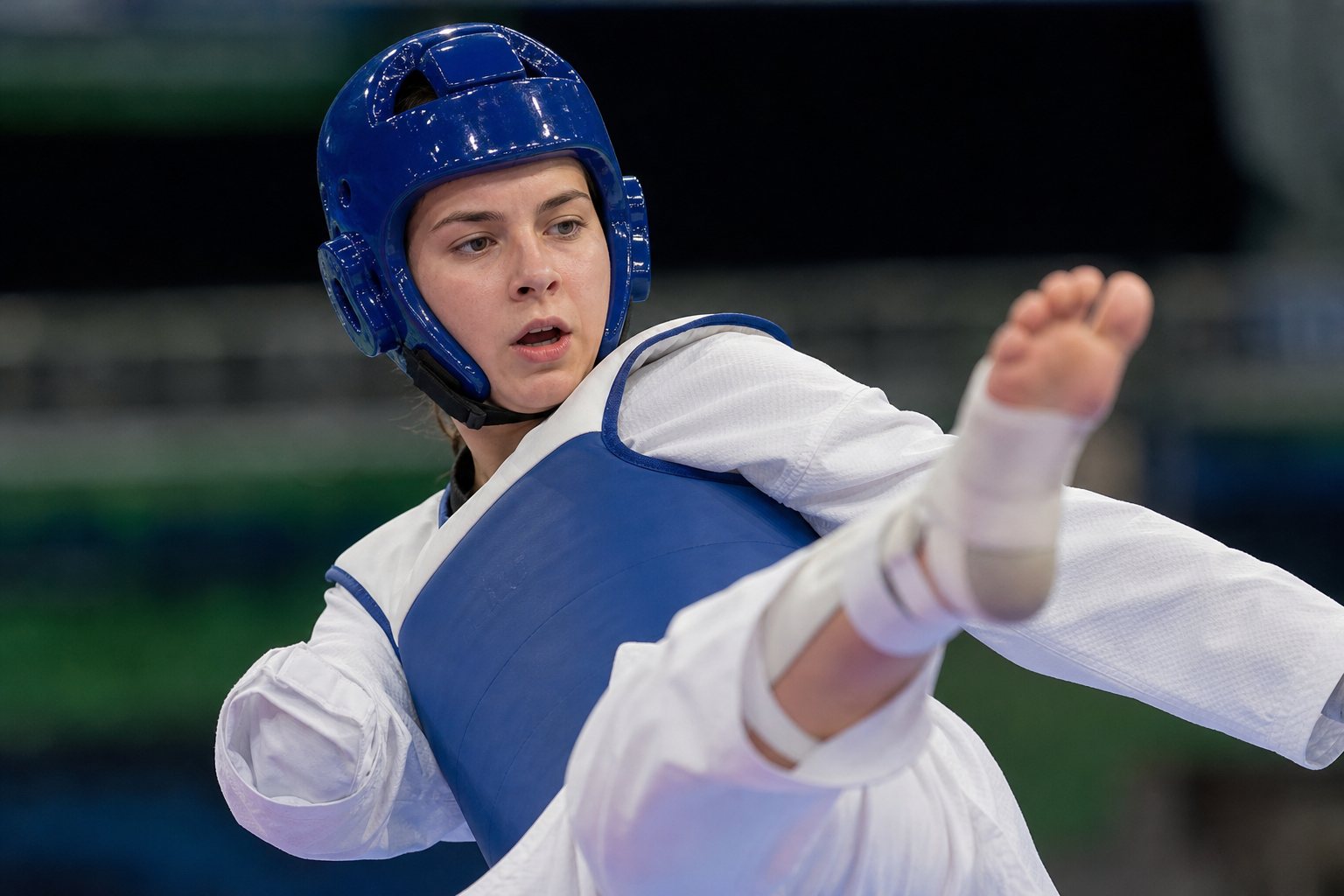
The referee calls a break. A fighter is down on the mat holding the front of an ankle after a clash of legs, and the doctor jogs in. Within a minute the question is the same one every athlete faces: is this a knock to shake off, or an injury to stop for? Para taekwondo injuries are physical problems that happen in training or competition, from bruises to sprains to concussions. This page explains the patterns reported in research and the general principles of rehabilitation. It cannot diagnose anything.
Quick answer: Reported injuries in taekwondo are mostly bruises (contusions), sprains and ligament injuries, often to the legs and feet, and most come from contact with an opponent. In Para taekwondo the injury rate is among the highest in the Paralympics: 27.3 per 1,000 athlete days at Paris 2024. See a sports medicine doctor, physical therapist or athletic trainer for any injury that does not settle quickly, and treat every blow to the head as serious.
General information, not medical advice. It does not replace an exam, and it cannot clear anyone to return to sparring. To lower your risk in the first place, read our injury prevention page.
What the surveillance numbers say
- Paris 2024 Paralympics: in a study of 4,450 athletes over 14 days (Derman and colleagues, British Journal of Sports Medicine, 2026), taekwondo had an injury incidence of 27.3 per 1,000 athlete days (95 percent confidence interval 20.7 to 35.8) and the highest burden, 64.3 days lost per 1,000 athlete days. All sports together had 8.6 injuries per 1,000 athlete days.
- Tokyo 2020 Paralympics: taekwondo had 16.0 injuries per 1,000 athlete days, second only to 5-a-side football, according to the earlier Games study (Derman and colleagues, 2022).
- Türkiye Open 2025: a retrospective study of 2,068 athletes recorded 18 injuries in Para kyorugi (K44), a rate of 105.88 per 1,000 athlete-exposures against 42.57 for senior Olympic-style fighters, and contusions were the most common injury type, with contact from another athlete the most frequent mechanism (Günaydın and colleagues, Physician and Sportsmedicine, 2026).
- One year in Brazil: in a prospective study of 102 Para athletes in four sports, taekwondo had the highest prevalence of injury, 44.9 percent, and the shoulder, ankle and knee carried the largest burdens (Madaleno and colleagues, Brazilian Journal of Physical Therapy, 2025).
A caution: those studies count injuries differently (per athlete day, per exposure, per athlete), so the numbers cannot be compared directly. Nor do they tell you your own risk.
Common patterns
A systematic review of eight studies of elite, mostly Olympic-style taekwondo (García Blanco and colleagues, Cureus, 2025) found that lower-limb injuries, especially the foot and the knee, were the most common, that contusions were the most frequent type followed by sprains and ligament tears, that direct contact was the leading cause, and that overuse injuries were more common in training. Most were low severity with one to seven days of time loss, and rates were generally higher in competition. Para fighters kick with the same legs, so these patterns are a reasonable guide, but we did not find a published body-site breakdown for Para taekwondo alone. Athletes with an upper-limb impairment may also load the shoulder and the residual limb differently, which is a question for a clinician.
Concussion and head knocks
Head techniques are prohibited in Para kyorugi, but fighters can still collide, be struck by accident or fall onto the mat. The CDC HEADS UP symptom list covers physical signs (headache, dizziness, balance problems, nausea, sensitivity to light or noise), thinking problems (fogginess, trouble concentrating), emotional changes (irritability, sadness) and sleep changes. Call 911 or go to the emergency department for a seizure, repeated vomiting, a worsening headache, slurred speech, weakness or numbness, unusual behavior or confusion, loss of consciousness, or one pupil larger than the other.
The WT Para rules show how seriously the sport treats this. At WT events a doctor must perform the SCAT5 test within 30 minutes of a head injury, an athlete diagnosed with a concussion receives a 45-day suspension, and an athlete who could not continue because of a serious injury cannot compete again within 30 days without approval from the WT Medical Committee. Those are rules for WT competitions, not advice for your own return. Only a clinician can decide that.
General rehabilitation principles
This section is general sports medicine practice. It is not from a Para taekwondo source, and it is not a treatment plan.
- Get it checked. A professional can tell a bruise from a sprain or a fracture, which look alike at first.
- Relative rest, not complete rest. Most rehab keeps the rest of the body moving while the injured area heals.
- Rebuild gradually. Motion, then strength, then balance and then kicking, one step at a time, guided by a physical therapist or athletic trainer.
- Pain is information. Pain that increases during or after an activity means the step was too big.
- Rehab is individual. Healing time depends on the injury and the person, and we give no recovery times.
A 2024 expert statement on Para athlete health checks (Pinheiro and colleagues) points out that Para athletes tend to under-report health problems. Tell your coach and clinician early, even if it feels minor. Residual limb skin problems, pressure sores or problems with a prosthesis need attention from a clinician or prosthetist.
When to see a professional
See a sports medicine doctor, physical therapist or athletic trainer for swelling that does not settle, a joint that gives way or locks, pain at rest or at night, numbness, any head injury, or any injury that stops you from training normally. Return to sparring should be decided with a clinician, not by a calendar or by this page. For rest, sleep and soreness, see recovery.
Frequently asked questions
What is the most common injury in taekwondo?
In a 2025 systematic review of elite taekwondo studies, contusions (bruises) were the most common type, followed by sprains and ligament tears, and the foot and knee were the most common sites.
How many injuries happen in Para taekwondo?
At Paris 2024 taekwondo had 27.3 injuries per 1,000 athlete days, the highest of any Paralympic sport and above the 8.6 average for all sports. Different studies count injuries differently, so compare rates with care.
How long does a Para taekwondo injury take to heal?
There is no single answer, because it depends on the injury and the person. A clinician can give a range after an exam. The review above found most elite taekwondo injuries cost one to seven days, but that is an average, not a promise.
Can I return to sparring after a concussion?
Only a healthcare provider can decide. WT events have their own suspension rules, but they are competition rules, not medical advice for you.
Do athletes with an amputation get different injuries?
We did not find a study that compares injuries by impairment type in Para taekwondo. Ask your sports medicine doctor or physical therapist about the shoulder and residual limb.
Sources
- Derman et al., injury and illness at the Paris 2024 Paralympic Games, Br J Sports Med 2026 (Europe PMC)
- Derman et al., injury incidence and burden at the Tokyo 2020 Paralympic Games, Br J Sports Med 2022 (PubMed)
- Gunaydin et al., injury epidemiology in the Turkiye Open 2025 taekwondo tournament, Phys Sportsmed 2026 (Europe PMC)
- Madaleno et al., burden of injuries and illnesses in Para athletes: one-year study, Braz J Phys Ther 2025 (PubMed)
- Garcia Blanco et al., epidemiology of injuries in high-performance taekwondo: systematic review, Cureus 2025 (Europe PMC)
- Pinheiro et al., periodic health evaluation in Para athletes: position statement, BMJ Open Sport Exerc Med 2024 (Europe PMC)
- CDC HEADS UP: signs and symptoms
- World Taekwondo, Para Taekwondo Competition Rules in force as of 23 October 2025, Art 19-20
General information for education only, not medical advice. It does not replace a visit with a doctor, physical therapist or athletic trainer. See how we write and check our pages in our editorial policy.