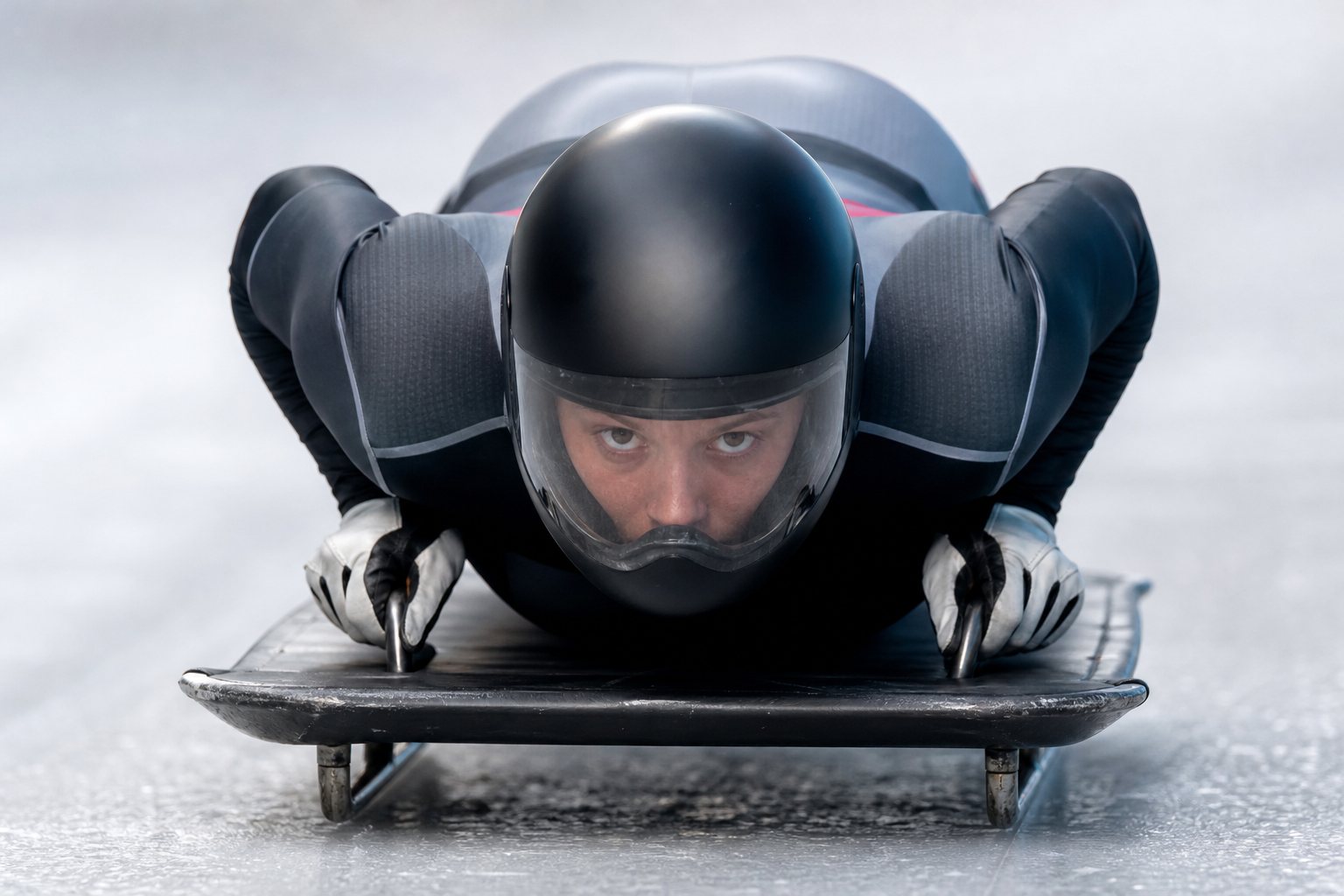
Sunday at the Cortina Sliding Centre, last run of the first Olympic mixed team skeleton. Britain’s Tabitha Stoecker sets a track record on the final run and Britain wins gold ahead of Germany. Reports of the event do not tell us what was in her head, and we will not guess. What anyone can say is that a skeleton athlete has to switch off the noise and run a routine at full speed with no steering wheel and no second chances. Mental training in skeleton is the practice of building focus, confidence and routines so that the skill an athlete has trained shows up when it counts. This page covers the evidence we found, labels general sport-psychology practice as such, and keeps mental performance separate from mental health.
Quick answer: There is no published mental-training trial in skeleton. A 2025 clinical commentary on sliding athletes names imagery and visualisation among strategies, a 2018 review suggests pre-run visualisation may help athletes react and reduce errors, and a 2026 meta-analysis found pre-performance routines, self-talk and quiet-eye training help performance under pressure, especially in closed-skill sports. None of this guarantees results. Anxiety, depression, disordered eating or burnout are health matters for a qualified professional.
General information, not medical advice. For logistics before racing see our rules and skills page; hub: skeleton.
What the sport asks of the mind
Skeleton is a closed skill: the athlete knows the track, the sled and the sequence, and the clock decides. A 2009 analysis of World Cup races found run-to-run results are hard to predict, with race-to-race correlations of only about 0.36 for the top ten, and that tracks vary in difficulty. Skeleton athletes also show less variability in performance time than athletes in other sports, the authors say, which means very small errors carry weight. The 2018 Frontiers in Neurology review adds that the ability to react in the moment is believed to be crucial for success in skeleton, and that pre-race performance is not always predictive of how a competition goes.
Visualisation and imagery
Mental imagery means rehearsing a run in your mind. A 2025 clinical commentary on sliding athletes lists mental imagery and visualisation as strategies to optimise performance. The 2018 review suggests pre-run simulation, plus calming and concentration strategies and pre-run visualisation, might help athletes minimise errors, while noting these are ideas for research, not proven interventions. A 2025 narrative overview of motor imagery says imagery has been shown to help skill development and engagement in a range of contexts and recommends that practitioners consider the athlete’s skill level and ability to form vivid images, and which perspective is used. In plain words: a coach can help you build a run-through that fits your own style. Imagery is most useful when it is specific: the track, the corners, the feel of the sled (general sport-psychology practice).
Pre-run routines and focus
A 2026 meta-analysis pooled 21 studies of interventions to counter choking under pressure, such as quiet-eye training, pre-performance routines, mindfulness, left-hand contraction and self-talk. It found improved motor accuracy and execution under pressure, with larger and more consistent effects in closed-skill sports. It also stresses that more research in realistic competition is needed. Skeleton was not tested directly, so the finding is a reason to try a routine with a sport psychologist, not a promise.
A routine is a fixed sequence you do before the push, for example a breath, a cue word, a look down the track, then go. The exact content is personal; examples are practical coaching ideas, not findings. Keep it short enough that you can repeat it in the cold with a helmet on, and the same every time in training so it becomes automatic.
Confidence, goals and motivation
- Confidence comes mostly from preparation you can point to: tested starts, clean runs, a plan for each corner. Keep a log.
- Goals: process goals (a repeatable start rhythm, a calm first corner) are in your control; the final time is not, because tracks and ice change (2009 World Cup analysis).
- Motivation across a long season of travel, cold and repeated sprints benefits from small checkpoints and a coach who listens (general practice).
Handling pressure and setbacks
Skeleton has four runs, so a poor first run leaves three more. Treat each run as a new start, because the clock only counts the times. After a mistake, many sport psychologists suggest a short reset: one breath, one cue, then the next task. After a crash or scary run, speak to coaches and medical staff before returning. Fear after a crash is normal, and a head symptom is a medical issue. The CDC says anyone with a possible concussion should stop for the day and see a healthcare provider.
A small 2022 study of eight Chinese Olympic bobsleigh athletes found that a heart-rate-variability biofeedback session before sleep improved some mood and sleep measures for one night. It is a hint that calming skills can be trained, not proof that it helps results. Ask a qualified sport psychologist about it.
Teamwork in the mixed event
In the mixed team, a man and a woman from one country each take a run and the times add together (NBC Olympics). It adds a different kind of pressure: your run affects a teammate’s result. Teams can talk through how they handle support and expectations before competition, but we found no research on this event, so treat it as a conversation for your coach.
Preparing for competition
Competition preparation is logistics plus routine: knowing your slot, your start order and the track. In the Olympic format start order follows rankings and reverses in later heats, so the leader goes last (NBC Olympics). Plan how you will warm up and stay warm in the cold. For what athletes should eat and drink around events see nutrition and athlete health.
Mental health is different from mental performance
Mental training builds skills. Mental health is about how you are doing. The IOC’s 2026 consensus statement says mental health symptoms and disorders are common among elite athletes, can have sport-related causes and can affect performance, and that with appropriate support many athletes can keep competing. If you have persistent anxiety, low mood, sleep loss, disordered eating, burnout or thoughts of self-harm, talk to a licensed mental health professional or a doctor. In the US you can call or text the 988 Suicide and Crisis Lifeline at any time. The Association for Applied Sport Psychology (AASP) has a directory of Certified Mental Performance Consultants, who work on performance skills; they are not a replacement for a clinician.
Skeleton mental training FAQs
Does visualisation help in skeleton?
Imagery is listed as a strategy in a 2025 commentary on sliding athletes and a 2018 review suggests pre-run visualisation may reduce errors, but no skeleton trial proves it. Try it with a coach.
How do I stay calm at the top of the track?
A short, repeatable routine such as breath, cue and look is a common approach, and a 2026 meta-analysis found routines and self-talk help under pressure, mostly in closed-skill sports. It is not a guarantee.
What if I am scared after a crash?
Fear is common. Tell your coaches and medical staff, get checked for any head or neck symptoms and return only through your program. A sport psychologist can help with confidence.
Is this the same as therapy?
No. Mental performance coaching builds skills. Anxiety, depression, eating problems and burnout need a licensed professional.
Where can I find help in the US?
The AASP lists Certified Mental Performance Consultants, and the 988 Suicide and Crisis Lifeline offers free 24-hour support.
Sources
- Interdisciplinary management of the sliding athlete, Int J Sports Phys Ther 2025
- McCradden and Cusimano 2018, Front Neurol (PMC)
- Characteristics of performance in skeleton World Cup races, J Sports Sci 2009
- Motor imagery training for load management, 2025
- Counteracting choking under pressure: meta-analysis, 2026
- HRV biofeedback in Chinese bobsleigh athletes, IJSPP 2022
- IOC consensus statement on mental health in elite athletes, 2026
- NBC Olympics: skeleton 101
- Team GB: Weston and Stoecker win mixed team skeleton gold
- CDC HEADS UP: responding to a concussion
- AASP resources
- 988 Suicide and Crisis Lifeline
General information for education only, not medical advice. It does not replace a sports medicine doctor, physical therapist, athletic trainer, licensed mental health professional or qualified coach. See our editorial policy for how we research and write.