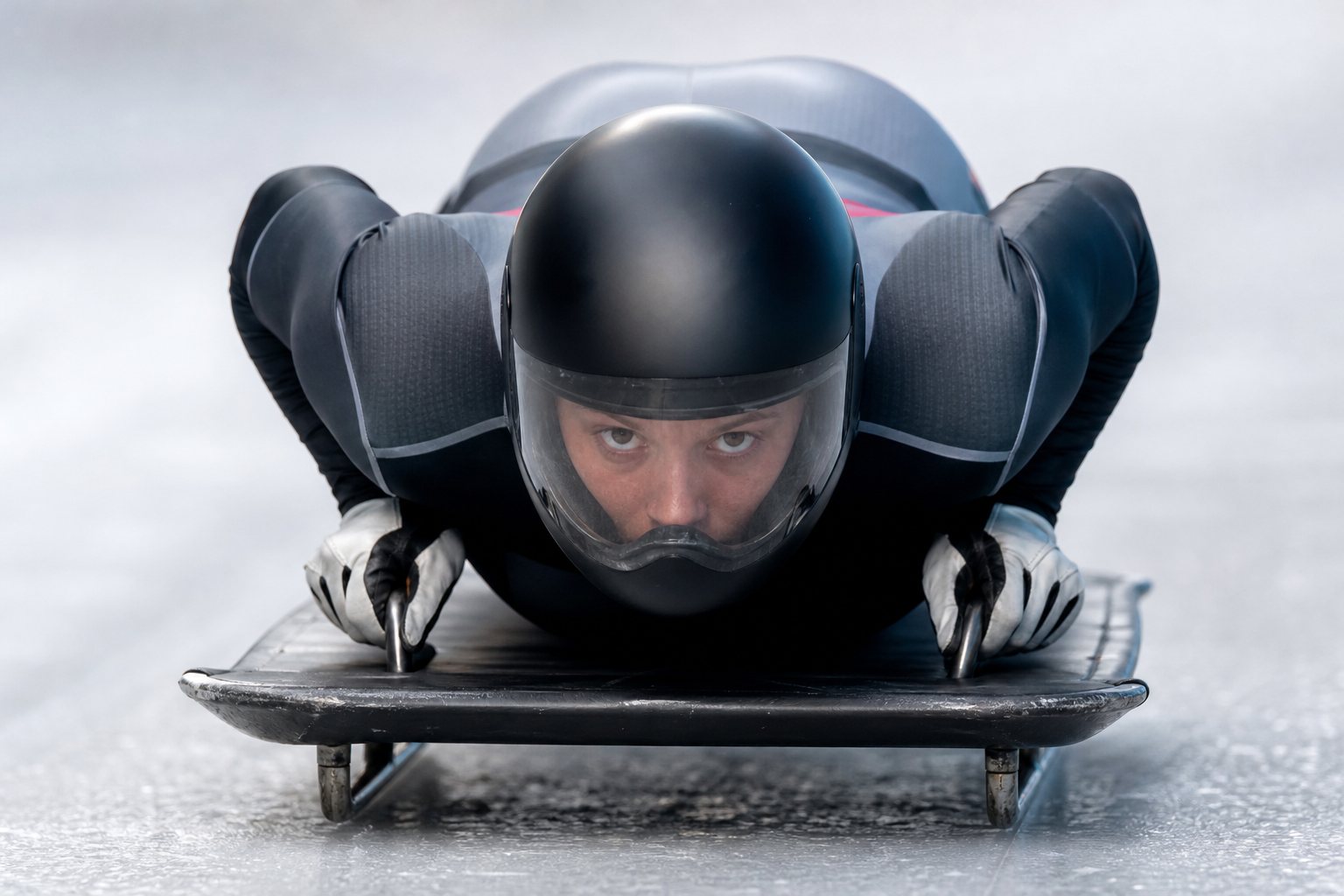
A skeleton athlete stands at the top of the track holding a sled that is barely bigger than a tray. Two or three seconds from now they will sprint, dive on face down and head first, and let gravity take over. That is the whole idea of skeleton, and also the reason beginners ask the same questions: how is it scored, how do you steer with no steering wheel, and how does anyone get a first run? This page explains the rules and the basic skills in plain words, then shows how a newcomer actually starts.
Quick answer: Skeleton is won by the lowest combined time over four runs, measured to the hundredth of a second. The athlete rides head first with no brake and no steering device, so the push start and tiny body movements decide the result. In the US, newcomers usually enter through a USA Bobsled and Skeleton recruitment combine. Check the current IBSF rulebook for exact equipment numbers.
General information, not medical advice. This page covers rules and starting out. For the sport overview see the skeleton hub; for training see skeleton training.
How a skeleton competition works
NBC Olympics describes the Olympic format as four heats, usually over two days, two runs each day. Times are recorded to 0.01 seconds and the lowest combined time wins; second and third lowest take silver and bronze. In the first heat, start order follows world rankings, with higher-ranked athletes usually starting later. The order then reverses, so the athlete with the fastest cumulative time starts last. Ties share a place, and the higher bib number goes first in later heats.
There are two individual events, men’s and women’s, plus a mixed team event. NBC notes that the mixed team was introduced for the 2024-25 season and is new for the 2026 Olympics. Each team has one man and one woman from the same country, each completes a run, and the combined times decide the winner. We did not find the exact run order or number of runs in the sources we could read, so check the current IBSF rules. The 2026 Olympic skeleton programme had three events: men’s, women’s and mixed team.
The sled, the suit and the rules around them
A skeleton sled is a steel frame on runners with a base plate. It has no brake and no steering device. NBC’s explainer lists maximum combined athlete-and-sled weights of roughly 115 kg for men and 102 kg for women, and says sleds are weighed in and then held in a controlled area where changes are generally not allowed unless approved. Helmets and specialised suits are mandatory. Other summaries give different details for the women’s limit and for the sled’s own weight, so treat these numbers as a guide and read the IBSF rulebook before you buy or build anything.
Why do weight limits matter to a beginner? They shape how athletes think about body mass and strength. We cover that on the nutrition page.
The basic skills
1. The push start
A 2025 biomechanics study of skeleton athletes measured an average starting distance of about 18.45 metres, covered in about 12 steps, with a starting speed of about 6.97 m/s for men and 6.25 m/s for women. The athlete pushes the sled, runs beside it, then loads it and dives on. A 2026 review of Olympic ice sports says performance in bobsleigh, skeleton and luge is overwhelmingly determined by start velocity, with the first 15 to 65 metres contributing disproportionately to the result. So the start is the first skill any coach will teach.
Within the start, research from a British team found that when the athlete loads the sled matters. In a 2018 study of ten athletes, loading later after a longer run gave a higher speed before loading but loading was less effective, and elite athletes’ own preferred loading distance usually beat shorter or longer ones. The lesson for beginners: find a repeatable rhythm with a coach, not a copied technique.
2. Loading and lying down
Loading is the moment the athlete dives onto the sled without losing speed. It is practised first on dry-land push tracks and wheeled sleds, long before ice, according to the research above, which tested athletes on dry-land push tracks.
3. Steering by feel
Once on the sled, athletes steer through small shifts of the shoulders, knees and head. The 2018 Frontiers in Neurology review describes skeleton steering as shifting the head and body, and lists skeleton as the sport where the rider lies face down and head first. A coach on the track learns your lines with you, run by run.
4. Reading the track
A study of World Cup races found that run times vary between tracks from about 50 to about 70 seconds, and that the track-to-track differences in how variable results were matched athletes’ views of which tracks are technically harder. Push time had only a small and inconsistent link with total time across tracks. In plain words, the start matters, but the driving over a whole run matters too, and every track has its own character.
How a beginner gets started
Skeleton is a talent-transfer sport in the US, and we found no school or college championship for it. USA Bobsled and Skeleton (USABS) runs a recruitment programme. Its recruitment page lists a 2026 virtual combine and an interest form for future combines and talent events, and says skeleton athletes are judged on both push performance and driving consistency, with push track times, start speed and on-ice results as key benchmarks. The page does not state age limits or rookie camp details; for those, see the USABS recruitment flyer or contact them. Outside the US, start with your national bobsleigh and skeleton federation, which you can find through the International Bobsleigh and Skeleton Federation (IBSF).
- Step 1: register interest with your national federation or a USABS recruitment event.
- Step 2: complete the tests asked for (the exact tests change from year to year; read the current page).
- Step 3: if invited, learn the push and the sled on a supervised programme, usually starting with dry-land work.
- Step 4: slide only with federation coaches, on tracks and in programmes they approve.
Sprinters, jumpers and other speed athletes often try the sport because the start is a sprint. Our track and field hub covers those events. Never try sliding on a public hill, a homemade sled or a track that is not run by a federation or licensed programme; speeds and crashes are far beyond ordinary sledding.
Levels and where the sport is run
IBSF organises the World Cup and World Championships. The sport shares ice with bobsleigh and luge. The Olympic status by edition: skeleton was on the programme at Milano Cortina 2026 with three events (NBC Olympics). For the 2030 Games, check the official Olympic programme; we could not confirm the skeleton events there. We also found no skeleton event on the Paralympic programme; check paralympic.org for the current Games.
Official rulebooks
The IBSF publishes the skeleton rules, including equipment and weight specifications, on its website. Start at ibsf.org and look for the current rules and the skeleton equipment documents. We could not open the rulebook PDF directly when writing this page, so all weights above come from NBC Olympics and should be verified.
Skeleton rules FAQs
How is skeleton scored?
The lowest combined time over four runs wins, timed to the hundredth of a second. There are no judges and no points; the clock decides.
Can you steer a skeleton sled?
Only with body movement. There is no steering device or brake, so athletes steer with small shifts of the head, shoulders and knees.
What is the difference between skeleton and luge?
In skeleton the athlete lies face down and head first. In luge the athlete lies on their back, feet first (Frontiers in Neurology review table).
How do I get a first run?
Start with your national federation. In the US that usually means a USABS recruitment combine. Do not try to slide anywhere outside a federation-run programme.
Is there a Paralympic skeleton event?
We found none on the Paralympic programme. Check paralympic.org for the current Games.
Sources
- NBC Olympics: skeleton 101, competition format
- USA Bobsled and Skeleton recruitment
- International Bobsleigh and Skeleton Federation
- Skeleton start biomechanics, Front Physiol 2025
- Loading distance and skeleton start, J Sports Sci 2018
- Skeleton sled velocity profiles, Sports Biomech 2018
- Characteristics of performance in skeleton World Cup races, J Sports Sci 2009
- Olympic ice sports narrative review, Scand J Med Sci Sports 2026
- Concussions in sledding sports, Front Neurol 2018 (PMC)
- Paralympic movement
General information for education only, not medical advice. It does not replace a sports medicine doctor, physical therapist, athletic trainer, licensed mental health professional or qualified coach. See our editorial policy for how we research and write.