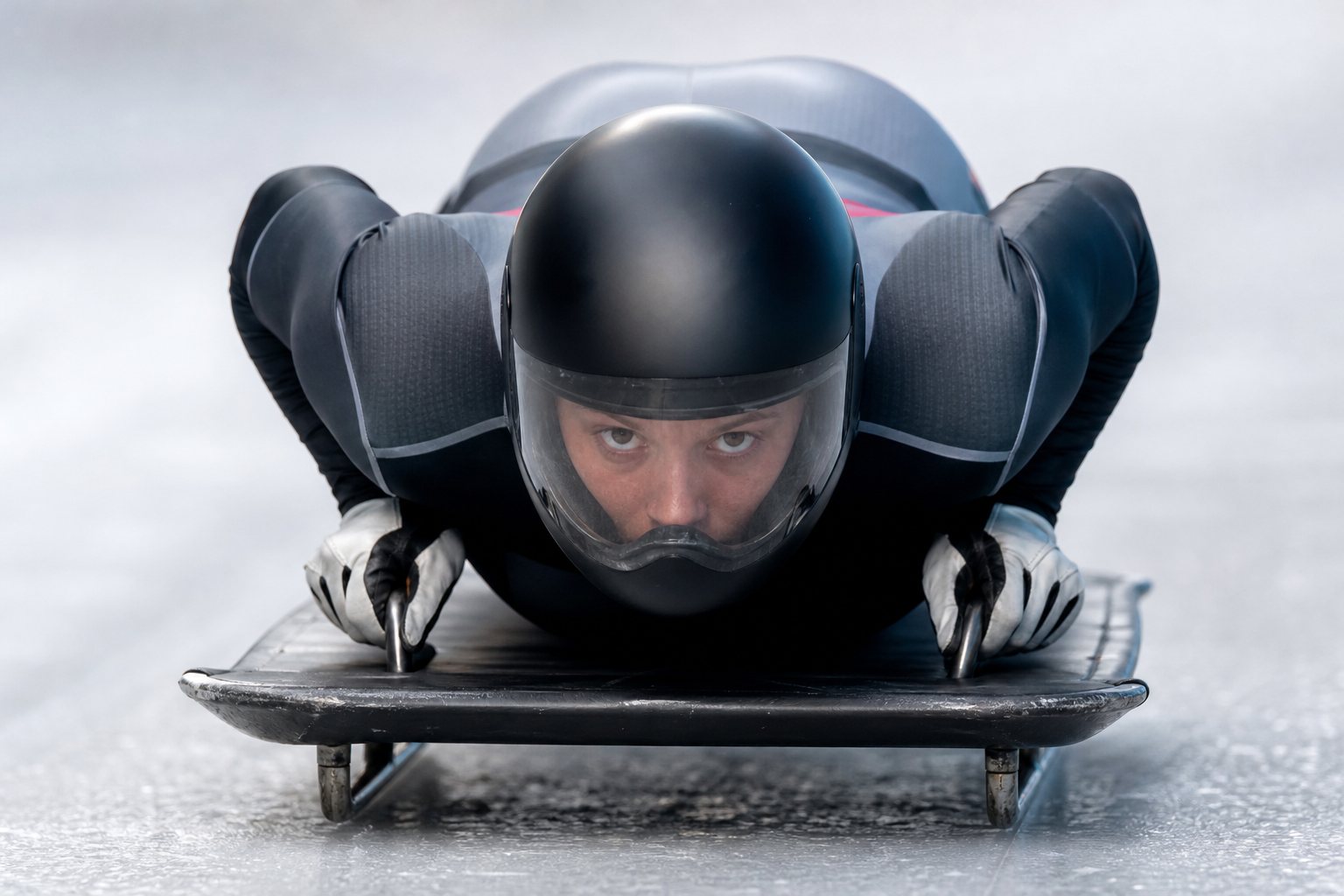
The ice track is cold and quiet, and the only thing that matters in the next few seconds is how fast the athlete can accelerate a sled. Skeleton training looks a lot like sprint training with a very specific finish. Skeleton training is the mix of sprint, strength, power and sliding practice that prepares an athlete for the push start and the run down. This page covers what the sport demands, what research says about what predicts a good start, and a sensible weekly shape. The weekly shape is general coaching practice, labelled as such, because no published skeleton template exists.
Quick answer: Skeleton performance is dominated by the start. Published research ties good starts to 15-metre sprint speed, jump power and leg force, and a 2026 review says training mirrors sprint athletes. A sensible week mixes short, fast sprints, heavy and fast lower-body lifts, trunk and neck work, and supervised track time. Build slowly, and ask a qualified coach and clinician before changing load.
General information, not medical advice. For starting out see skeleton rules and skills; for lowering injury risk see injury prevention.
What the sport demands
A 2026 narrative review of Olympic ice sports groups bobsleigh, skeleton and luge as gravity-driven sports in which performance is overwhelmingly determined by start velocity, with the first 15 to 65 metres contributing disproportionately. It says bobsleigh and skeleton training mirrors sprint athletes, with a priority on lower-body power. Biomechanics from a 2025 study of skeleton athletes found a maximum horizontal force of about 827 newtons during the push, about 12 steps over roughly 18 metres, and recommended sprint work, push simulations, downhill sprinting, lower-body maximal strength and core work.
A 2005 study of the US national skeleton team (seven men and seven women) found that crouched sprint starts achieved about 70% to 85% of upright sprint times, and that stronger, more powerful athletes tended to be better starters. These were 14 athletes and an older study, so treat the numbers as a snapshot, not a standard.
What predicts a good start
A 2017 study of 13 high-level British skeleton athletes tested them across a 24-week season. Three variables, unresisted 15-metre sprint time, countermovement jump height and leg-press force at peak power, together explained most of the variation in 15-metre sled velocity (R-squared 0.86). The authors concluded that only three physical tests were needed to predict start ability. That is useful for coaches choosing what to measure, but it is a small sample, and it does not prove that improving those numbers will improve the start for any single athlete.
Force and speed are both needed. In an 18-month study of seven elite and five talent skeleton athletes, heavy strength blocks tended to raise maximum force and lower maximum velocity, and the winter competition period reversed it. When the second training season emphasised higher-velocity sprint-based exercises, athletes’ force-power profiles became more velocity-oriented, which was associated with larger sled-velocity gains. The practical takeaway many coaches draw is to sequence strength first and speed closer to the season, but the study itself only reports these associations.
A 2025 study of 16 skeleton athletes found asymmetry between left and right legs in strength and in push gait, and that differences in ankle dorsiflexion torque and contact time had moderate links with push velocity. The authors suggest reducing those gaps may help. Because it was a small observational study, it is a reason to have a coach or physical therapist look at both legs, not a prescription.
A sensible weekly shape (general coaching practice)
We found no published weekly template or periodisation plan for skeleton. The outline below is general sprint-and-power logic, not a sourced programme, and it should be set by your coach.
- Sprint and start days (1 to 2 per week): short, fast efforts with long rests so quality stays high, including push-track or sled work when available. Fresh legs matter more than volume.
- Strength and power days (2 per week): lower-body lifts and jumps, trunk work and the neck and upper back; research above links leg strength and jump power with start speed.
- Track time (when in season): supervised runs build driving skill and track knowledge, and are scheduled around the rest of the load.
- Easy days and full rest: low-intensity movement and mobility, and at least one day with no hard training. See recovery and mobility.
- Non-sport fitness: some general aerobic fitness helps repeated sprints and recovery between them; amounts are for the coach to set.
Periodisation basics
Periodisation simply means planning the year in phases. A typical idea in strength and power sport is a general preparation phase with more volume, a specific phase closer to sliding season with more sprint and push work, and a competition phase that holds speed while limiting fatigue. The 18-month study above matches this pattern: strength phases changed force and velocity in opposite directions, and the competition winter changed them back. Skeleton also has a season shaped by track access, travel and ice time, so plans vary by country and athlete.
Warm-up and between runs
In World Cup racing athletes complete two runs within about an hour in some formats, and one study found their second 30-metre sprint after a standard warm-up was 1.4% slower, which is why teams look for ways to stay primed. A 2024 study of seven Chinese skeleton athletes found a 20-metre resisted sled sprint at 50% of body mass before a 30-metre ice push test was followed by the fastest times, about 5.02 seconds versus 5.08 seconds without resistance. Whole-body vibration has also been tested in elite skeleton athletes, with mixed or small effects in small studies. All are tiny studies of performance, not injury. Try new warm-up methods only with your coach.
Tracking training
A heart-rate chest strap is one way some athletes watch easy-day intensity and recovery. It does not measure sprint quality; sled speed and times do. Read our heart rate monitor guide and skeleton gear page. For general sprint ideas, see track and field training.
Skeleton training FAQs
Is skeleton training mostly sprinting?
A large part is. A 2026 review says bobsleigh and skeleton training mirrors sprint athletes, with a focus on lower-body power, and the start decides much of the result.
What fitness tests predict skeleton start speed?
A 2017 study of 13 athletes found 15-metre sprint time, jump height and leg-press force at peak power predicted 15-metre sled velocity. It is a small study.
Do I need heavy lifting for skeleton?
Strength and power are linked with start speed, but the right mix is for a coach to set. An 18-month study saw maximum force and velocity move in opposite directions across training phases.
Can I train for skeleton without a sled?
Much of the work is sprinting, jumping, lifting and dry-land pushing. Sliding itself needs a federation programme and a proper track.
How many days a week should I train?
No published skeleton template exists. Most plans pair a few sprint and strength days with easy days and a full rest day, but your coach should set it.
Sources
- Olympic ice sports narrative review, Scand J Med Sci Sports 2026
- Skeleton start biomechanics, Front Physiol 2025
- US National Skeleton Team profiles, Sports Biomech 2005
- Physical predictors of elite skeleton start performance, IJSPP 2017
- Force-power profiles and the skeleton start, IJSPP 2018
- Strength and push gait asymmetry in skeleton athletes, J Hum Kinet 2025
- Whole-body vibration in elite skeleton athletes, JSCR 2008
- Post-activation enhancement in Chinese skeleton athletes, PeerJ 2024
General information for education only, not medical advice. It does not replace a sports medicine doctor, physical therapist, athletic trainer, licensed mental health professional or qualified coach. See our editorial policy for how we research and write.