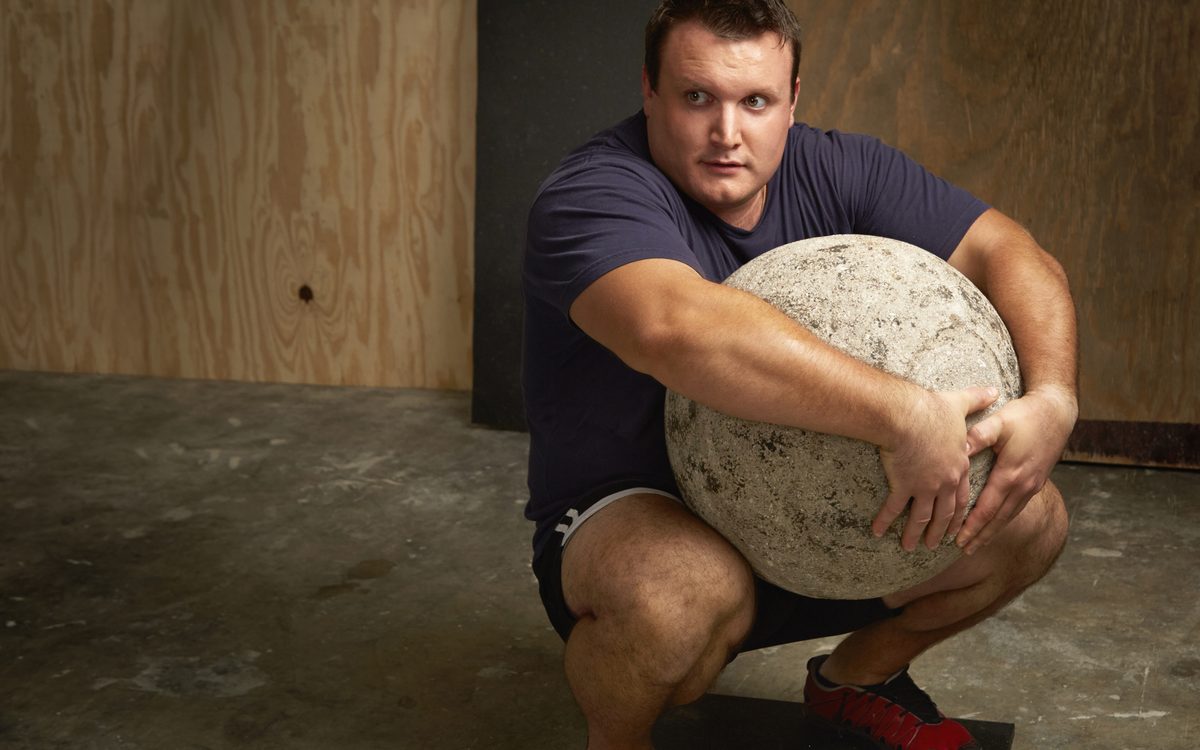
The first time most people see a strongman contest in person, what surprises them is how ordinary the place looks. A parking lot or a gym floor, a row of stones lined up by size, a yoke with a spotter at each end, a scoreboard on a folding table and a crowd of friends and family doing the counting out loud. Strongman is a strength sport in which athletes lift, carry, pull and throw heavy, awkward objects in a series of events, and are ranked by how they place in each one. This page is the practical start: how a show is run, what a beginner needs to know, how classes work and where to find a real contest. The strongman hub has the bigger picture.
Quick answer: A strongman contest is a set of separate events, and your total comes from your placing in each (common format, see below). In the US, Strongman Corporation runs the main amateur system: you must be at least 12, buy a membership, weigh in at or under your class limit in kilograms and can enter a Novice or Open class at local shows. Learn the movements with a coach first, start with a local novice show, and check each show’s own rules, because promoters set the events and weights.
How a contest works
A show is a chain of events, usually five or six, each testing something different. According to the Wikipedia overview of the sport, which is a general secondary source, the usual families are:
- Overhead presses: log press, axle press, Viking press.
- Stones: atlas stones lifted onto platforms, plus other natural stones.
- Deadlift and squat variants: elephant bar, car, barrel or giant barbell.
- Carries: farmers walk, yoke, frame carry, timber carry.
- Pulls: vehicles dragged on a harness.
- Throws and medleys: keg toss, weight over bar, loading medley.
- Grip events and holds.
Strongman Corporation’s licensing page says promoters set the events and the weights for their own shows, so two local contests can look quite different. We could not find a public Strongman Corporation rulebook with event-by-event standards, so what counts as a legal lift (when the log must be locked out, where a stone must land) is something you learn from the show’s own rules sheet and its referees, not from a general web page.
How scoring usually works
Most strongman contests, including the well-known televised ones, score by placing rather than by raw numbers. Wikipedia describes the common method: the winner of an event gets points equal to the number of athletes, each place below gets one fewer, last gets one, and an athlete who cannot complete or start an event gets zero. Ties share points evenly, so two athletes tied for first in a field of 10 would each take 9.5. Strongman Corporation’s public pages do not spell out its own scoring rules, so confirm tie-breaks and scoring with the promoter. We could not independently confirm the format beyond that secondary source.
Basic skills a beginner should expect to learn
This section is general coaching practice, not a finding from a study. Most coaches start newcomers on the movements that carry over to almost every event, and add implements slowly:
- Squat and deadlift patterns with a barbell, because these are the base for lifts, stones and many carries.
- Overhead pressing with a barbell or log, learning to brace the trunk and keep the ribs down.
- Loaded carries (farmers walk first, then yoke), which teach short, quick steps under load.
- Picking an object up from the floor that does not have a handle, which is the real skill behind stones and sandbags.
- Safe dropping: knowing how to let an implement go and step away from it.
Research on strongman movements supports a few of these ideas. A 2019 systematic review of 11 studies in Sports Medicine – Open found that faster farmers-walk and sled-pull athletes took longer strides, stepped faster and spent less time on the ground. A 2021 study of 19 strongman athletes found the yoke walk is a high-stride-rate, short-stride movement. A 2021 study of 20 experienced athletes split the atlas stone lift into five phases: recovery, initial grip, first pull, lap and second pull.
Divisions, classes and who can compete
The details below are from Strongman Corporation’s athlete rules, effective 1 January 2026. Other organisations around the world have their own rules.
| Minimum age | 12. Athletes under 18 need a parent or guardian to register them and sign waivers. |
|---|---|
| Teen division | Athletes 19 or younger on competition day; America’s Strongest Teen runs age classes of 12 to 14, 15 to 17 and 18 to 19. |
| Men’s classes | 80, 90, 105, 120 (amateur only) and over 120 kg. |
| Women’s classes | 57 (amateur only), 64, 73, 82 and over 82 kg. |
| Masters | 40+ and 50+, with their own class lists; not every event offers them. |
| Weigh-in | Up to 24 hours before the start; scales read in kilograms with no rounding or clothing allowance; you must be at or under your class limit. |
| Divisions | Open (local and regional shows need no qualification), Novice (for first-time competitors, optional) and Pro/Am. |
| Membership | Digital, bought on the Strongman Corporation site; memberships from other federations are not recognised. |
How a beginner starts
- Train the basics first. Many athletes spend months on squats, deadlifts, presses and carries before touching a stone. Learn from a coach if you can; see our strongman training guide.
- Find a show. Strongman Corporation says licensed events are listed on its Events page and social media. A State Representative can answer questions about local shows.
- Choose Novice or Open. Novice is open to every first-time competitor and is optional. Strongman Corporation says to ask your coach first, then the promoter.
- Register early. Entry deadlines apply to most shows, and day-of sign-ups are usually not allowed. Buy your membership a few days ahead, because Strongman Corporation says doing so speeds check-in.
- Read the show’s rules sheet for events, weights, equipment allowed and attempt rules, and ask the promoter anything unclear.
- Be honest about your level. Pick event weights you have already handled in training. A contest is a poor place to try a new implement for the first time.
Levels and how the ladder works in the US
Strongman Corporation says local and regional shows are open to everyone. To enter Amateur Nationals you must compete in an open division at a local, regional or Pro/Am show and meet the qualifying placing; the thresholds are on its qualification standards page. Pro cards are earned at Nationals, the Arnold and select Pro/Am shows, and open the door to invitation-only events such as America’s Strongest Man and Woman. The World’s Strongest Man is a separate invitational contest, first held in 1977 according to the Strongman Archives. See the strongman hub for more on the pro side.
Olympic and Paralympic status
We found no Olympic or Paralympic strongman event and no IOC or IPC statement on it. Check the official programme for the current Games. The nearest Olympic relative is weightlifting; powerlifting and bodybuilding are the closest barbell and physique sports, and CrossFit shares some training.
For safe training and injuries, see injury prevention and injuries. Official pages are listed under Sources.
Frequently asked questions
Do I need to be very strong to enter a first show?
No fixed strength test exists for Novice classes at local shows; Strongman Corporation says Novice is for all first-time competitors regardless of background. In practice, coaches suggest entering when you can handle the show’s weights with good technique (general coaching practice).
How old do you have to be to compete?
Strongman Corporation requires athletes to be at least 12, with a parent or guardian registering anyone under 18. Other organisations set their own age rules, so check the show you want to enter.
Are there weight classes in strongman?
Yes. In Strongman Corporation events men’s classes run from 80 kg to over 120 kg and women’s from 57 kg to over 82 kg, with separate masters classes. Weigh-in can be up to 24 hours before the contest.
How are strongman events scored?
Most contests score by placing: the winner of an event earns points equal to the number of athletes, then one fewer for each lower place, with zero for not completing (Wikipedia overview, secondary source). Confirm the scoring with your show’s promoter.
Is strongman in the Olympics?
We found no Olympic or Paralympic strongman event. Check the official programme for the current Games.
Where do I find a strongman show near me?
Strongman Corporation lists licensed events on its Events page, and State Representatives help promoters and athletes in each state. Local strongman or powerlifting gyms often know about upcoming shows.
Sources
- Strongman Corporation, athlete info (effective 1 Jan 2026)
- Strongman Corporation, FAQ
- Strongman Corporation, licensing regulations
- Strongman Corporation, qualification standards
- Strongman Archives, World’s Strongest Man
- Wikipedia, Strongman (events, scoring; secondary)
- Hindle et al., biomechanics of strongman exercises, systematic review 2019
- Hindle et al., yoke walk 2021
- Hindle et al., atlas stone lift 2021
General information for education only, not medical advice. It does not replace a visit with a doctor, physical therapist or athletic trainer. See how we write and check our pages in our editorial policy.