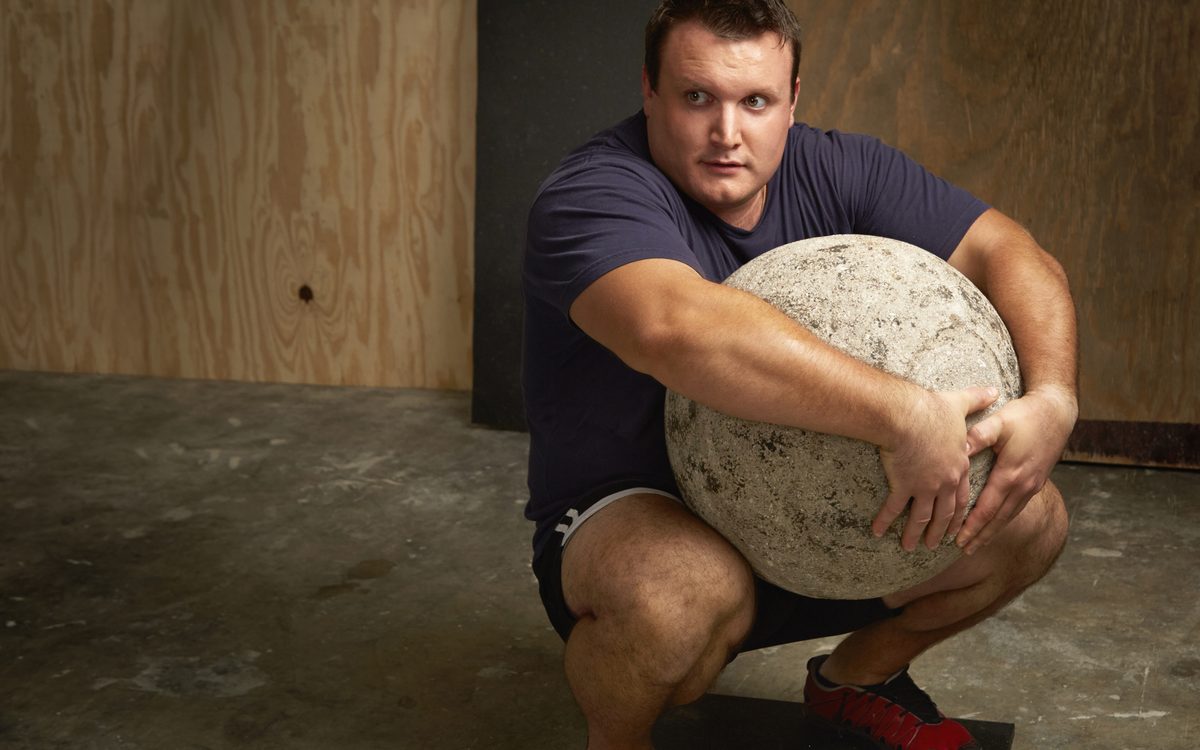
The announcer calls the next name. The athlete walks to the platform, claps chalk off both hands, stares at the heaviest stone of the day and breathes out slowly. Two minutes earlier, he was joking with a friend. Mental training for strongman is the practice of getting your attention, arousal and confidence to the right level for a short, heavy effort, and of staying steady through a day of events that rarely go to plan. This page is about mental performance. It is not a substitute for mental health care, which we cover separately below.
Quick answer: Strength athletes often use “psyching-up” before heavy lifts, and in a 2026 study of 200 competitive strength athletes (including strongmen), bar speed on a deadlift was about 18.6% higher after psyching-up than in a passive control. No single method beat the others; athletes picked what matched their personality. Build a simple routine, practise it in training, and treat results as helpful rather than guaranteed. Anxiety, depression, disordered eating or burnout are health matters for a qualified professional.
Confidence and focus
We did not find strongman-specific research on confidence building, so this part is general sport-psychology practice, not a study result. Many coaches suggest that confidence comes from evidence: a training log of weights handled, successful reps and competition practice. For focus, pick one or two cues for each event, such as “hips, chest, drive” on a stone, and use them the same way each time. Surveyed athletes (Winwood and colleagues, 2019) said they used cognitive strategies to improve performance and to raise or hold the level of psychological arousal needed in competition.
Psyching-up: what the research shows
Psyching-up refers to self-directed strategies used right before or during a lift to change activation or prepare the mind. A 2003 review (Tod, Iredale and Gill) tentatively concluded that it may improve strength and muscular endurance tasks, with preparatory arousal the strategy with most support, while noting that most studies used untrained people. More recent work focuses on strength athletes:
- A 2025 concept-mapping study of 246 strength athletes and coaches identified 64 techniques in eight clusters, from pre-performance routines and positive thoughts to stimulation and aggressive acts. Participants rated pre-performance routines the most effective cluster.
- The 2026 study of 200 strongmen, strongwomen and powerlifters found deadlift velocity of 0.39 m per second with psyching-up against 0.34 without, an estimated 4.3% rise in predicted one-rep max. The strategies did not differ significantly in effect, and athletes with higher reward sensitivity, more trait aggression and lower anxiety sensitivity chose arousal-raising strategies.
- The practical read: find what works for you in training. Hype is not the only option, and calmer athletes may do better with calmer approaches. No method guarantees a result.
Pre-contest and pre-event routines
Because the concept-mapping study rated pre-performance routines highest, a routine is a sound place to start. A typical outline, labelled as general coaching practice: the same warm-up order, a short breathing reset, one or two cues, a look at the implement and a start. Practise it with every heavy set so it is automatic. Our training page and rules page cover warm-ups and show logistics.
Self-talk and imagery
A 2011 meta-analysis of 32 studies (Hatzigeorgiadis and colleagues) found a moderate positive effect of self-talk on sport performance (ES = 0.48), but it was larger for tasks needing fine motor control than for gross tasks and for novel rather than well-learned tasks. Strongman lifts are largely gross-motor, so expect smaller effects from cue words than in, say, a golf putt. A 2025 meta-analysis of imagery (86 studies, 3,593 athletes) found it improved performance in areas including muscle strength, that combining it with one or two other psychological skills worked better than imagery alone, and that sessions of around ten minutes, three times a week, over about a hundred days gave the largest gains in the studies analysed. Those figures are averages from mixed sports, not a prescription for strongman.
Handling pressure, setbacks and strategy
- Pressure: a failed or no-count lift can score zero in many placing-based contests (see our rules page), which makes the next event feel big. Practise lifting for contest-style attempts in training.
- Setbacks: events are scored one by one, so a bad event is not the end of the show. A short reset routine, such as a breath, a drink and a look at the next event, is general coaching practice.
- Decisions and tactics: decide with your coach, before the day, how to pace events and which attempts to take. Under pressure, plans made in advance are easier to follow.
- Teamwork: strongman is individual, but coaches, spotters and loaders are part of the team. Brief them on cues and signals.
Competition preparation
For logistics such as weigh-in, entry and classes, see our rules page. For weight classes and food, see nutrition. Practise your pre-event routine at least a few times in training before using it in a show, and avoid trying anything new, such as a new supplement or a different cue, on contest day.
Mental health is different from mental performance
Everything above is about performance. Anxiety that does not settle, low mood, loss of interest, disordered eating, a sense of being unable to stop training or burnout are health matters, and they need a qualified professional, such as a doctor, psychologist or therapist. The International Olympic Committee’s 2019 consensus statement says mental health symptoms and disorders are common in elite athletes and impair performance, and that mental health cannot be separated from physical health. A 2026 study of 381 weight trainers linked obsessive passion and exercise addiction with more injuries, and mentioned muscle dysmorphia among relevant psychological factors, so training habits that feel compulsive are worth discussing with a professional.
If you are in the US and are struggling, you can call or text 988 (the 988 Suicide & Crisis Lifeline) at any time. Outside the US, look for your local crisis line. In an emergency, call your local emergency number.
Frequently asked questions
Does psyching-up really help lifting?
In a 2026 study of 200 competitive strength athletes, deadlift bar speed was higher with psyching-up than without. Earlier reviews called the evidence tentative. It is not a guarantee.
Which psyching-up strategy is best?
The study found no significant difference between eight strategies. Athletes tended to pick methods that fit their personality, so experiment in training.
Should I use music or yelling?
Some athletes do. Surveyed strength athletes named stimulation and aggressive acts among their strategies, though a routine was rated the most effective cluster. Use what you can repeat and that is allowed at the show.
Can imagery help?
A 2025 meta-analysis found imagery practice improved athletic performance, including muscle strength, especially combined with other psychological skills. Results varied across sports, so treat it as one tool.
When is it a mental health issue?
If anxiety, low mood, disordered eating or compulsive training is affecting your life, see a qualified professional. In the US, 988 is available by call or text.
Sources
- Cusimano et al., psyching-up and deadlift performance in strongmen, strongwomen and powerlifters, 2026
- Cusimano et al., psyching-up strategies in strength sports, concept mapping, 2025
- Tod, Iredale and Gill, psyching-up and muscular force production, 2003
- Hatzigeorgiadis et al., self-talk and sports performance meta-analysis, 2011
- Liu et al., imagery practice and athletes’ performance, meta-analysis 2025
- Winwood et al., competition-day preparation strategies of strongman athletes, 2019
- Reardon et al., IOC consensus statement on mental health in elite athletes, 2019
- Naderi et al., psychological factors and injury in weight trainers, 2026
- 988 Suicide and Crisis Lifeline
General information for education only, not medical advice. It does not replace a visit with a doctor, physical therapist or athletic trainer. See how we write and check our pages in our editorial policy.