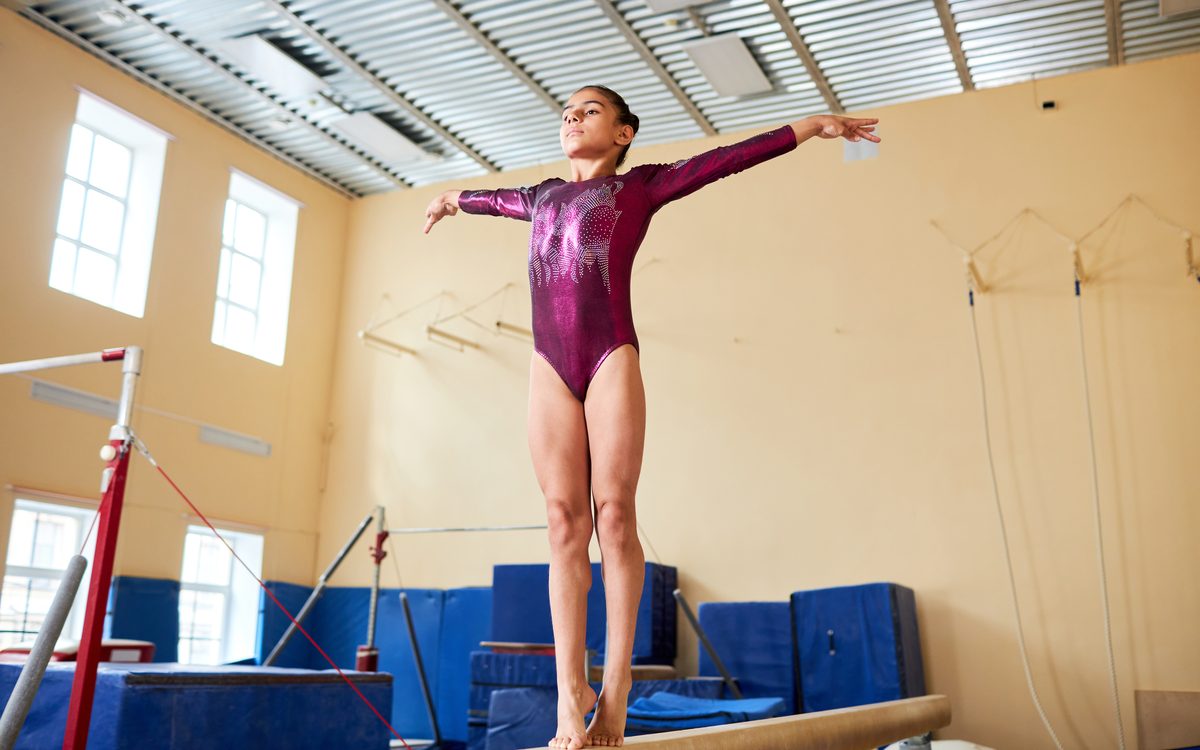
At 4:30 on a Tuesday the gym is loud with chalk and springs. A 12-year-old finishes her fifth vault, rests thirty seconds, and runs again; in the next corner a teenage boy lowers himself slowly into a still-rings support. Artistic gymnastics training is the weekly mix of skill practice on each apparatus, strength and flexibility work, and rest that prepares a gymnast to perform short, powerful routines and land safely. This page covers what the sport asks of the body and how training is commonly organized. It is general information, not a program for any one athlete.
Quick answer: Training for artistic gymnastics is mostly skill repetition on the apparatus, with strength, power, flexibility and landing work around it. Sources recommend raising load gradually (the AAP says no more than 10 to 20% a week), keeping 1 to 2 days off a week, and having coaches supervise strength work for young athletes. See a sports medicine doctor, physical therapist or athletic trainer for pain that lingers or returns.
What the sport asks of the body
Each routine is brief but intense. Vault and tumbling need fast running and explosive take-offs; bars, rings, pommel horse and parallel bars load the shoulders, wrists and grip; beam asks for balance and calm; every event ends in a landing. Studies of gymnasts show the pattern. A 2026 study of 13 competitive female gymnasts (average age about 11.6) found that lower-body strength and power measures did not correlate with balance beam scores, while lean mass correlated with jump power; the authors concluded that beam performance depends on other physical factors and technique as well. A 2026 study of 13 male gymnasts found higher shoulder rotator strength relative to body mass than in 13 physical education students, which fits the demands of the support events.
As general coaching practice, training differs a little because the events differ. Men spend more time on pommel horse, rings, parallel bars and high bar, where the shoulders do much of the work. Women spend more time on beam and bars, where balance, timing and swing matter. Both groups share floor and vault, so both train jumping, landing and tumbling a lot.
A sensible weekly shape
No source gives one correct artistic gymnastics week, and the right shape depends on age, level and the athlete’s health. The outline below is general coaching practice, with the numbers that sources do give.
- Event practice. Most training time is skill work, rotated across the apparatus. Quality repetitions matter more than numbers, and coaches usually stop an event when form falls apart or the athlete is tired.
- Strength and conditioning. Often at the start or end of practice. See below.
- Flexibility and mobility. Included in warm-ups and cool-downs; see our recovery and mobility page.
- Rest. The AAP’s 2024 clinical report recommends at least 1 to 2 days off a week from sport-specific training and 2 to 3 months off a year, in blocks of at least a month.
How many hours? A 2023 review of injury pathology in young gymnasts reported average weekly training of 11.3 hours for ages 6 to 9, 16.5 hours for ages 10 to 13 and 14.8 hours for ages 14 to 17, and noted that the two younger groups trained more hours per week than their age in years. A 2015 clinic-based study (Jayanthi) found that sports-specialized intensive training was an independent risk factor for injury in young athletes. These numbers show what gymnasts often do; they are not targets.
Strength, power and conditioning
A 2014 international consensus on youth resistance training (British Journal of Sports Medicine), endorsed by professional organizations in sports medicine and pediatrics, and an NSCA position statement both say that strength training is appropriate for young people when it is properly prescribed and supervised. For gymnasts that usually means body-weight work and light external load, such as the following examples of general coaching practice:
- Hollow body and arch holds, planks and leg raises for trunk control. A 2026 systematic review of low back pain in competitive gymnasts reported that core stability training lasting 8 to 12 weeks reduced pain in the studies it included.
- Push-ups, scapular push-ups and supports for shoulders and wrists.
- Pull-ups and rope climbs for pulling strength, especially for bars and rings.
- Calf raises, squats and jumps for the legs and Achilles tendons. Gymnasts have a real Achilles injury burden, see our injuries page.
- Single-leg balance and landing drills.
Landing practice. A 2026 study of 18 female gymnasts (average age 14) found that telling them to look down or straight ahead had little effect on their stability when landing, while the task itself (such as a backward somersault series) governed stability. The practical lesson is that landings are trained like any other skill, in progression, not fixed with one cue.
Skill progressions and periodisation basics
Coaches usually move gymnasts through a skill ladder: a drill on the floor, then a lower or softer version, then spotted or on a safe landing surface, then the full skill. Whether you start a skill on a trampoline, in a foam pit or on a mat is the coach’s call; no source we found shows that any one method is safest. USA Gymnastics’ professional members must complete safety and Safe Sport education, and USAG’s Safe Sport policy bans painful stances or positions and warns against returning to training too early after a serious injury without medical clearance.
Periodisation simply means planning the year in phases. Common patterns, labeled here as general practice, are an off-season or pre-season of strength and skill building, a competition season of fewer new skills and more routines, and planned breaks. A 2026 narrative review of 140 gymnastics publications (Zaharie) emphasized progressive, individualized training, workload monitoring, recovery and early detection of pain and fatigue; the authors did not do a formal risk-of-bias assessment, so treat it as a summary of themes.
Managing load
- The 10% rule. The USAG Safe Sport policy says training time, distance or weight should not increase more than 10% a week. The AAP’s 2024 report gives 10 to 20%.
- Stop signs. The USAG policy says any activity that causes vomiting, heat illness, acute pain or obvious distress should end immediately.
- Growth spurts. A 2026 review of aesthetic and acrobatic sports (65 studies) found a higher risk of bone injury around puberty and linked it, among other factors, to later menarche, lower bone age and nutrition shortfalls. Ask a coach and doctor how to adjust load during rapid growth.
- Fuel and sleep. Training load, sleep and food are linked; see nutrition and recovery.
For the injury side, read injury prevention. For the wider sport, see gymnastics training and the artistic gymnastics hub.
Artistic gymnastics training FAQs
How many hours a week do artistic gymnasts train?
It varies widely. A 2023 review of young gymnasts reported averages of 11.3 hours a week at ages 6 to 9, 16.5 at ages 10 to 13 and 14.8 at ages 14 to 17. Those are averages from that review, not recommendations.
Do gymnasts lift weights?
Many do some form of strength training, mostly body-weight work. Youth strength-training statements say it is appropriate when properly prescribed and supervised by qualified coaches.
Does flexibility matter more than strength?
Both matter, and the balance varies by event. Research summaries note that flexibility-strength imbalance can be a concern in aesthetic sports, so most coaches train them together.
How much rest does a young gymnast need?
The AAP’s 2024 report recommends at least 1 to 2 days off a week and 2 to 3 months off a year, in blocks of at least a month.
Can I train gymnastics at home?
Our sources do not cover home training for artistic gymnastics. The AAP strongly discourages home trampolines, and any new skill should be learned in a gym with a coach.
Sources
- Papacharalampus 2026, strength, power and beam performance (PMID 41609440)
- Milosis 2026, shoulder rotator strength in male gymnasts (PMID 42931570)
- Pavlasova 2026, gaze direction and landing (PMID 41651765)
- Qin 2026, low back pain in competitive gymnasts (PMID 42298596)
- Zaharie 2026, gymnastics training optimization review (PMID 42881724)
- Fitch 2026, growth and maturation in aesthetic and acrobatic athletes (PMID 41893970)
- Williams 2023, Injury Pathology in Young Gymnasts
- AAP clinical report on overtraining in young athletes, 2024 (PMID 38247370)
- Jayanthi 2015, sports specialization and injury (PMID 25646361)
- Lloyd 2014, International consensus on youth resistance training (PMID 24055781) and Faigenbaum 2009, NSCA position (PMID 19620931)
- USA Gymnastics Safe Sport Policy (12.15.21)
- AAP policy on trampoline safety, 2012 (PMID 23008455)
General information for education only, not medical advice. See our editorial policy for how we research and write.