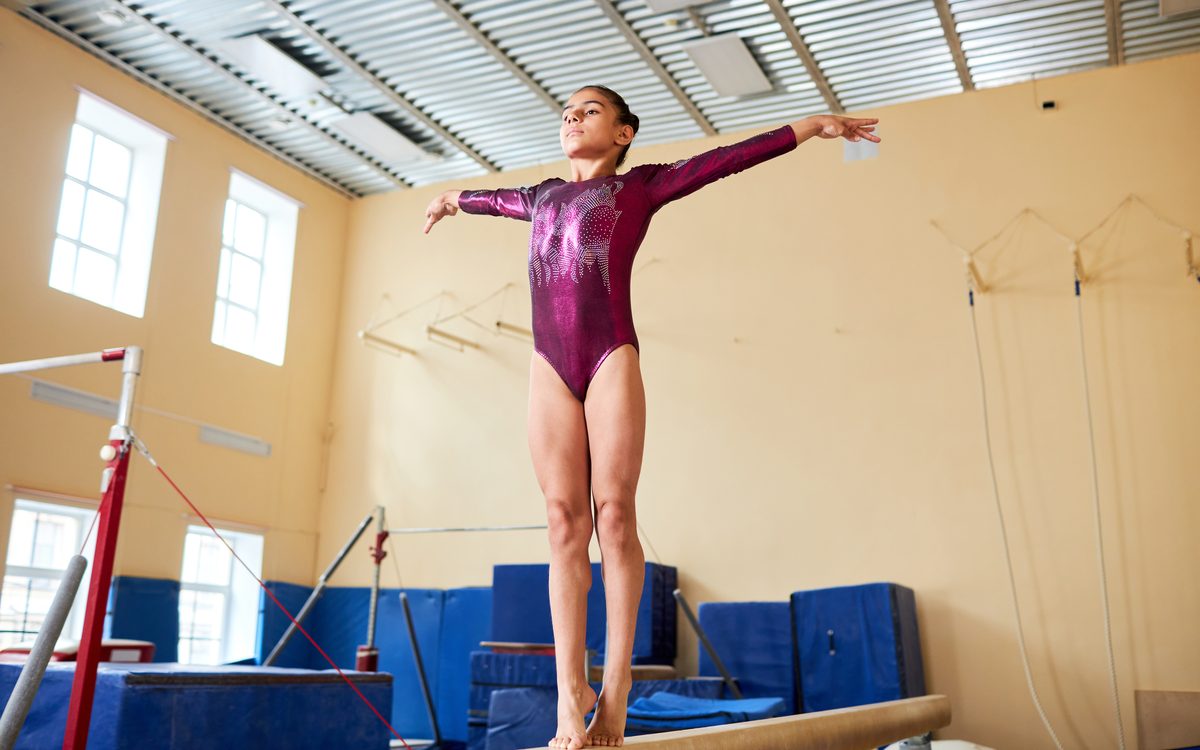
The women’s team is warming up for floor. One gymnast tests her left ankle after a landing that felt a little off; the coach sees it and calls a break, then asks her to show the next pass on the soft mat first. Artistic gymnastics injury prevention is the set of habits around a gymnast, such as a proper warm-up, landing practice in progression, training load that rises slowly, strength work, suitable mats and quick reporting of pain, that may lower the chance of getting hurt. They lower the odds. They cannot promise anything.
Quick answer: The best-supported steps are a gradual rise in training load, 1 to 2 rest days a week, core and lower-body strength and landing work, soft and appropriate surfaces, and telling a coach about pain early. Most of the evidence is observational, so treat these as sensible habits, not guarantees. See a sports medicine doctor, physical therapist or athletic trainer if pain stays in one spot, returns after rest or changes how a skill feels, and call emergency services after a head or neck injury with danger signs.
Why landings and loading matter
NCAA surveillance data show where the risk sits. In women’s collegiate gymnastics from 1988 to 2004, about 70% of competition injuries came from landings in floor exercise or dismounts (Marshall 2007). A 2023 survey of NCAA programs found that 95% of Achilles ruptures happened on floor and 98% on the take-off of a tumbling skill (Kobayashi 2023). Among elite men at USA Gymnastics competitions from 2008 to 2018, contact with the surface was the most common cause of injury and vault the event with the most injuries (Kruse 2021). A 2025 systematic review of 19 studies named repetitive loading, improper technique and insufficient recovery as the main causes of injury in artistic gymnastics (Mekic 2025). The injury list itself is on our injuries page.
Warm-up
We did not find a published, gymnastics-specific warm-up program with trial evidence behind it, like the FIFA 11+ in soccer. What gyms commonly do is general coaching practice: 10 to 15 minutes of easy running and jumping, joint circles for the wrists, shoulders and ankles, dynamic stretching, wrist weight-bearing in steps, then light versions of the skills about to be used. For meets, USAG’s rules allow a general warm-up of 15 to 30 minutes, followed by timed apparatus warm-ups, so building up gradually before a routine is part of the sport’s format. See meet day for the logistics.
Technique and skill progression
Because most injuries happen on landings, coaches teach them early and in steps. The usual pattern, again general practice, is to master the skill at a lower height or with a larger landing surface before progressing, and to drop back a step when form is shaky. A 2026 study of 18 female gymnasts found that how hard a landing task was mattered more to stability than where the gymnast was told to look, which suggests progression matters more than one cue. We found no study showing that any spotting method lowers injury rates, so do not treat spotting as a guarantee either.
Progressive training load
- The AAP’s 2024 clinical report on overtraining recommends at least 1 to 2 days off a week from sport-specific training, 2 to 3 months off a year in blocks of at least a month, and weekly increases of no more than 10 to 20%.
- The USAG Safe Sport policy cites a 10% weekly increase limit and says activity causing vomiting, heat illness, acute pain or obvious distress must stop.
- A 2015 case-control study (Jayanthi) found that sports-specialized intensive training was an independent risk factor for injury in young athletes. Gymnasts specialize early, the AAP notes.
- A 2026 review (DiLeo) tied wrist pain to age 10 to 14, training intensity, years training and weekly hours, and a 2026 review of low back pain (Qin) found rates of 25 to 50% that rose with age and weekly volume.
Conditioning and strength
The NCAA surveillance authors recommended neuromuscular training and core stability work in the off-season and preseason to improve landing and skill mechanics (Marshall 2007), and a 2026 systematic review found 8 to 12 weeks of core stability training reduced low back pain in gymnasts (Qin 2026). A 2026 study of 129 young competitive female gymnasts found tibial bone stress injuries in 64.7% of pre-pubertal girls, 30.9% of those entering puberty and 4.4% of late-pubertal gymnasts, with weaker tibial and calf strength linked to repeated injuries (Steinberg 2026). The authors suggest screening from a young age. That is an association, not proof that strength work prevents them. More ideas are on our training page.
Surfaces and equipment
A 2025 lab study (Brtva) of drop landings by 11 female gymnasts and 11 non-gymnasts found the lowest peak force on a FIG-certified mat and the highest on carpet, and that stiffer mat construction transmitted higher loads. It is a lab study, not injury data, but it supports using proper landing surfaces. The FIG also sets apparatus norms for international competition, such as a 500 centimeter beam that is 125 centimeters high.
Ankle support. After reviewing NCAA data, Marshall and colleagues recommended that gymnasts with a past ankle sprain wear an ankle brace or tape the ankle to lower the risk of a repeat sprain. Ask a clinician which fits.
Wrist supports and grips. A 2023 lab study of 23 girls (Hart 2023) found that two common wrist supports raised wrist flexion moment during back handspring landings. Wrist pain is common (a 2026 meta-analysis found about 53% prevalence), but supports are not a proven fix; ask a coach or doctor about when to wear them. Verified rules and maker claims are separated on our gear page.
Growth, food and sleep
A 2026 systematic review of 65 studies in aesthetic and acrobatic sports (Fitch 2026) found that gymnastics can help bone health before puberty, but bone-injury risk rises around puberty, possibly with later menarche, lower bone age and nutritional deficiency. Under-fueling can raise injury risk; see nutrition and recovery. For youth specifics, read our youth gymnastics page.
What prevention cannot do
Gymnasts fall, land short and over-rotate even in well-run gyms. The 2026 narrative review by Zaharie described progressive, individualized training, workload monitoring, recovery and early pain detection as themes, without a formal quality assessment, and no program removes risk. Do not use a brace, mat or strength routine to push through pain.
When to see a professional
- Pain in one spot for more than a few days, pain at rest or at night, or pain that changes how a skill feels.
- Back pain in a young gymnast. Jackson and colleagues wrote in 1976 that low back pain in a young gymnast should be a warning sign.
- A pop or sudden weakness at the back of the ankle.
- Any head injury. Follow CDC HEADS UP: remove the athlete from practice, and let a health care provider decide when to return. Call emergency services for severe headache, repeated vomiting, confusion, seizure, loss of consciousness, or neck pain or weakness.
Artistic gymnastics injury prevention FAQs
Does stretching prevent gymnastics injuries?
We found no source showing that stretching alone prevents injuries in gymnasts. Coaches use dynamic movement in warm-ups and keep flexibility paired with strength.
Should my child wear wrist guards?
It depends. A 2023 lab study found that two common wrist supports increased wrist flexion moment in landings, and the authors advised considering injury history and limiting wear time. Ask the coach or a sports medicine professional.
Are foam pits and soft mats safer?
Softer, certified landing surfaces gave lower peak forces in a 2025 lab study, but that is not injury data. Surfaces help, and technique and load still matter.
How many days off does a gymnast need?
The AAP’s 2024 report recommends at least 1 to 2 days off a week from sport-specific training, plus 2 to 3 months off a year.
Can I prevent a stress fracture of the back?
No one can promise that. AAOS lists gymnastics among sports linked to spondylolysis, and says it usually looks like a muscle strain. Report back pain early and see a professional.
Sources
- Marshall 2007, NCAA women’s gymnastics injury surveillance (PMID 17710171)
- Kruse 2021, elite male artistic gymnastics competitions (PMID 33055133)
- Kobayashi 2023, Achilles ruptures in NCAA gymnastics (PMID 36853933)
- Mekic 2025, injuries in artistic gymnastics, systematic review (PMID 41303413)
- Steinberg 2026, tibial bone stress injuries in young gymnasts (PMID 41570375)
- Brtva 2025, landing mat properties (PMID 41309750)
- Hart 2023, wrist guards in gymnastics (PMID 37794701)
- Pavlasova 2026, gaze direction and landing (PMID 41651765)
- DiLeo 2026, wrist pain prevalence (PMID 41552624) and Qin 2026, low back pain (PMID 42298596)
- Fitch 2026, growth and maturation review (PMID 41893970) and Zaharie 2026, training and injury prevention review (PMID 42881724)
- AAP overtraining clinical report, 2024 (PMID 38247370) and Jayanthi 2015 (PMID 25646361)
- USA Gymnastics Safe Sport Policy
- AAOS OrthoInfo, spondylolysis
- CDC HEADS UP, responding to a concussion
- FIG Apparatus Norms
General information for education only, not medical advice. See our editorial policy for how we research and write.