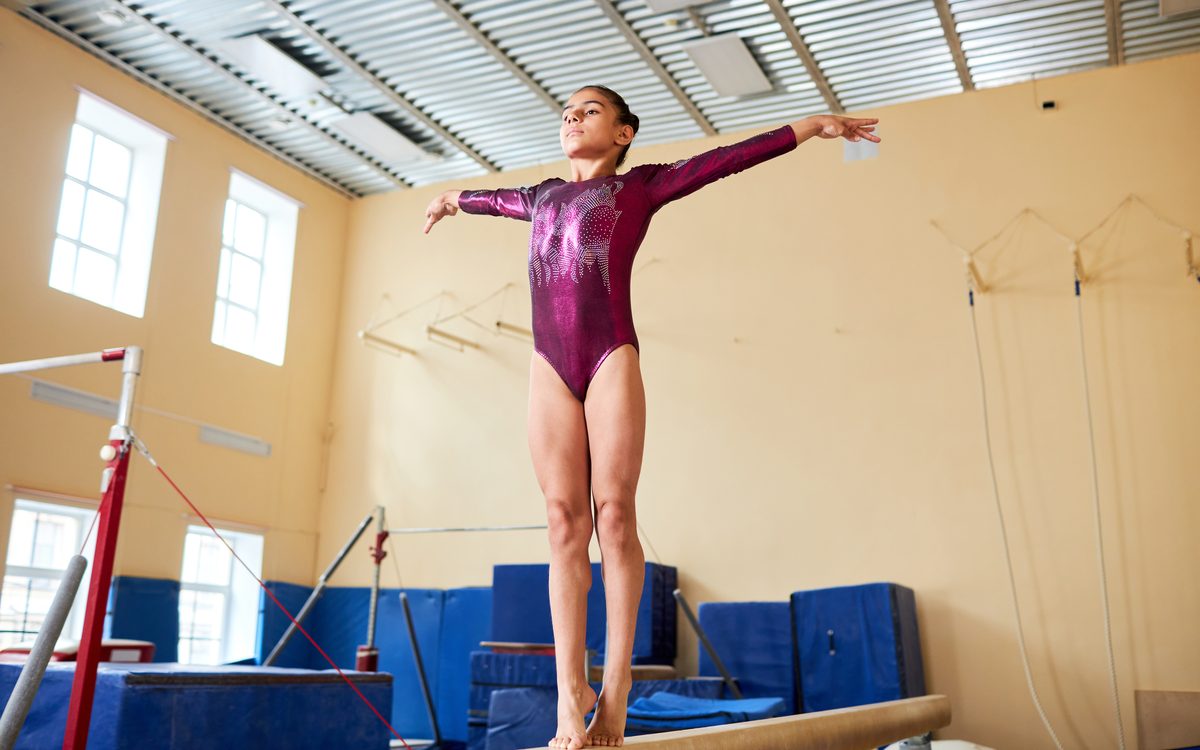
The meet is over, the gymnast is in the car with a bag of ice on one wrist and a banana in her hand, and by the time she is home she is asleep. Artistic gymnastics recovery is everything an athlete does between sessions so the body can adapt to the training: sleep, food and fluid, rest days, gentle movement and care for the hands. Some of it has good evidence and some has very little. This page says which is which.
Quick answer: For artistic gymnasts the best-supported recovery basics are enough sleep, planned rest days and off-season breaks, eating after hard sessions, and not increasing training too fast. Massage may help soreness and perceived fatigue, while cold-water immersion, cool-downs and percussion guns have weak or mixed evidence. See a sports medicine doctor, physical therapist or athletic trainer for pain that lingers, is sharp, or sits in one spot.
Sleep
The AASM pediatric consensus endorsed by the AAP recommends 9 to 12 hours of sleep a night for ages 6 to 12 and 8 to 10 hours for ages 13 to 18; adults need 7 or more hours (AASM and Sleep Research Society, 2015). Gymnasts are often early risers and late finishers, so sleep is easy to squeeze. In a 2018 study of 26 elite female artistic gymnasts, total sleep time was shorter on weeknights than weekends, higher training load was followed by shorter sleep that night, and shorter sleep and higher load went with worse results at a world championship (Dumortier 2018). It is a small observational study, so it shows an association, not proof. General practice tips: keep a steady bedtime, wind down without screens, and avoid caffeine late in the day. The AAP says energy drinks have no place in the diets of children and adolescents.
Rest days and the off-season
The AAP’s 2024 clinical report recommends at least 1 to 2 days a week off sport-specific training and 2 to 3 months off a year, in blocks of at least a month. It also tells doctors to consider overtraining or burnout when a young athlete has ongoing fatigue, mood changes, poor sleep or academic problems. Wrist pain and back pain in gymnasts rise with weekly hours (DiLeo 2026; Qin 2026), which is one reason rest is part of training and not a reward for it. See training for how to raise load gradually.
Refuel and rehydrate
The ACSM, Academy of Nutrition and Dietetics and Dietitians of Canada joint position (2016) says that after exercise athletes should refuel carbohydrate, include protein (about 0.25 to 0.3 g per kilogram of body weight, or 15 to 25 g, in the first two hours) and rehydrate to replace losses, drinking about 125 to 150% of the fluid lost. For a 40 kg child that protein figure works out to 10 to 12 g; ask a registered dietitian for individual advice. Eating enough overall matters most; see nutrition and athlete health.
Mobility and flexibility
Flexibility is part of the sport, and many gymnasts are very flexible already. A 2026 systematic review of aesthetic and acrobatic athletes (Fitch 2026) noted hypermobility, scoliosis and a flexibility-strength imbalance among the factors discussed in the literature, which is a reason to pair stretching with strength. General coaching practice is to value flexibility you can control, to stretch warm muscles, and not to push into pain. The USAG Safe Sport policy lists lying or sitting on top of an athlete to stretch as a discouraged practice and painful stances or positions as physical misconduct.
- Warm-up mobility. Wrists, shoulders, hips and ankles through easy ranges before practice.
- After practice. Gentle stretching and easy walking if the athlete likes them. A 2018 review (Van Hooren) found cool-downs largely ineffective for next-day performance, injury risk or soreness, though they may help circulation and breathing return to normal.
- Off days. Light movement such as walking, easy swimming or play.
Recovery tools: what the evidence says
| Method | What research says | Notes |
|---|---|---|
| Massage | A 2018 review of 99 studies (Dupuy) found massage the most effective of the methods compared for delayed-onset soreness and perceived fatigue | The 2025 SafeSport MAAPP recommends that coaches not massage minor athletes |
| Foam rolling | Many athletes use it; our sources did not test it separately | Avoid rolling on joints or the lower spine |
| Percussion guns | A 2026 meta-analysis of 12 randomized trials found improved jump recovery but no clear benefit for strength or soreness | Many are designed with adults in mind; ask a pediatrician before use on a child |
| Cold-water immersion | A 2016 review (Machado) examined 10 to 15 degrees C for 10 to 15 minutes against passive rest; a 2015 study (Roberts) found cold water after strength sessions blunted strength and muscle gains over 12 weeks | Not for children without medical advice; skip it during strength-building phases |
Weak or mixed evidence does not mean a method does no good for an athlete, only that research has not shown it. Products are optional, and none replaces sleep, food and rest days.
Taking care of hands
Calluses and rips are part of bars, rings and high bar. General first-aid practice: keep hands clean, file down calluses before they tear, trim torn skin with clean tools, cover open rips, and tell a coach if a rip looks infected (spreading redness, pus, warmth or fever). This is general advice and not from a single study. Grip choices are on our gear page.
Soreness or injury?
General practice usually separates the two this way. Normal training soreness is dull, felt in the muscles on both sides, and eases with movement within a couple of days. Warning signs are sharp or pinpoint pain, pain in one joint or bone, pain at rest or at night, swelling, a feeling that the joint gives way, and pain that gets worse as a skill goes on or comes back every session. Ongoing signs, such as bone stress injuries or missed periods, can be signs of too little fuel for the training, the AAP says. Take these to a clinician and see injuries for patterns.
Artistic gymnastics recovery FAQs
How much sleep does a gymnast need?
The AASM pediatric consensus is 9 to 12 hours for ages 6 to 12 and 8 to 10 for ages 13 to 18, and adults need 7 or more.
Should gymnasts take ice baths?
Evidence for cold-water immersion is mixed, and a 2015 study found it blunted strength gains after strength training. For children, ask a doctor first.
Are rest days really necessary?
Yes. The AAP recommends at least 1 to 2 days off a week and 2 to 3 months off a year from sport-specific training.
Is stretching after practice needed?
A 2018 review found cool-downs largely ineffective for next-day soreness or performance, but many athletes like them. Stretching should never be forced into pain.
Can a massage gun help my child?
Research found limited benefits, mostly in jump performance, and many are designed for adults. Ask a pediatrician or athletic trainer first.
Sources
- AASM pediatric sleep duration consensus and AASM/SRS adult recommendation, 2015 (PMID 25979105)
- Dumortier 2018, sleep and training load in elite female gymnasts (PMID 29072537)
- AAP, energy drinks, Pediatrics 2011
- AAP overtraining clinical report, 2024 (PMID 38247370)
- DiLeo 2026 (PMID 41552624) and Qin 2026 (PMID 42298596)
- ACSM, AND and DC joint position on nutrition and athletic performance, 2016 (PMID 26891166)
- Fitch 2026, growth and maturation review (PMID 41893970)
- Van Hooren 2018, cool-down review (PMID 29663142)
- Dupuy 2018, recovery methods review (PMID 29755363)
- Percussive therapy meta-analysis, 2026 (PMID 42286692)
- Machado 2016, cold-water immersion (PMID 26581833) and Roberts 2015 (PMID 26174323)
- USA Gymnastics Safe Sport Policy and 2025 MAAPP
General information for education only, not medical advice. See our editorial policy for how we research and write.