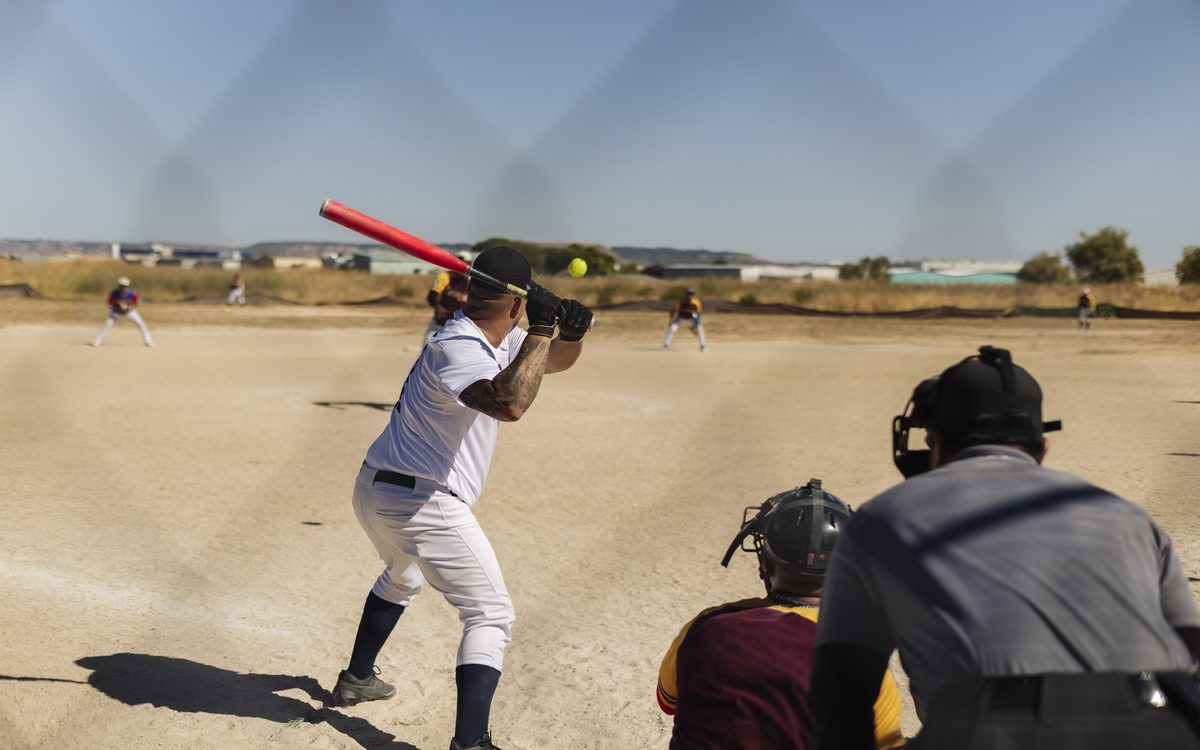
The score is tied, a runner on second hears “go” and tries to beat the throw home with a headfirst slide into a base bolted to the ground. That one moment, a fast stop against an anchored base, is behind more slow-pitch injuries than anything else researchers have counted. Slow-pitch injury prevention is the set of habits around a recreational player, a warm-up, safer bases and sliding rules, gradual conditioning, the right gear and honest reporting of pain, that aim to lower the chance of getting hurt. They lower the odds. They cannot promise anything.
Quick answer: The best-supported step in slow-pitch is the simplest: break-away (quick-release) bases, which cut sliding injuries sharply in a controlled study. After that, the sensible habits are a warm-up before first pitch, getting stronger before the season, treating heat seriously, and asking whether face protection fits in your league. Most other advice is general sports medicine, not slow-pitch research. See a sports medicine doctor, physical therapist or athletic trainer if pain stays in one spot or you cannot put weight on a limb, and call 911 after a head injury with danger signs.
General information, not medical advice. This page is about lowering risk. What the injuries look like and how rehab works is on our slow-pitch injuries page, so we do not repeat it here. For the sport as a whole, start at the slow-pitch softball hub.
Break-away bases and safer sliding
This is where the evidence is. In a prospective study published in JAMA in 1988, Janda and colleagues in Ann Arbor, Michigan, played 633 games on fields with break-away bases and 627 on fields with standard stationary bases. There were 45 sliding injuries on the stationary-base fields and 2 on the break-away fields. A follow-up across 1,035 games on break-away fields saw 2 sliding injuries. The authors, who began from an earlier finding that sliding caused 71% of recreational softball injuries, concluded that break-away bases should be mandatory. A CDC report on the same study gave a rate ratio of 22.7 and said the bases did not significantly delay play. The study is old, local and run by the researchers who proposed the bases, so treat the exact size of the effect with some caution; the direction is clear.
An earlier Hawaii study of 83 injured slow-pitch players (Wheeler, 1984) found 42% were hurt sliding, and suggested recessed bases, quick-release bases, safer sliding technique or eliminating the slide. The American Academy of Orthopaedic Surgeons (OrthoInfo) adds, for baseball and softball in general, that older players should practice sliding on a sliding bag before sliding in games, and that a double bag at first base gives the runner and fielder separate bases. Ask your league what its sliding rules are.
Warm up before first pitch
We did not find a warm-up program tested in slow-pitch players. What published programs share is general: OrthoInfo recommends easy calisthenics, light walking or jogging, then position-specific stretches for the back, hamstrings and shoulders, saving longer static stretches for after the game. A 2012 systematic review (Herman and colleagues, BMC Medicine) found that neuromuscular warm-ups, such as the FIFA 11+, reduced lower-limb injuries in young amateur football and basketball players. Those were not softball players, so the result is a hint that a structured, dynamic warm-up is worth trying, not proof it works in slow-pitch.
Build up before the season
Many recreational players do nothing between September and April, then play two games on opening night. Loosli and colleagues, who surveyed adult slow-pitch players and reviewed clinic records (1988), noted that many injuries were chronic or not from a single traumatic event, and suggested preseason conditioning and strengthening. A 2021 review of throwing injuries (Paul and colleagues) in fastpitch softball found decreased range of motion, unbalanced strength and fatigue as risk factors, and focused on rotator cuff strength and hip and glute motion. It excluded slow-pitch articles, so it applies by analogy. A practical reading is to start light, add games and throwing gradually, and keep your hamstrings and hips strong; see the training page.
Heat, fields and the environment
Evening leagues still play in summer heat. The National Athletic Trainers’ Association position statement on exertional heat illness recommends gradual heat acclimatization and treats exertional heat stroke as an emergency: cool the person first, then transport, and call 911. Drink before, during and between games, and take a break in shade if you feel dizzy, nauseated or unusually tired. Look at the field before you play too: a hole, a wet patch or a loose bag can end a season. OrthoInfo lists unsupportive or slippery shoes and uneven surfaces among ankle sprain risk factors, so wear shoes with good grip and ankle support.
Protective equipment and fit
This is the part where a verified fact and a maker claim need to be kept apart.
- Batted-ball speed. A 2005 laboratory study (McDowell and Ciocco, British Journal of Sports Medicine) found that slow-pitch bats with polyurethane softballs produced batted-ball speeds of 134.0 to 159.7 km/h (roughly 83 to 99 mph), leaving a pitcher between 0.409 and 0.361 seconds to react. The recommended limit was 137.2 km/h (about 85 mph). The authors concluded that high-tech bats with these balls can exceed the limit. That is why pitchers and infielders are the ones to ask about face protection.
- Face and head. A US emergency department study of softball injuries (Birchak and colleagues, 2013) found that being hit by a ball caused 52.4% of injuries, including 89.6% of face injuries and 75.7% of head injuries. The authors urged more use of face guards, mouth guards, safety softballs and break-away bases. Whether a fielder’s mask is allowed or required depends on your league, so ask before you buy.
- Batting helmets and shoes. OrthoInfo says to wear a batting helmet at the plate, in the on-deck circle and while running bases (that is baseball guidance), and to choose shoes with good traction and ankle support, broken in before games. Whether your league requires helmets varies.
- Maker claims. A listing is the maker’s description, not a test. Our gear page separates the two.
What prevention cannot do
Break-away bases reduced sliding injuries in one study, not all injuries, and the authors of that study noted that poor judgment, technique and alcohol use still need attention. A good warm-up and strong legs make a hamstring or ankle injury less likely but do not remove the risk. No piece of equipment makes a hit to the head or face safe.
When to see a professional
- Pain that stays in one place, comes back every time you throw or run, or wakes you at night.
- Swelling, a joint that feels loose, or trouble putting weight on a foot (OrthoInfo recommends seeing a doctor if symptoms resemble a broken bone or last several weeks).
- Any head injury: the CDC HEADS UP guidance is to recognize the signs, take the player out of the game and refer them to a healthcare provider, and call 911 for danger signs such as repeated vomiting, a seizure, worsening headache or loss of consciousness.
- Signs of heat illness that do not settle quickly with cooling and rest: call 911 if someone is confused or collapses.
Slow-pitch injury prevention FAQs
What is the most common way to get hurt playing slow-pitch?
Sliding. Wheeler’s 1984 Hawaii study found 42% of injuries came from sliding, and a 10-year Air Force review (Burnham and colleagues, 2010) found sliding, being hit by a ball and colliding with another player accounted for 60% of reported softball injuries.
Do break-away bases really work?
In the Janda study they cut sliding injuries from 45 to 2 across roughly equal numbers of games. It is one local study, but the CDC reported its results and the direction is strong. If your field has them, use them.
Should I wear a mask in slow-pitch?
It is a personal choice within your league’s rules. Being hit by a ball caused most face and head injuries in a national study of softball, and slow-pitch bats can produce high ball speeds, so pitchers and infielders may want to ask about face protection.
How do I protect myself in the heat?
Drink before and during games, take a break in shade, and learn the signs of heat illness. The NATA statement treats suspected exertional heat stroke as an emergency: cool first, transport second, call 911.
Sources
- Janda et al. 1988, Softball sliding injuries, JAMA (PubMed)
- Janda et al. 1990, A three-phase analysis of the prevention of recreational softball injuries, Am J Sports Med (PubMed)
- CDC MMWR, break-away bases and sliding injuries
- Wheeler 1984, Slow-pitch softball injuries, Am J Sports Med (PubMed)
- Burnham et al. 2010, Mechanisms of slow-pitch softball injuries, Air Force Safety Center (PubMed)
- Loosli et al. 1988, Injuries in slow-pitch softball, Phys Sportsmed (PubMed)
- Birchak et al. 2013, softball injuries in US emergency departments (PubMed)
- McDowell and Ciocco 2005, batted ball speed in slowpitch (PubMed)
- Paul et al. 2021, injury prevention programs for throwing injuries in softball players, Sports Health (PubMed)
- Herman et al. 2012, neuromuscular warm-up strategies, BMC Med (PubMed)
- NATA position statement, exertional heat illnesses (PubMed)
- CDC HEADS UP, signs and symptoms
- OrthoInfo (AAOS), Baseball injury prevention
- OrthoInfo (AAOS), Sprained ankle
General information for education only, not medical advice. It does not replace a visit with a doctor, physical therapist or athletic trainer. See how we write and check our pages in our editorial policy.