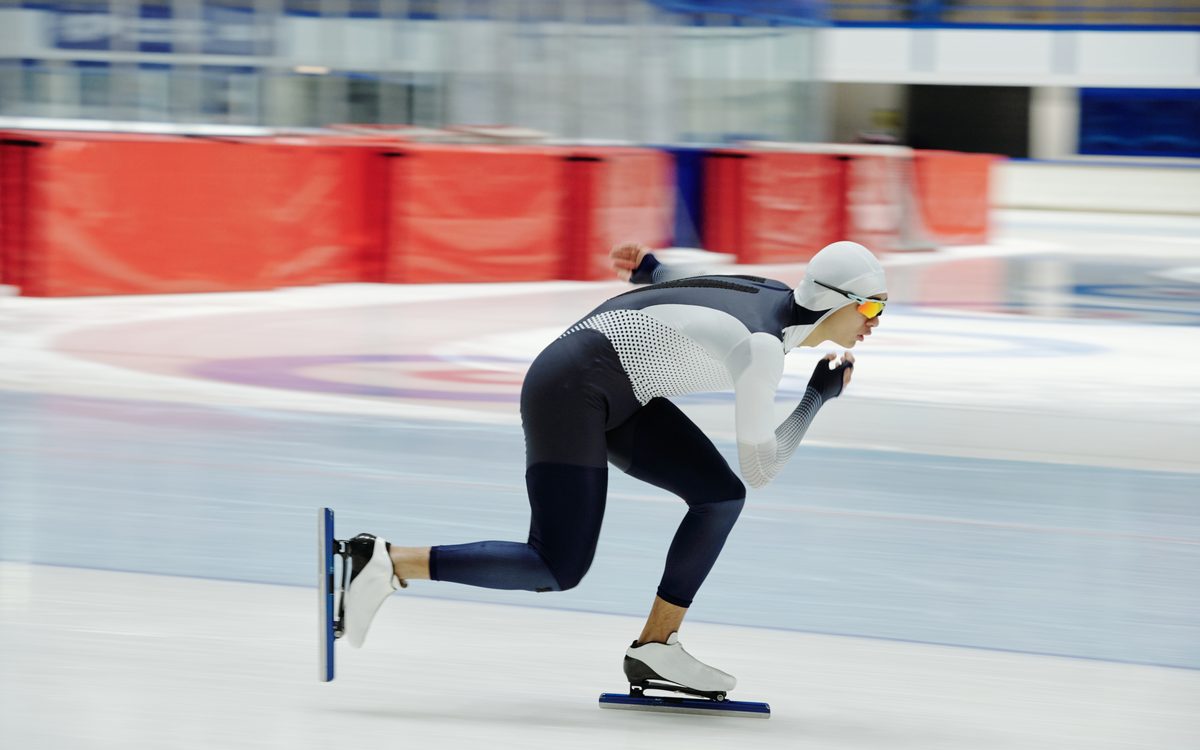
It is 5:45 a.m. and the oval is cold and quiet. A skater who skipped dinner and rushed past breakfast is lacing up for a two-hour session that will include a set of starts. Speed skating is a sport of hundredths of a second, so it is tempting to chase a lighter body. Long track speed skating nutrition is about the opposite: eating enough, at the right times, to support a lot of training. This page covers fuel and fluid, protein, relative energy deficiency in sport (REDs) awareness, bone health and supplements. It is general education, not an individual diet plan. For training load see the training page, and for the sport overall see the speed skating hub.
Quick answer: Eat enough to cover training. The 2016 ACSM, Academy of Nutrition and Dietetics and Dietitians of Canada position gives ranges, for example 6 to 10 g of carbohydrate per kg of body weight per day for 1 to 3 hours of daily exercise, and 1.2 to 2.0 g of protein per kg. Supplements are not required, can contain banned substances, and should be chosen with a doctor or sports dietitian. If a skater is losing weight on purpose, missing periods, getting repeated injuries or feeling constantly tired, see a doctor or sports dietitian.
Fueling a heavy training load
The 2016 joint position statement (Thomas, Erdman and Burke, Med Sci Sports Exerc) gives daily carbohydrate ranges by training load: 3 to 5 g/kg for light training, 5 to 7 g/kg for about an hour a day, 6 to 10 g/kg for 1 to 3 hours a day, and 8 to 12 g/kg for 4 to 5 hours. A 2026 review put elite skaters at 900 to 1,100 training hours a year (Sperlich et al.), so many skaters are in the high ranges on big days. As arithmetic only, a 60 kg skater at 6 to 10 g/kg would be 360 to 600 g of carbohydrate a day. Those are ranges for athletes in general, and a sports dietitian can tailor them. We did not find skating-specific carbohydrate targets. Practical foods are general: rice, pasta, potatoes, oats, fruit, bread, with a snack before and after hard sessions.
Protein
The same statement gives 1.2 to 2.0 g/kg a day and suggests 15 to 25 g of protein after exercise. Spreading protein across meals is general practice. Food first (dairy, eggs, meat, fish, beans, tofu); powders are a convenience.
Hydration in a cold rink
We did not find skating-specific fluid guidance. Cold air does not remove sweat loss, since skaters work hard in layers or a suit, so general sports nutrition advice is to start sessions hydrated, drink to thirst during long sessions and rehydrate afterward.
Weight, body image and REDs
Speed skating is not a weight-class sport, but some skaters feel pressure to be lean for a fast time. The IOC’s 2023 consensus on Relative Energy Deficiency in Sport (Mountjoy et al., Br J Sports Med) describes REDs as a syndrome of health and performance problems in female and male athletes caused by low energy availability, meaning too little energy intake for the energy used in exercise. It lists possible effects on reproductive function, bone, metabolism, immunity, mental health and performance. Missing menstrual periods are one sign in female athletes; the statement notes primary amenorrhea as no periods by age 15. Low energy availability can be unintentional, such as long sessions and busy days.
Awareness is a known gap. In a 2026 survey of Russian coaches in athletics and short track speed skating, 39 of 99 coaches (39.4%) reported prior awareness of RED-S (Bezuglov et al., Sports). That is a survey of coaches in another country, but it shows why skaters and parents should learn the signs. If you are worried about eating or body image, talk to a doctor or sports dietitian. The ANAD Eating Disorders Helpline in the US is 1-888-375-7767.
Bone health and the season
In 12 elite skaters, whole-body bone mineral content was 1.0% higher before the season and 0.8% higher at its end than at mid-season, which the authors linked to training-load fluctuations (Varley et al., Int J Sports Med, 2019). It is a small study. Calcium and vitamin D come up often in advice for young athletes, but how much a person needs depends on diet, sun and health, so ask a doctor before supplementing. Rink athletes training early or late may get little sun, a general observation rather than a finding.
Iron
Female athletes and growing teens may have higher iron needs, according to the ACSM statement. The 2021 UEFA expert group statement warns that routine iron supplementation can do more harm than good. Check with a doctor if a skater is unusually tired; blood tests, not guessing, decide.
Supplements: what the major bodies say
The IOC consensus on dietary supplements (Maughan et al., Br J Sports Med, 2018) says only a few supplements have good evidence for performance, such as caffeine, creatine and nitrate, with others less certain, and that the benefit depends on the event and the person. In one study of world-class short track skaters, nitrate did not improve performance (Richard et al., IJSPP, 2018). Many athletes take creatine for strength training and it is one of the most studied supplements, but the AAP’s Council on Sports Medicine and Fitness (LaBotz and Griesemer, Pediatrics, 2016) advises against performance-enhancing substances such as creatine in young athletes, and an AAP clinical report (2011) says energy drinks are not appropriate for children and adolescents.
The bigger risk is contamination. The IOC and USADA note that supplements may contain substances not on the label, and skaters at national and international level can be drug tested, with the athlete responsible for what is in their body. USADA says no supplement is 100% risk free and recommends choosing products with third-party certification. We give no doses. Read the label, ask a doctor or sports dietitian, and check with your national anti-doping agency before using any product.
Long track speed skating nutrition FAQs
How many calories does a long track skater need?
It varies with size, age and training. We did not find skating-specific numbers; a sports dietitian can estimate it.
Should skaters take protein powder?
Most protein needs can be met with food. Powders are a convenience. If you use one, look for third-party testing.
Do skaters need to be light?
Speed skating has no weight classes. Chasing a low weight can cause REDs, so see a doctor if worried.
Are supplements safe if they are on a store shelf?
Not necessarily. USADA says no supplement is 100% risk free, so look for third-party certification and ask your anti-doping agency.
Can a doctor test iron or vitamin D?
Yes. Blood tests are the safe way to decide on iron or vitamin D, not guessing.
Sources
- ACSM, Academy of Nutrition and Dietetics, Dietitians of Canada, Nutrition and Athletic Performance, 2016 (PMID 26891166)
- Mountjoy et al., IOC consensus statement on REDs, Br J Sports Med 2023
- Sperlich et al., Olympic Ice Sports, 2026
- Varley et al., Int J Sports Med 2019
- Bezuglov et al., RED-S awareness among coaches, Sports 2026
- UEFA expert group statement on nutrition in elite football, 2021 (iron)
- Maughan et al., IOC consensus on dietary supplements, Br J Sports Med 2018
- Richard et al., nitrate in short track skaters, Int J Sports Physiol Perform 2018
- LaBotz and Griesemer, Use of Performance-Enhancing Substances, Pediatrics 2016 and AAP, Sports drinks and energy drinks for children and adolescents, Pediatrics 2011
- USADA, Supplement Connect
- ANAD Eating Disorders Helpline
General information for education only, not medical advice. It does not replace a visit with a doctor or registered dietitian. See how we write and check our pages in our editorial policy.