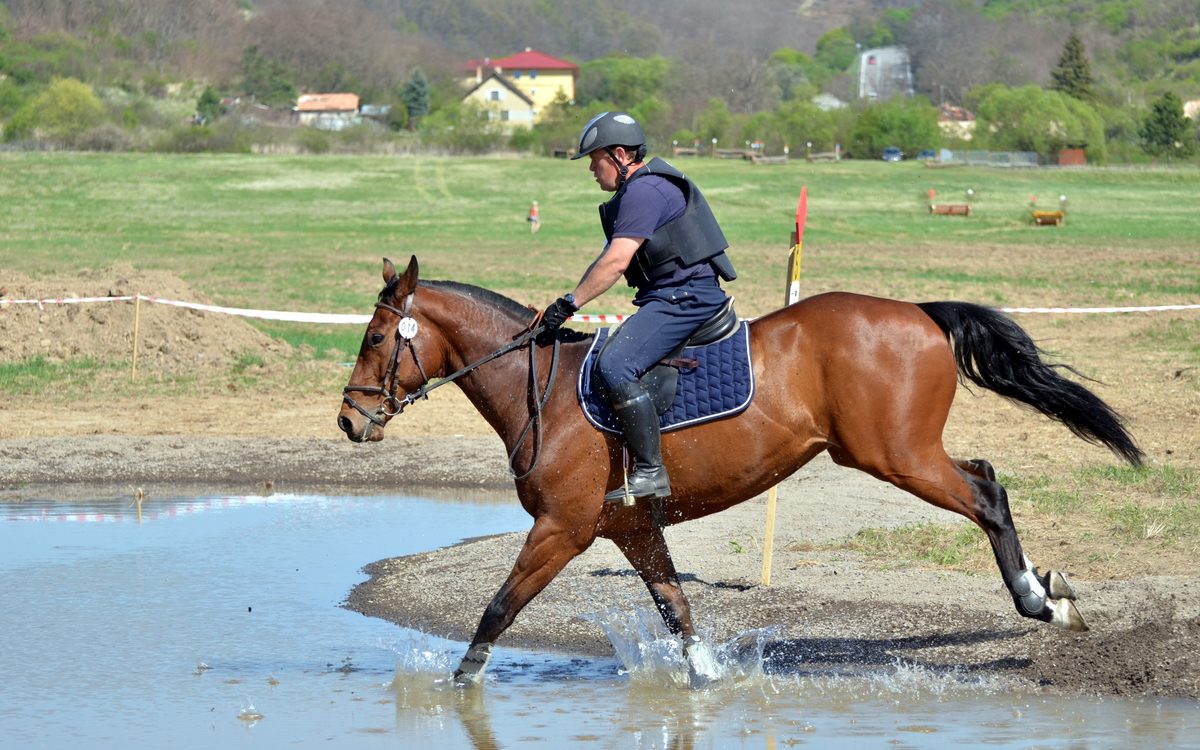
The alarm goes off before the barn is awake. A rider in the saddle for the first lesson of the day sits tall through a flatwork session, then spends twenty minutes on the ground doing planks and single-leg balance work in the aisle, because the course she wants to ride in the spring will ask more of her legs and lungs than any single lesson does. Eventing training means preparing the rider (this page) and the horse (your coach and vet) for three different physical jobs. We cover the rider side: what the sport asks of the body, and how riders commonly organize a week.
Quick answer: Eventing is a real cardiovascular workout, especially cross-country, where studies in riders have measured heart rates near 180 beats per minute. Most riders also need strength, balance and core work off the horse, because riding alone often does not build it. A sensible week mixes riding, aerobic work, strength and rest. The structure below is general coaching practice, not a prescription; ask a qualified coach or physical therapist to tailor it.
What eventing asks of the rider
Research on riders is small and scattered, but a few findings are consistent. A 2023 review of the physiology and nutrition of equestrian riders (Best and colleagues) reported average heart rates of about 150 to 185 beats per minute, with near-maximal values around 200, in sports with a larger muscle mass involved such as cross-country eventing. It also noted that heart rate and oxygen demand can drift apart in long periods in a jumping position, probably because repeated isometric muscle contractions raise blood pressure.
A small study of 16 female collegiate riders in a simulated Pre-Novice horse trial measured how the load rose across phases (Comparative Exercise Physiology, published 2010):
| Phase | Oxygen uptake (ml/kg/min) | Heart rate (beats/min) |
|---|---|---|
| Dressage | 20.4 | 157 |
| Show jumping | 28.1 | 180 |
| Cross-country | 31.2 | 184 |
So cross-country is the most demanding phase by these measures, but the numbers come from one small sample at the lowest level; higher-level riders on bigger courses may differ. A University of Worcester thesis on female novice event riders reported heart-rate strain close to maximal, while blood lactate data did not clearly support that, so the cardiac load looks high while the muscular load looks moderate. Treat these as pieces of the picture, not a formula.
The Best review also gives approximate energy costs by gait, from about 3.4 METs at walk to 6.2 at trot and 7.7 at canter. A 2025 narrative review found that riders often neglect structured off-horse conditioning even though riding itself has moderate to vigorous cardiovascular demands, and that targeted core training, cross-training and nutrition support improved balance and reduced back pain in the studies it examined.
A sensible weekly shape
No published eventing study prescribes one weekly plan, so the structure below is common coaching practice, shown as an example of how the pieces fit rather than as a recipe. Most adult riders start from public health guidance: the CDC and the World Health Organization recommend at least 150 minutes of moderate activity a week for adults plus muscle-strengthening on two or more days.
| Day | Example focus | Why |
|---|---|---|
| Mon | Rest or easy walk, mobility | Recovery after weekend competition or schooling |
| Tue | Flatwork lesson plus 20 to 30 minutes of strength (squats, hip hinges, rows, core) | Seat control and the muscles that support it |
| Wed | Aerobic session off the horse (jog, bike, swim) at a conversational pace | Cardiovascular base for cross-country |
| Thu | Jumping lesson or gridwork | Skills and rhythm over fences |
| Fri | Short balance and core circuit, mobility | Stability without heavy fatigue before the weekend |
| Sat or Sun | Schooling, cross-country practice or competition | Putting the pieces together |
Adjust for school, work, the horse’s own fitness plan and your history of injury. A horse is also an athlete with its own conditioning timeline, so rider fitness work should not squeeze the horse’s rest days.
Strength, conditioning and skills
- Core and trunk. A 2025 review linked correct pelvic orientation, dynamic trunk control and even weight distribution with better saddle pressure and equine gait. Plank variations, dead bugs and carries are common choices.
- Legs and hips. Squats, lunges, step-ups and single-leg work support the two-point (jumping) position. A strong lower body also helps with the up-and-down of cross-country.
- Symmetry. The same review found that riders often do not know they are asymmetrical, and asymmetry leads to uneven loading. A coach or physical therapist can look at it, and mirrors or video from the ground help.
- Aerobic base. Steady running, cycling or swimming builds the engine for cross-country. Interval work is sometimes added later; ask a coach before adding it.
- Skills. Flatwork, grids, show-jumping courses and cross-country schooling build the technical side. Time on horses matters as much as gym time.
Periodisation basics
Periodisation means planning the year in phases so training builds toward the events that matter. This is general coaching practice, not an eventing-specific rule. A common outline for riders: a base phase in the off-season focused on general fitness, strength and flatwork; a build phase with more jumping and aerobic intensity; a competition phase where volume drops a little and the focus is on sharpness and recovery between events; and a transition phase for rest and mobility. Your calendar of horse trials, the horse’s own plan and your work or school schedule will shape the details.
Load management matters. A Swedish study of adult eventing riders found that attitude to risk-taking predicted injury, and that riders moving up to higher qualification groups needed care, which fits a cautious approach to adding intensity. See eventing injury prevention and eventing recovery.
Using a heart-rate monitor
Wearables can show how hard a session is. The 2023 review notes that heart rate and oxygen cost can separate in two-point positions, so a high number on cross-country does not map exactly to effort. Use trends over weeks rather than single readings, and check your gadget’s limits with a coach. See also our horseback riding wearables guide.
When to get help
If pain stays in one place, appears at rest or changes how you ride, see a sports medicine doctor, physical therapist or athletic trainer. A concussion needs medical care before returning to riding; see the CDC HEADS UP guidance. For the whole discipline, return to the eventing hub or the broader horseback riding training page.
Eventing training FAQs
How fit do I need to be for eventing?
Cross-country has been measured at heart rates near 180 beats per minute in riders, so a solid aerobic base helps. The right level depends on your event level; a coach can help you judge it.
Do I need to go to the gym?
Many coaches suggest off-horse strength and core work because a 2025 review found riders often skip structured conditioning. You do not need a gym: bodyweight and bands at home work for the basics.
How many days a week should I ride?
There is no published eventing standard. Many riders ride most days but include easier days and rest, and the horse’s workload matters as much as yours.
Is cross-country harder than dressage on the body?
By heart rate, yes in the one small study we found: 184 versus 157 beats per minute. Dressage still asks for precise control and endurance in the core.
Can I get fit for eventing by riding alone?
Riding builds skills and some fitness, but reviews suggest it often does not cover strength, core and aerobic needs on its own.
Sources
- Best R et al. 2023, Physiological requirements and nutrition for equestrian riders (PubMed)
- Best et al. 2023, Nutrients, full text (PMC)
- Comparison of the metabolic cost of the three phases of the one-day event in female collegiate riders (Comparative Exercise Physiology)
- University of Worcester thesis on female novice event riders (Douglas)
- Narrative review of rider performance factors, 2025 (PubMed)
- Swedish eventing injury study (PubMed)
- CDC adult physical activity guidelines
- WHO 2020 guidelines on physical activity and sedentary behaviour (PubMed)
General information for education only, not medical advice. It does not replace a sports medicine doctor, physical therapist, athletic trainer or qualified coach. See our editorial policy for how we research and write.