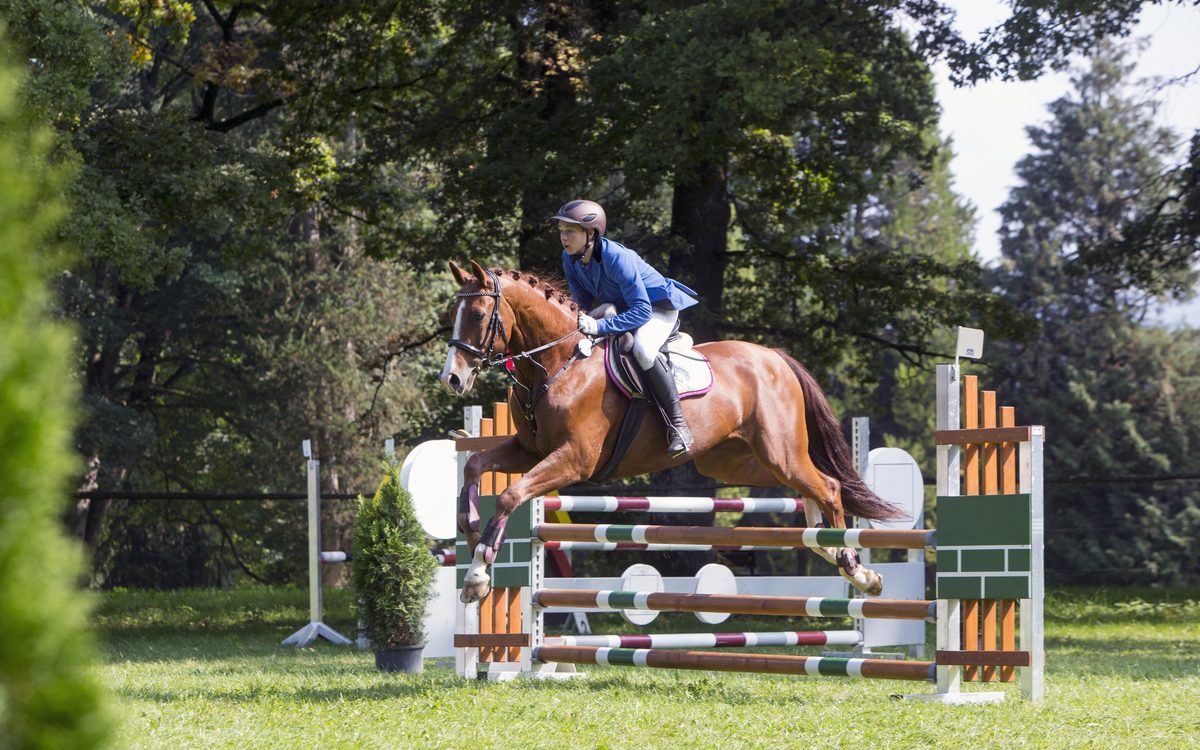
A teenage rider is schooling a green horse at home on a weekday evening, no one watching, no helmet strap checked because it is “just a quick ride.” Then the horse spooks at a rail. In a German survey of show jumpers, 84.1% of reported falls happened in training, not at shows. Show jumping injury prevention is the set of habits around a rider and horse, from helmets and warm-ups to a sensible jump count and rest, that aim to lower the chance of getting hurt. They lower the odds. They cannot promise anything.
Quick answer: The best-supported steps are a certified, well-fitted helmet worn on every ride, a body protector or safety vest for jumping, riding a horse and fences that suit your level, building height and workload gradually, and keeping strong and mobile off the horse. Most of the research is self-reported or observational, so treat these as sensible habits, not guarantees. See a sports medicine doctor, physical therapist or athletic trainer if pain stays in one place or you hit your head, and call emergency services for danger signs after a head injury.
General information, not medical advice. This page is about lowering risk. What each injury looks like is on our show jumping injuries page, so we do not repeat it. For the sport overview, start at the show jumping hub.
Warm up the rider, not just the horse
We did not find a published injury-prevention warm-up program tested in show jumpers. General sports-medicine advice is to start with easy movement and dynamic stretches that raise body temperature, and many riders do hip, trunk and shoulder mobility before getting on, then walk and trot on a loose rein before cantering or jumping. That is common coaching practice, not a tested routine.
Technique and riding to your level
A 2011 survey of 264 show jumpers found professionals had fewer injuries per hour than amateurs (1.1 against 2.1 per 1,000 hours) but more severe ones, and the authors suggested that a performance-oriented riding style and readiness to take risks may be part of the reason (Lechler and colleagues). Practical habits that trainers commonly teach, as general practice and not trial results: jump fences and distances you can ride calmly, school new horses and new courses at modest heights, and stop the session when either of you is tired or tense.
Progressive load
Most falls in the German survey of 363 show jumpers (Meyer and colleagues, 2022) came in training: 12,788 of the 15,215 reported falls, or 8.3 falls per 1,000 riding hours across the group. That points to training sessions as a place to be careful, not only competitions. The AAP’s clinical report on young athletes advises at least one to two days off a week and a break of about three months a year from any single sport. A 2024 survey of 347 riders found lower back pain was more likely with higher weekly riding workloads and with daily stable chores (Duarte and colleagues), so count the barn work. We found no published rule such as “raise fence height by X per month,” so ask your instructor to progress heights and workload step by step.
Strength and conditioning
A 2025 pilot study of 12 elite junior equestrian athletes found hip flexion contractures in every show jumper and hip adductors 8 to 19% stronger than abductors (Havertz and colleagues). It is a tiny sample and not proof. Ask a physical therapist or strength coach to check your hip mobility, trunk control and left-right symmetry, then build strength in legs, hips, trunk and upper back. See show jumping training for the weekly shape and recovery and mobility for flexibility work.
The ground, the horse and handling
Not all horse injuries happen in the saddle. In a study of US emergency-department visits from 2001 to 2003, CDC authors found about two-thirds of injured people were mounted and one-third were not, and the unmounted were kicked most often (Thomas and colleagues, 2006). Extension services teach basics such as approaching a horse at the shoulder while speaking, never wrapping a lead rope around your hand, and tying with a halter and a quick-release knot. We found no sourced numbers for arena footing, so check that footing, fence cups and poles are in good repair and that a safe jump is set up for the horse, as general practice.
Protective equipment and fit
US Equestrian rules (GR801) make an approved helmet compulsory when mounted at licensed competitions, and allow body protectors in any class, recommending ASTM F1937 or SEI standards. The USEF accepted-standards list names ASTM F1163 through SEI, PAS 015, VG1 01.040 and Snell, and says a helmet should be fitted by someone qualified.
| Finding | Source and size | What it can and cannot say |
|---|---|---|
| Helmet wearers had fewer head injuries (4.7 vs 9.1 per rider) and shorter total injury time | Meyer et al. 2022, 363 German show jumpers, self-reported | An association, not proof; the overall injury rate did not differ |
| Vest wearers had fewer spinal injuries (2.9 vs 4.7 per rider) | Same survey; only 14% often or always wore a vest | An association from a small group |
| Helmets protect against skull fracture and TBI; vests were not linked to less spinal cord injury but may protect the chest | Crawford et al. 2025, systematic review of 53 papers | The review supports helmets more clearly than vests |
| Head injury risk was similar across helmet brands and with or without MIPS | Gould et al. 2025, 357 collegiate riders | No evidence that a pricier or MIPS helmet is safer |
In that collegiate study, 78% of riders said they would not replace a helmet after every fall. Makers such as Troxel advise replacing a helmet after any impact; that is maker guidance, not a regulation. Check the certification label yourself and have the fit checked. Our gear page covers inspection and the difference between standards and maker claims.
What prevention cannot do
Nothing on this page removes the risk of a fall. Jumping is physical contact with a large moving animal over fixed or heavy obstacles. A fall can still cause serious injury. If you hit your head, stop, tell someone and follow the CDC HEADS UP rule (recognize and remove): a healthcare provider decides when to return. Call emergency services for danger signs such as repeated vomiting, a seizure or a worsening headache, and do not move someone with a possible neck or back injury.
Show jumping injury prevention FAQs
Should I wear a body protector for show jumping?
USEF rules allow one in any class, and recommend ASTM F1937 or SEI standards. A German survey found fewer spinal injuries among riders who wore a vest, but it was a small, self-reported group, and a 2025 review found vests were not clearly linked to less spinal cord injury. It is a personal choice to discuss with your trainer.
How often should I replace my riding helmet?
Makers such as Troxel advise replacing a helmet after any impact and after a set number of years. Follow the maker’s instructions on the helmet label, and replace it after a fall even if it looks fine.
When do most show jumping falls happen?
In a German survey of 363 riders, 84.1% of reported falls happened in training. That does not make shows safe, but it means home riding deserves the same care.
Does a MIPS helmet reduce concussion risk?
A 2025 study of 357 collegiate riders found head injury risk was similar with and without MIPS. A certified helmet that fits matters more.
Can stretching prevent riding injuries?
We did not find riding-specific evidence that stretching alone prevents injuries. Dynamic warm-ups, strength work and sensible workload are better supported as general sports practice.
Sources
- Meyer et al., injuries and overuse injuries in show jumping, Int J Environ Res Public Health 2022 (full text)
- Lechler et al., traumatology and sport injuries in show-jumping competitors, 2011
- Thomas et al., horse-related injuries in the US 2001-2003, Br J Sports Med 2006, equestrian maxillofacial injuries, Ir J Med Sci 2025
- Crawford et al., CNS and thorax injury in equestrian sports, Sports Health 2025, Gould et al., equestrian helmet type, Clin J Sport Med 2025
- Duarte et al., lower back pain in riders, Sports 2024, Havertz et al., young elite equestrian athletes, 2025, AAP, young athletes and intensive training, 2016
- USEF GR8: Conduct of Licensed Competitions (GR801) and USEF list of applicable international helmet standards
- Troxel helmet certifications (maker guidance), Penn State Extension: safe horse handling, Basic Horsemanship Principles
- CDC HEADS UP: response
General information for education only, not medical advice. It does not replace a visit with a doctor, physical therapist or athletic trainer. See how we write and check our pages in our editorial policy.