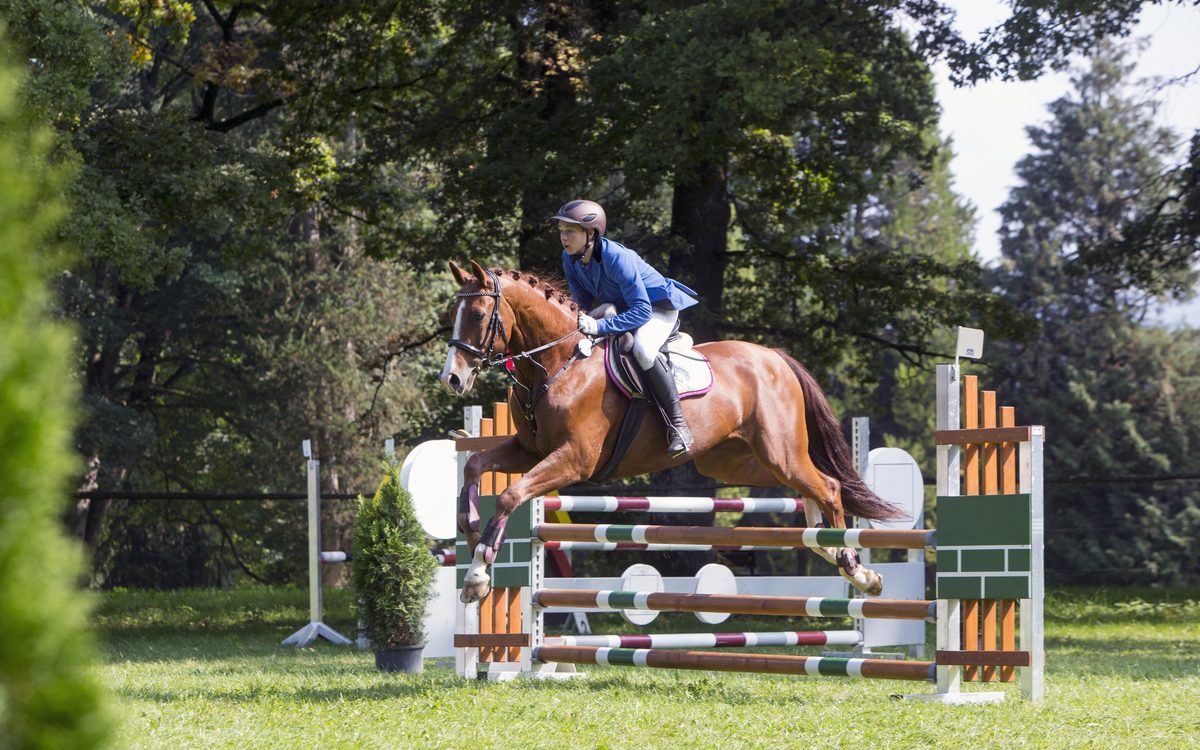
The truck is unloaded, the horse is rugged and fed, and the rider finally sits down on a tack trunk at the end of a long show day. Her hips feel tight, her lower back is sore, and tomorrow there are two more classes. Show jumping recovery is everything a rider does between rides to be ready for the next one: sleep, food, easing off when training piles up, and keeping joints mobile. This page covers what the evidence supports, where it is weak, and how to tell normal soreness from an injury. It is general information for riders, and the horse’s own recovery is a separate topic for your vet and trainer.
Quick answer: Sleep, enough food and fluids, regular rest days and a sensible training load are the best-supported parts of recovery. Massage may reduce soreness, but cool-downs, stretching and many gadgets have weaker or mixed evidence, and we found no recovery trials in show jumpers. Muscle soreness usually eases over days; sharp, one-sided, worsening or night pain, swelling, or any head, neck or back symptoms after a fall are reasons to see a sports medicine doctor, physical therapist or athletic trainer.
Sleep
The American Academy of Sleep Medicine and the Sleep Research Society recommend that healthy adults sleep at least seven hours a night. For young people the AASM consensus is 8 to 10 hours for ages 13 to 18 and 9 to 12 hours for ages 6 to 12. Show days make this hard: early loading, late classes and strange beds. General practice, not a study result, is to plan your own sleep when you plan the horse’s schedule, and to avoid planning a 4 a.m. start on the night before an important class if you can avoid it.
Load management and rest days
Recovery is mostly about not piling load on load. The AAP’s clinical report on young athletes advises one to two days off a week and about three months a year away from a single sport. A 2024 survey of 347 riders found lower back pain more likely with higher weekly riding workloads and daily stable duties (Duarte and colleagues), so barn work counts. Meyer and colleagues found most falls among German show jumpers came in training (84.1%), so tired training rides are worth thinking about. A common practice, which we cannot back with a trial, is to follow a hard jumping day or a multi-day show with a lighter day of flatwork or a day off. Our training page covers weekly shape.
Mobility and flexibility
Riders use their hips, thighs and trunk in set positions for a long time, and a small 2025 study of 12 elite junior riders found hip flexion contractures in every show jumper (Havertz and colleagues). A 2022 study of 147 riders found most were uneven in how they loaded the stirrups (Baragli and colleagues). Neither study tested whether stretching fixes anything. Many riders and therapists still use easy hip, thigh, calf and upper-back mobility work and ask a physical therapist to check asymmetry. That is general practice.
Cool-down, massage and other methods: what the evidence says
| Method | What the research says | How sure we are |
|---|---|---|
| Active cool-down | A 2018 review (Van Hooren and Peake) found it largely ineffective for next-day soreness and performance, and not shown to prevent injuries | Fair; not riding-specific |
| Massage | A 2018 meta-analysis of 99 studies (Dupuy and colleagues) found massage the most effective of the methods for soreness and perceived fatigue | Moderate; short-term relief |
| Other methods (compression, cold or contrast water, cryotherapy, active recovery) | The same meta-analysis found small to large reductions in soreness for several of these, and no change for the other methods it examined | Mixed; results vary by method |
| Foam rollers, massage guns and gadgets | No show-jumping studies found; maker claims are not evidence | Weak |
None of these tested show jumpers. They are studies of other exercise, so treat them as hints. If a method feels good and is safe for you, it is fine to use; just do not rely on it instead of sleep and food. People with circulation problems, injuries or other health conditions should ask a doctor before using compression, cold or heat.
Refuelling after a ride
The 2023 review in Nutrients (Best and colleagues) suggests 1 to 2 grams of carbohydrate per kilogram of body weight within three hours of competition and 25 to 40 grams of protein within one to three hours, especially when you ride several classes. For fluids, the ACSM position stand says to aim to limit water loss to under 2% of body weight and that individual sweat rates vary. Details are on nutrition and supplements.
Soreness or injury?
Delayed muscle soreness after an unusual ride is dull, widespread, tender to press and eases over a few days. Warning signs of something more are sharp or catching pain, pain in one spot that gets worse, swelling, a joint that gives way, numbness or tingling, pain at rest or at night, or pain that changes how you sit or jump. After a fall, a headache, dizziness, vomiting or confusion means stop and follow the CDC HEADS UP steps, and neck or back pain, or pain in the pelvis, should be assessed by a clinician, because a 2023 study linked spinal and pelvic injuries to falls from a horse (Hoffmann and colleagues). More on patterns and when to get help is on show jumping injuries.
Show jumping recovery FAQs
How much sleep does a show jumper need?
Healthy adults should sleep at least seven hours a night according to the AASM and SRS. The AASM pediatric consensus is 8 to 10 hours for ages 13 to 18. Sleep is one of the few recovery habits with broad support.
Does stretching prevent soreness?
Stretching was not among the methods the 2018 meta-analysis listed as reducing soreness. Mobility work may still feel useful for stiffness, but it is not proven to prevent soreness or injury.
Is massage worth it after riding?
In the 2018 meta-analysis, massage was the most effective method for soreness and fatigue. It was not tested in show jumpers, and relief is short-term.
How many rest days do riders need?
There is no rider-specific rule. The AAP advises young athletes to take one to two days off a week. Adults vary, so ask a coach or clinician.
When is soreness a sign of injury?
Sharp, one-sided, worsening, swelling, night pain, numbness or any head, neck or back symptoms after a fall point to something more than soreness. See a professional.
Sources
- AASM and SRS, Recommended Amount of Sleep for a Healthy Adult, 2015 and AASM, Recommended Amount of Sleep for Pediatric Populations, 2016
- AAP, Sports Specialization and Intensive Training in Young Athletes, Pediatrics 2016
- Van Hooren and Peake, Do We Need a Cool-Down After Exercise?, Sports Med 2018 and Dupuy et al., recovery techniques meta-analysis, Front Physiol 2018
- Duarte et al., lower back pain in riders, Sports 2024, Meyer et al., show jumpers, 2022, Havertz et al., 2025, Baragli et al., 2022, Hoffmann et al., 2023
- Best et al., Nutrients 2023 and ACSM position stand, Exercise and Fluid Replacement, 2007
- CDC HEADS UP: response
General information for education only, not medical advice. It does not replace a visit with a doctor, physical therapist or athletic trainer. See how we write and check our pages in our editorial policy.