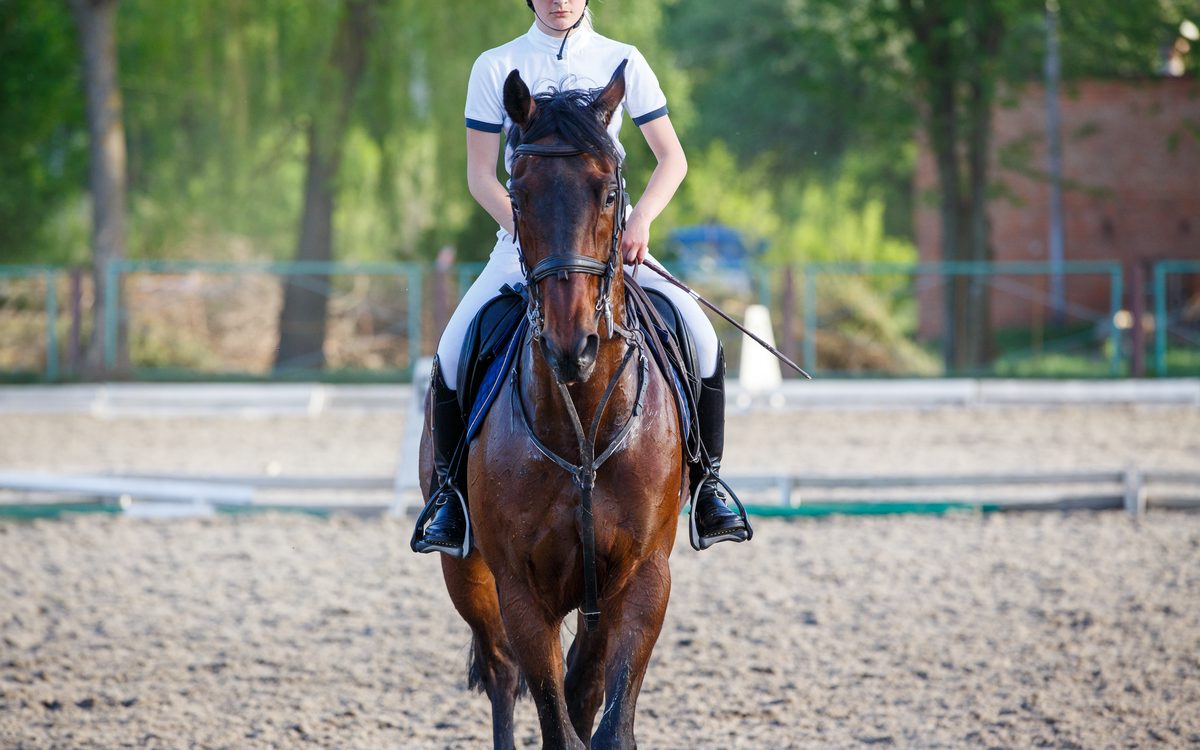
Sunday evening after a two-day show. The horse is cooled out, fed and bedded. The rider has been up since five, ridden three tests, carried buckets, braided and driven two hours home. Her hips are tight, her lower back aches and she has to be at work in the morning. Recovery is the time and habits that let the body adapt to training and bounce back from a hard day. For dressage riders it covers sleep, planned easy days, mobility, food and fluid, and knowing when soreness is just soreness. We say plainly where the evidence for popular recovery tools is weak.
Quick answer: Sleep, enough food and fluid, easy days and gentle movement carry most of the recovery load. Evidence for stretching, foam rolling and massage guns is mixed or small, and we found no rider-specific studies. Ordinary muscle soreness fades within a few days; sharp, one-sided, worsening or night pain, or any symptom after a fall, is a reason to see a sports medicine doctor, physical therapist or athletic trainer.
Sleep first
The CDC and the American Academy of Sleep Medicine and Sleep Research Society consensus say adults should regularly sleep at least 7 hours a night, and the AASM pediatric consensus recommends 8 to 10 hours for 13 to 18 year olds and 9 to 12 hours for 6 to 12 year olds. Show days start early, so plan an earlier bedtime the night before and a lighter morning after. We found no dressage-specific sleep research.
Rest days and load management
Recovery is mostly how you plan the week. The AAP’s 2016 clinical report on young athletes recommends 1 to 2 days off from a sport each week. Riders carry hidden load: a 2024 Portuguese survey of 347 riders (Duarte and colleagues) found low back pain more likely with higher weekly riding workload and daily stable duties, and a 2023 review (Best and colleagues) says grooming and horse care add energy cost. Practical, general coaching habits:
- Schedule at least one rest day from riding and heavy barn work.
- Follow a hard show weekend with an easy day.
- Split or share heavy chores such as hay and water buckets, lifting close to the body, bending hips and knees and not twisting.
- Notice trends: tightness that returns every week is information to share with your coach or physical therapist.
Mobility and flexibility
Dressage asks hips, pelvis and back to follow the horse’s motion without bracing. A 2026 pilot study of four riders (Zeliszewska-Duk and colleagues) used a program of flexibility, mobility and fitness work three times a week and found less irregularity in saddle pressure afterward. It was tiny, but it matches the review evidence that cross-training and core work help balance (Balog and colleagues, 2025). General routines, labelled coaching practice, usually include:
- Gentle hip openers and glute stretches for the hip flexors and adductors that spend hours in the saddle.
- Thoracic (upper back) rotation and extension to counter a rounded posture.
- Walking, cycling or swimming as easy movement the next day.
A 2025 study of 12 elite junior riders in Germany (Havertz and colleagues) found hip adductors were 8% to 19% stronger than abductors, a reminder that strength balance matters too. It is a small sample from one team.
What the evidence says about recovery methods
- Cool-down: a 2018 review (Van Hooren and Peake) concluded cool-downs are largely ineffective for next-day soreness and performance, though they may help the heart and breathing settle. Walking the horse out while you walk beside it is good horse care either way.
- Massage: a 2018 review with meta-analysis (Dupuy and colleagues) found massage was the most effective of the methods it compared for muscle soreness and perceived fatigue. It tested manual massage, not massage guns, so those may or may not give the same effect.
- Foam rollers, massage guns, recovery boots, ice baths and the like: we did not find rider-specific evidence. Many athletes use them for comfort. Our foam roller guide and massage gun guide compare products, and none are a treatment.
- Sleep, food and rest days: the best-supported tools, and free.
Refuel and rehydrate
A 2023 review of equestrian physiology (Best and colleagues) suggests 1 to 2 g of carbohydrate per kilogram of body weight within three hours after competition, sooner if you ride again, with protein alongside, and says alcohol may impair rehydration. A joint position from the ACSM, the Academy of Nutrition and Dietetics and Dietitians of Canada suggests about 15 to 25 grams of protein early in recovery. See dressage nutrition. Heat adds to fluid loss on outdoor show grounds.
Soreness or injury?
Soreness from a hard ride or new strength work is usually widespread, dull, and eases over a few days. Warning signs are different:
- Sharp or catching pain in one spot, or pain that is getting worse after a few days.
- Pain at rest or at night.
- Swelling, numbness, tingling or weakness.
- Any symptoms after a fall or kick.
After a fall, the CDC’s HEADS UP program says symptoms of a concussion can show up hours or days later and that a rider with a possible concussion should be seen by a health care provider before returning. The 2022 Amsterdam consensus (Patricios and colleagues) suggests a short period of relative rest of 24 to 48 hours. See dressage injuries. Do not move someone with a possible neck injury.
Dressage recovery FAQs
Do I need a cool-down after riding?
A walk lets the horse and you settle. A 2018 review found cool-downs mostly do not reduce next-day soreness, so do it for the horse and the heart rate, not as a guaranteed cure.
Does stretching prevent soreness?
We did not find a rider study. General stretching can help comfort and mobility, but should never be forced into pain.
How much sleep do I need?
Adults should regularly get at least 7 hours, according to the AASM and SRS consensus; teens 8 to 10 hours.
Are massage guns worth it?
The best evidence is for massage by hand in general, not for devices. Many riders like them for comfort; avoid using them over an injury.
When is soreness a problem?
If it is sharp, localized, worsening, present at rest or follows a fall, see a professional.
Sources
- Van Hooren B, Peake JM. Do we need a cool-down after exercise? Sports Med 2018; Dupuy O et al. Post-exercise recovery techniques: systematic review with meta-analysis, Front Physiol 2018
- Best R, Williams JM, Pearce J. Physiological requirements and nutritional recommendations for equestrian riders, Nutrients 2023; Thomas DT et al. ACSM, AND and DC position on nutrition and athletic performance, 2016
- CDC, about sleep; Watson NF et al. AASM and SRS adult sleep consensus, 2015; AASM, AASM pediatric sleep consensus, 2016
- Brenner JS, AAP. Sports specialization and intensive training in young athletes, Pediatrics 2016
- Duarte C et al. Low back pain in Portuguese riders, 2024; Zeliszewska-Duk P et al. Riders’ physical activity and seat balance, 2026; Balog O et al. Rider performance and horse welfare, 2025; Havertz A et al. Young elite equestrian athletes, 2025
- CDC HEADS UP, signs and symptoms; Patricios JS et al. Amsterdam 2022 consensus, Br J Sports Med 2023
General information for education only, not medical advice. It does not replace a visit with a doctor, physical therapist or athletic trainer. See how we write and check our pages in our editorial policy.