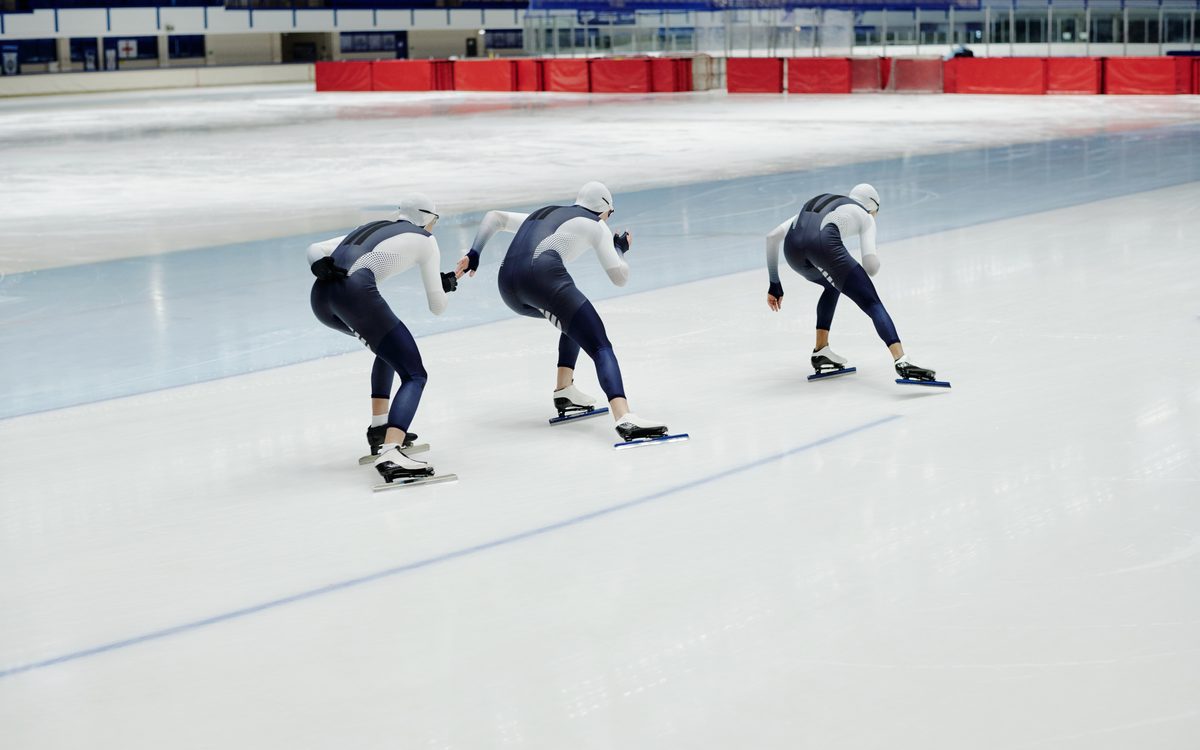
The last lap of a 1500 m semi-final: legs burning in the same low crouch they have held for two minutes, three skaters shoulder to shoulder through the final corner, and the one who still has something left makes the pass. Short track training is the planned mix of on-ice skating, strength, power, endurance and tactical practice that prepares a skater for that moment. It is a sprint sport with a real endurance side, and the research below shows how the energy is split.
Quick answer: Short track asks for a lot of everything: fast starts, a long-lasting low position, repeated efforts across a competition day and sharp racecraft. Elite skaters train a lot (a 2026 review gives 900 to 1,100 hours a year for speed skaters), mixing easy volume with hard intervals, and most pair that with strength and power work off the ice. The weekly shape below is general coaching practice, not a prescription. Young skaters should train with a qualified coach.
General information, not medical advice. For the rules of the sport see our rules page; for how training connects to getting hurt see injury prevention and injuries. The parent sport is on the speed skating hub.
What the sport demands of the body
A 2026 study in the Journal of Strength and Conditioning Research (Kiyici and colleagues) had nine national-level elite male skaters do maximal time trials over 500, 1000 and 1500 m. Total energy use rose with distance, and the aerobic share rose from 22.2% at 500 m to 35.3% at 1000 m and 44.3% at 1500 m. The glycolytic and phosphagen systems supplied the rest. In plain terms, even the 500 m is not a pure sprint, and the 1500 m draws on the aerobic system almost as much as on the others. That is why most programs include both sprint work and endurance work.
The crouch adds its own demand. A 2013 study of ten elite skaters (Hesford and colleagues, Medicine and Science in Sports and Exercise) found local muscle oxygen in the thigh dropped to its lowest values much faster than whole-body oxygen uptake peaked. A literature review of long track skaters (Konings and colleagues, 2015) says the crouched technique is mechanically favorable but a smaller knee angle may increase muscle deoxygenation. A 2016 study of 12 talented short track skaters (Hettinga and colleagues) also found the left and right legs behave differently on the ice, which fits a sport that is all left turns.
How much and what kind of training
A 2026 narrative review of Olympic ice sports (Sperlich and colleagues) says speed skating needs high annual training volumes, around 900 to 1,100 hours a year, with polarized, mixed-modal training, and that short track adds tactical and pack-dynamic skills. A 2014 interview study of Olympic medal-winning coaches and skaters (Orie and colleagues) found training shifting toward a polarized pattern over 38 years, meaning a lot of easy work and some very hard work with little in between. Those are elite numbers, not targets for a club skater.
A sensible weekly shape
There is no published short track template that suits everybody, so what follows is general coaching practice and should be adjusted by a coach. A common pattern in a build period is:
- Two to three on-ice sessions: one with technique and low-position skating at modest speed, one with starts and short repeats, and one with race-pace work and pack practice.
- Two strength sessions off the ice (leg strength, single-leg work, core and trunk).
- One or two easy aerobic sessions such as cycling or a light skate, kept easy.
- At least one rest day, with lighter days around the hardest ones.
Near competitions the same skater usually keeps the intensity and trims the volume, so they arrive fresh enough to race several rounds in a day. See our recovery page for how skaters manage load and rest.
Strength, power and starts
Strength matters. A 2016 study of 17 young short track skaters (Felser and colleagues) found that concentric knee-extensor strength was more strongly linked with on-ice times and speeds than isometric strength, and that force dropped about 25% when testing was done on skates rather than standing, so the knee and ankle need to be stabilized to carry strength onto the ice. A 2026 study of 23 sub-elite to elite long and short track skaters (Sliedrecht and colleagues) followed a 39-week program that alternated strength and power periods, with strength and power measured after each block.
For young lifters, the American Academy of Pediatrics clinical report on resistance training says programs should be supervised, with attention to technique. The start has its own research: nine highly trained short track skaters did two dry-land sprint-start sessions a week for four weeks (nine timed 14.43 m starts each) and improved their on-ice start by a small amount, about 0.07 seconds (Haug and colleagues, 2019). Balance helps too. In a 2015 trial in 28 young speed skaters, a 15-minute proprioceptive circuit five times a week for 12 weeks improved dynamic balance on a stability platform (Winter and colleagues).
Slide board, cycling and off-ice conditioning
The slide board imitates the side push of skating and is widely used off the ice. A 2026 randomized trial in 27 youth speed skaters (Zhang and colleagues) found that four weeks of slide-board interval training (three sessions a week) improved aerobic and anaerobic measures, while a moderate continuous session of 20 minutes at 70% of maximum heart rate did not produce meaningful changes in that time. Cycling is a common low-impact way to add endurance, though we did not find strong skater-specific evidence.
Tactics and racecraft
Because skaters race each other, pacing studies of World Cup races are useful. For the 500 m and 1000 m (Noorbergen and colleagues, 2016) a fast start seemed best in the 500 m, while the crucial part of the 1000 m was from lap six to the finish. In the 1500 m (Konings and colleagues, 2016, 510 skaters in 85 races), correlations between mid-race and final positions rose steadily, winners were leading in over half the cases in the last three laps, and top finishers were faster than others only in the last five laps. Racecraft such as choosing when to pass and holding position is best learned by racing, with a coach reviewing video.
The year in outline
This is general coaching practice. Most skaters organize a year into a base period (volume, strength), a build period (race-pace and speed), a competition period (racing with trimmed volume) and a short break. For athletes under 18, the AAP (Brenner, 2016) recommends one to two days off a week from the main sport and about three months a year away from it in one-month blocks, which can include other sports.
Short track training FAQs
Is short track speed skating more sprint or endurance?
Both. In a 2026 study of nine elite male skaters, the aerobic share of energy was 22.2% in the 500 m, 35.3% in the 1000 m and 44.3% in the 1500 m, so the system mix shifts with distance.
How many hours a week do short track skaters train?
The 2026 Olympic ice sports review gives about 900 to 1,100 hours a year for elite speed skaters, which is not a target for beginners. A coach should set volume for the skater’s age and level.
Do skaters need to lift weights?
A study of young short track skaters linked leg strength with on-ice times, and a 39-week program alternated strength and power blocks. Many programs include strength work. Young lifters should be supervised with a focus on technique, as the AAP recommends.
Is a slide board worth it?
It copies the side push of skating, and a 2026 youth study found slide-board intervals improved aerobic and anaerobic measures over four weeks. It is one tool among several, and it does not replace time on the ice.
Can I practice starts off the ice?
One small study found two dry-land sprint-start sessions a week for four weeks gave a small on-ice start improvement in nine trained skaters. It is a reason to include start practice, not a guarantee.
Sources
- Kiyici et al., energy systems in short track, J Strength Cond Res 2026 (PMID 42213907)
- Hesford et al., muscle oxygenation by race distance, Med Sci Sports Exerc 2013
- Konings et al., performance characteristics of long track skaters, Sports Med 2015
- Hettinga et al., muscle oxygenation, fatigue and recovery in LT and ST, Front Physiol 2016
- Sperlich et al., Olympic ice sports review, Scand J Med Sci Sports 2026
- Orie et al., 38 years of training distribution in Olympic speed skaters, IJSPP 2014
- Felser et al., strength and short track performance in young athletes, Scand J Med Sci Sports 2016
- Sliedrecht et al., long conjugate sequence resistance training in speed skaters, 2026
- Haug et al., dry-land sprint start training, J Strength Cond Res 2019
- Winter et al., proprioceptive training in young speed skaters, J Sports Sci 2015
- Zhang et al., slide-board HIIT vs MICT in young speed skaters, PLoS One 2026
- Noorbergen et al., pacing in 500 and 1000 m short track, IJSPP 2016
- Konings et al., pacing in 1500 m short track, IJSPP 2016
- Menting et al., pacing development in youth short track skaters, MSSE 2020
- AAP, Brenner, sports specialization and intensive training, Pediatrics 2016
- AAP clinical report, resistance training for children and adolescents, Pediatrics 2020
General information for education only, not medical advice. It does not replace a visit with a sports medicine doctor, physical therapist or athletic trainer. See how we write and check our pages in our editorial policy.