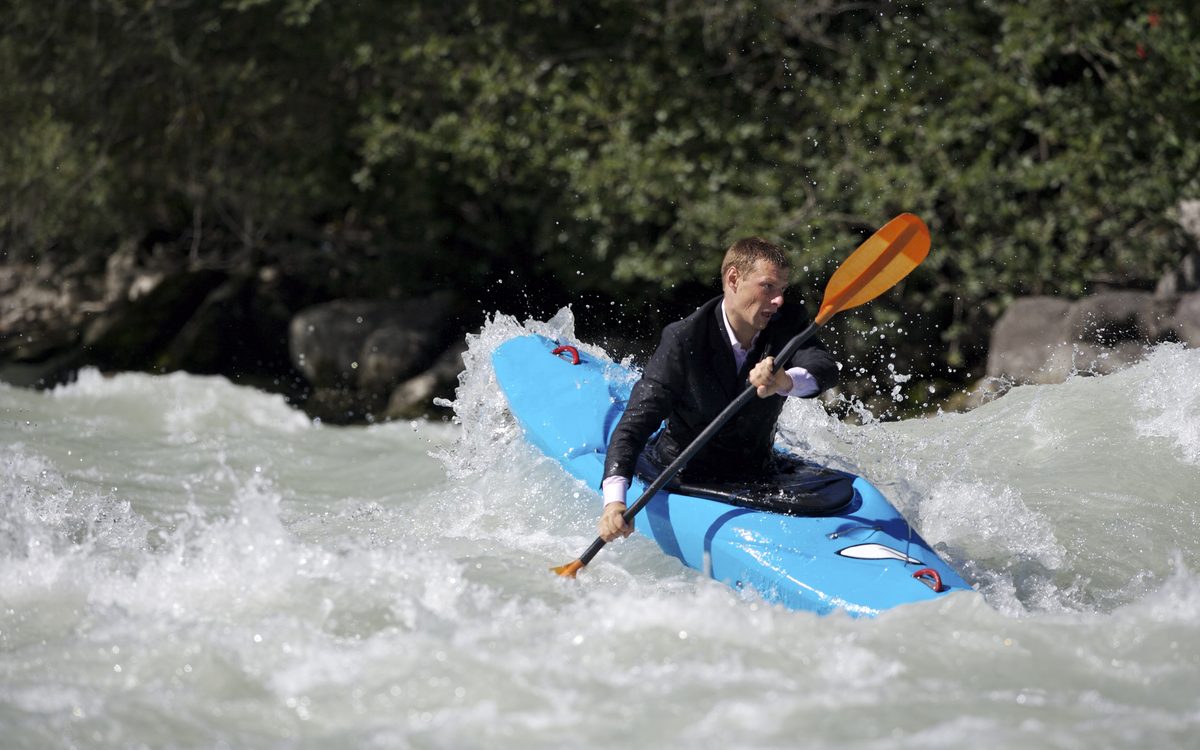
The last run of the day is done, the boat is on the rack, and your hands are cold and your forearms feel like wet rope. Tomorrow is another training day on the same course. Recovery is what you do between sessions so that the next one goes well: sleep, food, easy movement, planned rest. For paddlers it also means looking after shoulders and hips that do repetitive work. This page covers sleep, rest, mobility and the evidence on common recovery tools, and tells you where the evidence is weak. For the training that creates the need, see training. Back to the canoe slalom overview or the canoeing hub.
Quick answer: Sleep and planned rest days do most of the work. Massage has the best support among recovery tools for soreness, compression garments show small benefits, percussive guns and cold-water immersion have mixed evidence, and none has been tested specifically in slalom. Soreness that eases over a few days is normal; sharp, persistent or night-time pain is a reason to see a clinician.
Sleep comes first
The American Academy of Sleep Medicine and Sleep Research Society consensus recommends that adults sleep seven or more hours a night, and the AASM’s pediatric recommendations cover teenagers aged 13 to 18 at 8 to 10 hours. In a study that followed 17 French national-team canoe-kayak athletes for 5,855 nights (Foucaud et al., 2025), sleep quantity and fragmentation measures explained up to 79 percent of the variation between night types, while heart rate and heart rate variability each explained 4 percent or less. Forty-one percent of nights counted as “optimized recovery.” It is a small study of elite athletes, but it supports giving sleep priority over gadget numbers. Early river sessions, travel to courses and competition nerves can all eat sleep, so plan for them.
Rest days and load
Recovery is partly a training-plan decision. The IOC consensus on load and injury risk (Soligard et al. 2016) names poor load management as a major injury risk factor, and the American Academy of Pediatrics advises young athletes to take one to two days off each week (Brenner 2016). A hard gate session, a gym session and a long flatwater piece back to back, followed by another, is a pattern to avoid. Planning is covered on our training page.
Cool-down and easy movement
A narrative review (Van Hooren and Peake, 2018) concluded that an active cool-down is largely ineffective for same-day and next-day performance, though some next-day benefits have been reported, and it does not appear to prevent injuries. It does speed recovery of blood lactate, and many athletes simply like it as a transition. Cold hands and wet clothing matter more on a river bank: get dry and warm quickly. The American Whitewater Safety Code notes that cold water drains strength and judgment.
Mobility for paddlers
Slalom asks for rotation through the trunk and a stable shoulder girdle in a seated or kneeling posture. We found no slalom trial of any mobility routine. One study of 16 junior canoeists (Alvarez-Yates and Garcia-Garcia, 2020) tested an eight-week hamstring flexibility program during a competition season. Knee range of motion and trunk flexion improved by roughly 4 to 25 percent depending on measure and group, without a drop in lower-limb power. The sample is small and the sport is canoeing generally, so treat it as encouraging. General coaching practice, not tested in slalom, usually adds easy shoulder and thoracic mobility work and hip openers after sessions; an athletic trainer can tailor it. For C1 paddlers, spending time on the off-side is also a mobility and balance issue.
What the evidence says about recovery tools
- Massage: a meta-analysis of 99 studies (Dupuy et al., 2018) found massage was the most effective technique for reducing delayed-onset muscle soreness and perceived fatigue.
- Compression garments: a meta-analysis of 23 studies (Brown et al., 2017) found small benefits for recovery, largest for strength. A study of 23 elite German canoe and kayak athletes (Grim et al., 2020) found no clear average change in performance with upper-body compression garments, with differences between individuals.
- Percussive therapy (massage guns): a 2026 meta-analysis of 12 trials found improvements in countermovement-jump recovery (low certainty), but no clear improvement in strength recovery or soreness.
- Cold-water immersion: a meta-analysis of nine trials (Machado et al., 2016) found a small soreness benefit compared with passive recovery, with water at 10 to 15 C looking best. But a 2015 study in 21 men found cold-water immersion after strength sessions blunted strength and muscle gains over 12 weeks (Roberts et al.). Many coaches avoid it right after strength work.
Honestly, there is no evidence on these tools in slalom paddlers, and none of them replaces sleep, food and rest. If you use a device, use it as comfort. Anyone with a medical condition should check with a doctor before cold immersion, and see the maker’s directions for devices.
Refuel and rehydrate
After long or hard sessions, the sports nutrition position statement from the Academy of Nutrition and Dietetics, Dietitians of Canada and the ACSM covers refuelling, including 15 to 25 g of protein after training. The details are on our nutrition page.
Soreness or injury?
Muscle soreness that peaks a day or two after unfamiliar work and fades within days is common. These are signs to take seriously: pain that is sharp, that returns every session, that wakes you, or comes with numbness, weakness or swelling, or a shoulder that feels unstable. See injuries and rehabilitation. A sports medicine doctor, physical therapist or athletic trainer can examine you. The CDC’s HEADS UP guidance covers head hits.
Skin, hands and sun
Blisters, sunburn and sore hands come with long days on the water. The American Academy of Dermatology publishes guidance on preventing and treating blisters and treating sunburn (see Sources). It is general advice and a pharmacist or doctor can help with anything that looks infected.
Canoe slalom recovery FAQs
How much sleep do paddlers need?
The AASM and SRS consensus is seven or more hours for adults, and 8 to 10 hours for teenagers aged 13 to 18 per AASM pediatric guidance. Individual needs vary.
Do massage guns help recovery?
A 2026 meta-analysis of 12 trials found improvement in jump recovery (low certainty) but no clear benefit for strength recovery or soreness. No slalom data exist.
Is an ice bath good after paddling?
Cold-water immersion reduced soreness slightly in a meta-analysis of nine trials, but a 2015 study found it blunted strength gains after strength training. Mixed evidence; ask a coach or clinician.
Should I stretch after every session?
We found no slalom evidence on stretching. A small study in junior canoeists found a supervised flexibility program improved range of motion without losing power; a coach can tailor one.
How do I know if my soreness is an injury?
Soreness fades over a few days. Persistent, sharp, night-time pain, numbness or weakness is a reason to see a sports medicine doctor or physical therapist.
Sources
- AASM and SRS, recommended sleep for adults (PMID 25979105)
- AASM, recommended sleep for pediatric populations (PMID 27456512)
- Foucaud et al. 2025, recovery patterns in elite canoe-kayak athletes (PMID 41346793)
- Soligard et al. 2016, IOC consensus on load and injury (PMID 27535989)
- Brenner 2016, AAP overuse injuries (PMID 27573090)
- Van Hooren and Peake 2018, cool-down review (PMID 29663142)
- Alvarez-Yates and Garcia-Garcia 2020, hamstring flexibility in canoeists (PMID 29481457)
- Dupuy et al. 2018, recovery techniques meta-analysis (PMID 29755363)
- Brown et al. 2017, compression garments (PMID 28434152)
- Grim et al. 2020, compression garments in canoe and kayak athletes (PMID 31319426)
- Percussive therapy meta-analysis 2026 (PMID 42286692)
- Machado et al. 2016, cold water immersion (PMID 26581833)
- Roberts et al. 2015, cold water immersion and strength training (PMID 26174323)
- ACSM, Academy and Dietitians of Canada position, nutrition and athletic performance (PMID 26891166)
- American Whitewater Safety Code 2024
- AAD, preventing and treating blisters
- AAD, treating sunburn
General information for education only, not medical advice. It does not diagnose, treat or replace care from a sports medicine doctor, physical therapist or athletic trainer. See our editorial policy for how we research and write.