This article contains affiliate links: if you buy through them we may earn a commission, at no extra cost to you. Read our affiliate disclosure.
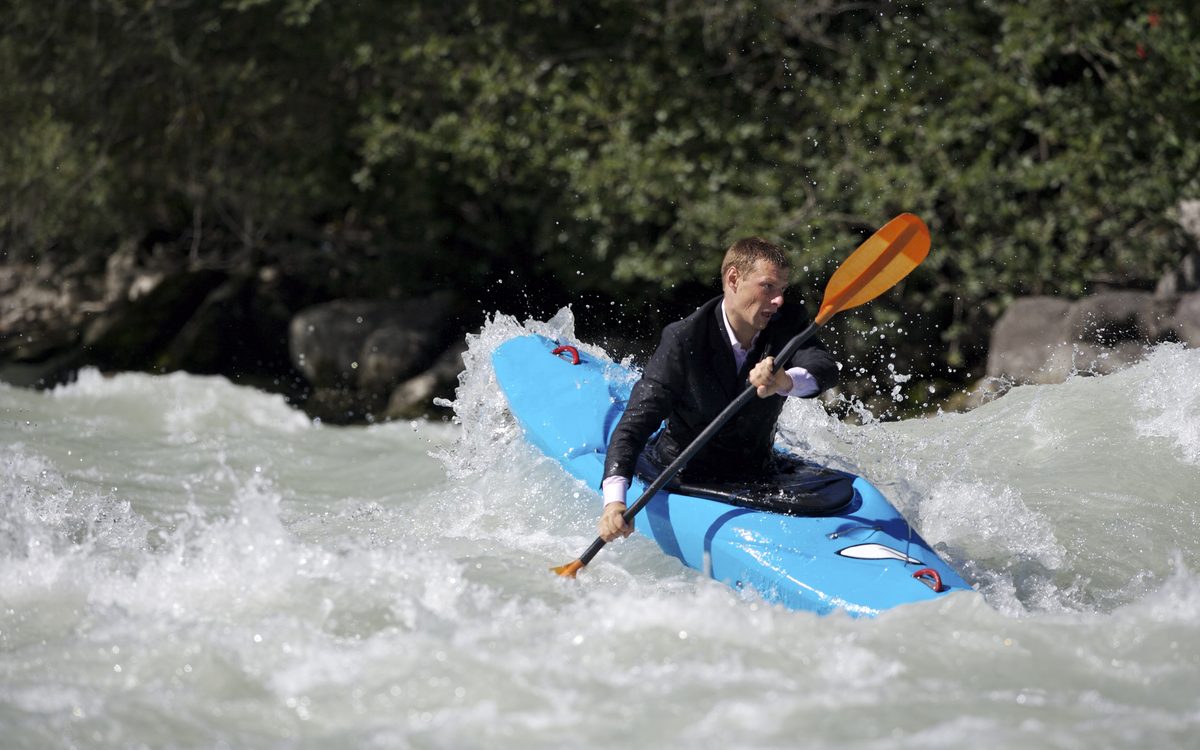
A paddler drops into a churning rapid, drives hard across the current to slip through an upstream gate, spins the boat in a tiny eddy, and ferries back across the river, all while a stopwatch runs. At the Munich Games in 1972, canoe slalom made its Olympic debut as an introduction sport, and East Germany took all four golds. Canoe slalom, also called whitewater slalom, is a timed race down a whitewater course in a kayak or canoe, passing through a series of hanging gates without touching them.
Canoe Slalom guides: what do you need?
New to canoe slalom? Start with the first card. Everything here is general education, not medical advice.
History & Origins of Canoe Slalom
Canoe slalom began in Switzerland in 1933, first on flat water and soon on whitewater, according to Paddle Worldwide, the sport’s world body (formerly the International Canoe Federation). The first World Championships were held in Geneva in 1949. Slalom reached the Olympics as an introduction sport at Munich 1972, where the Augsburg Eiskanal course set the blueprint for modern competition courses, and it has been a core Olympic sport since Barcelona 1992 (Paddle Worldwide). Since then the programme has kept changing: kayak cross, a head-to-head race, joined the World Cup in 2015, women’s C1 was added at Tokyo 2020 in place of men’s C2, and kayak cross made its Olympic debut in Paris in 2024. Recent events have used purpose-built courses, such as the Vaires-sur-Marne stadium in Paris and the Oklahoma City course that hosted the 2026 World Championships and will host the LA28 Olympic slalom.
- 1933: Slalom begins in Switzerland.
- 1949: First World Championships, in Geneva.
- 1972: Olympic introduction sport at Munich; East Germany wins all four golds.
- 1992: Core Olympic sport from Barcelona.
- 2015: Kayak cross joins the ICF World Cup.
- 2020: Women’s C1 at the Tokyo Olympics, replacing men’s C2.
- 2024: Kayak cross debuts at the Paris Olympics.
- 2026: World Championships in Oklahoma City, 20 to 25 July.
Recent Champions
This list covers the Olympic Games and the senior World Championships in the individual K1, C1 and kayak cross events. It does not cover team events, the World Cup or junior and U23 races. We found no slalom on the Paralympic programme; see our para canoe page.
| Event | Paris 2024 Olympics | 2025 Worlds, Penrith | 2026 Worlds, Oklahoma City |
|---|---|---|---|
| Men’s K1 | Giovanni De Gennaro (ITA) | Titouan Castryck (FRA) | Jakub Krejčí (CZE) |
| Women’s K1 | Jessica Fox (AUS) | Klaudia Zwolińska (POL) | Jessica Fox (AUS) |
| Men’s C1 | Nicolas Gestin (FRA) | Nicolas Gestin (FRA) | Miquel Travé (ESP) |
| Women’s C1 | Jessica Fox (AUS) | Klaudia Zwolińska (POL) | Tereza Kneblová (CZE) |
| Men’s kayak cross | Finn Butcher (NZL) | Joseph Clarke (GBR) | Vít Přindiš (CZE) |
| Women’s kayak cross | Noémie Fox (AUS) | Angèle Hug (FRA) | Alena Marx (SUI) |
The World Championships also award a separate kayak cross “individual” (time trial) title: Joseph Clarke (GBR) and Jessica Fox (AUS) won it in 2026, David Llorente (ESP) and Alena Marx (SUI) in 2025. Source: Paddle Worldwide official results for Paris 2024, Penrith 2025 (29 September to 3 October) and Oklahoma City 2026 (20 to 25 July). Results verified through 13 November 2026. Latest completed event included: 2026 ICF Canoe Slalom World Championships, Oklahoma City, closed 25 July 2026.
Records & Milestones
| Record or milestone | Holder | Result | Category |
|---|---|---|---|
| Most world titles, all athletes | Michal Martikán | 15 | World Championships |
| Most world titles, women | Jessica Fox (AUS) | 10 (as listed; may not include 2026) | World Championships |
| Most world titles, nation | France | 61 | World Championships |
| Two individual Olympic golds at one Games | Jessica Fox (AUS) | K1 and C1, Paris 2024 | Olympic Games |
| First Olympic kayak cross champions | Finn Butcher (NZL), Noémie Fox (AUS) | Paris 2024 debut | Olympic Games |
Source: Paddle Worldwide slalom page for the world title counts, which carry no “as of” date, and the Paris 2024 official results above. Records verified through 13 November 2026.
Legends of the Sport
Paddlers from different eras, in no ranking order.
- Michal Martikán: the most world titles in slalom history, 15 (Paddle Worldwide).
- Jessica Fox (AUS): won both K1 and C1 at Paris 2024 and the 2026 world K1 title (official results).
- Noémie Fox (AUS): won the first Olympic women’s kayak cross in Paris (official results).
- Finn Butcher (NZL): won the first Olympic men’s kayak cross in Paris (official results).
- Nicolas Gestin (FRA): Paris 2024 Olympic C1 champion and 2025 world champion (official results).
- Giovanni De Gennaro (ITA): Paris 2024 Olympic K1 champion (official results).
- Klaudia Zwolińska (POL): K1 silver at Paris 2024, then K1 and C1 world champion in 2025 (official results).
- Joseph Clarke (GBR): Paris 2024 kayak cross silver, 2025 world kayak cross champion, and 2026 kayak cross individual champion (official results).
- Jakub Krejčí (CZE): 2026 world K1 champion and 2025 silver medallist (official results).
How we keep this current: we re-check results after each major championship and update the date above. Spot an error? See our editorial policy.
It is the whitewater side of canoeing, the counterpart to flat-water canoe sprint. This page explains the rules, the levels from club paddler to Olympian, what the sport demands and how to keep it safe.
Canoe slalom at a glance
| What it is | A timed race through 18 to 25 gates on a whitewater course (ACA rules; ICF allows a maximum of 25), with a minimum of six gates upstream. |
|---|---|
| How it is scored | Fastest time wins. A touched gate adds 2 seconds; a missed gate adds 50 seconds. Leaders typically finish in roughly 90 to 110 seconds. |
| Boats | Kayak (K1): seated, double-bladed paddle. Canoe (C1): kneeling, single-bladed paddle. Slalom boats have no rudder. |
| Olympic events | Six at LA28: men’s and women’s K1, C1 and kayak cross. |
| Where it is played | Whitewater courses, natural or built. LA28 uses the Whitewater Center in Oklahoma City. |
| Governing bodies | The International Canoe Federation (now Paddle Worldwide); ACA Paddlesports in the United States. |
| Season | Depends on water levels; the LA28 slalom window is 14 to 22 July 2028. |
How it works
Gates hang over the water as pairs of poles. Green gates are run downstream and red gates upstream, so racers must turn and paddle against the current for some of them. The whole head has to pass through a gate for it to count. At the Olympics each boat holds one paddler. The Canadian Olympic Committee describes the format: a two-run qualifying heat in which the better time counts, then single-run semifinals and finals. Because courses change with water level and design, tactics matter as well as speed.
Kayak cross is the head-to-head format. Four racers in identical plastic creek boats start together by sliding off a ramp more than two metres above the water. Contact between racers is allowed, there are up to eight buoys or gates, and every racer must complete a compulsory roll (a full 360-degree flip) in a set area. Penalties apply for breaking the start, missing a gate, dangerous paddling or failing the roll. It joined the ICF World Cup in 2015.
Who plays it and at what level
ACA Paddlesports runs the national pathway: published selection procedures for national, Under-23 and junior teams, team trials and ICF World Ranking races, a US Open, a feeder race, Age Group Nationals (at the Nantahala Outdoor Center in North Carolina in 2026) and the USA National Championships. Athletes must be ACA members. Courses used for US events include RIVERSPORT in Oklahoma City, Montgomery Whitewater in Alabama and the US National Whitewater Center in Charlotte.
Olympic and Paralympic status (as of 2026). Canoe slalom debuted as an introduction sport at Munich 1972 and has been a core Olympic sport since Barcelona 1992. Women’s C1 joined at Tokyo 2020, replacing men’s C2, and kayak cross was listed as joining at Paris 2024. Paddle Worldwide’s LA28 programme news (April 2025) lists six slalom events (men’s and women’s K1, C1 and kayak cross) with 82 athlete places, 41 for each gender, at the Whitewater Center in Oklahoma City. ACA lists the slalom dates as 14 to 22 July 2028. ACA also says the United States has won one Olympic gold (men’s C2), two silvers (women’s K1) and two bronzes (men’s C1 and women’s K1) in the sport. We could not find canoe slalom on any Paralympic programme; the Paralympic discipline is paracanoe, described on our para canoe page. Check the official programme for the current Games.
What it demands of the body
Slalom blends short, explosive pulls with the endurance to keep going for a minute and a half, plus constant balance and decision-making. A 2025 analysis of 20 years of lab tests on 153 national-team athletes found seniors produced higher peak and total work in a 30-second upper-body test than juniors across all four categories. In a study of 20 C1 paddlers, the average force of a stroke was similar on flatwater and whitewater, but strokes lasted longer on whitewater, giving more total force per stroke, which suggests whitewater runs are harder than flatwater drills. Strong shoulders, lats and trunk are central, and so is the mobility to paddle both sides.
Health and safety
This is general information, not medical advice. If you are hurt, see a sports medicine doctor, physical therapist or athletic trainer.
Head and body impacts. Rivers have rocks. American Whitewater says to always wear a snug life jacket, preferably a whitewater-specific model, and a whitewater-specific helmet designed to withstand multiple impacts. A 2022 laboratory study tested 126 impacts on whitewater helmets that met the European EN 1385:2012 standard. The head impacts at 4.9 m/s predicted a very high risk of concussion for all impact locations, and scores differed between helmets. The authors say there is a clear need for better helmets. A helmet is necessary, not a guarantee. The CDC’s HEADS UP guidance applies: after a head hit, stop, and have a healthcare provider decide when to return; call 911 for danger signs such as repeated vomiting or a seizure.
Shoulders. Paddling is overhead, repetitive work. In a study of 19 British team paddlers, a shoulder questionnaire (the KJOC) separated paddlers with current or past shoulder pain from those without, and a score under 88 was linked with a higher risk of shoulder pain in the following months. It is a research tool, not a diagnosis. Persistent shoulder pain needs a professional.
Cold, strainers and swims. American Whitewater advises a drysuit or wetsuit when the water is below 50 F, warns that cold water drains strength and judgment, and flags wood and strainers as hazards. Learn to roll and to swim a rapid defensively, practise with trained instructors and paddle with others. For a general introduction, see our canoeing injuries guide. ACA slalom rules require both a helmet and a life jacket to start a race.
Training, recovery and nutrition pointers
Slalom training mixes gate work on whitewater, flatwater technique, gym strength and mobility. The C1 study above suggests flatwater drills are not the same load as a river run. See canoeing training, recovery and nutrition and supplements.
Gear
Start with safety gear, which is standardised: a whitewater helmet that meets EN 1385, a snug whitewater life jacket (American Whitewater suggests Coast Guard-approved models with a minimum Performance Level of 70), a whistle attached outside the life jacket, and a throw bag. Slalom boats and paddles are specialist items and clubs often lend them, so ask before you buy. The Canadian Olympic Committee notes slalom paddlers wear a watertight skirt and a helmet.

NRS Havoc Livery Helmet
- Meets CE EN 1385 for whitewater
- DialFit adjustment
- Replaceable fit pads

NRS Compact Rescue Throw Bag, 70 ft
- High-visibility rope
- Internal foam flotation
- Compact

Fox 40 Classic Whistle
- Pea-less, three chambers
- 115 dB
- Attach to your life jacket
$8.61 at Amazon, as of Nov 17, 2026 02:07 UTC
Check price on AmazonRelated sports and disciplines
- Canoeing, the parent sport, and its gear page.
- Canoe sprint, the flat-water discipline.
- Kayaking, rowing and para canoe.
Canoe slalom FAQs
What are the penalties in canoe slalom?
Touching a gate adds 2 seconds to your time and missing a gate adds 50 seconds.
What is kayak cross?
A head-to-head format in which four paddlers race down a short course together after a ramp start, with a compulsory roll and contact allowed.
How is slalom different from sprint?
Sprint is a straight race on flat water. Slalom is a timed run through gates on whitewater, with penalties.
Do slalom paddlers wear helmets?
Yes. Paddlers wear a whitewater helmet and a life jacket; ACA slalom rules require both to start.
How do I start?
Learn whitewater paddling with qualified instructors, then ask a local paddling club about slalom programmes and loaner boats. ACA Paddlesports is the national governing body.
Sources
- ICF / Paddle Worldwide, Canoe slalom; programme and quotas confirmed for LA28; LA28 rankings.
- ACA Paddlesports, Slalom, LA28 ticketing guide and Canoe Slalom Rules (2025).
- Canadian Olympic Committee, Differences between canoes and kayaks: sprint vs slalom.
- American Whitewater, Safety Code (2024).
- Whitewater Helmet STAR: biomechanical performance and risk of head injury (2022).
- Kerlan-Jobe Orthopaedic Clinic shoulder and elbow score in elite canoe slalom (2021).
- Paddle forces in whitewater and flatwater training in C1 canoe slalom (2024); exercise capacity of national team canoe slalom athletes (2025).
- CDC, HEADS UP: signs and symptoms.
Keep exploring: the canoeing hub, canoeing injuries, our recovery tools guide, massage guns and the sports hub.