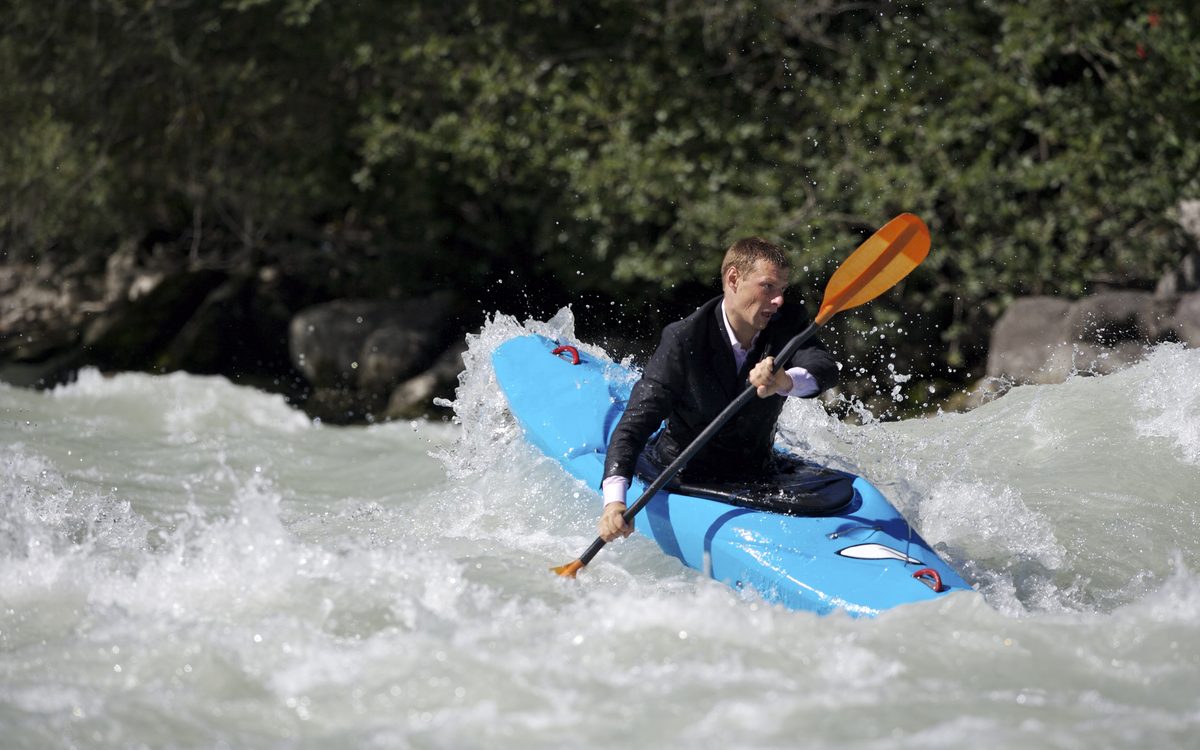
You are standing on a riverbank with a stopwatch somewhere downstream, watching a paddler spin a boat on a dime inside an eddy, then dig hard to cross the current and slip upstream through a red-and-white pair of poles. One pole swings. Was that a touch? Canoe slalom is a timed race down a whitewater course in a kayak or canoe, through numbered gates, and the rules are simple enough to follow from the bank in a few minutes. This page covers how a run is scored, what the boats must be, how the levels work and how a newcomer starts. It sits under our canoe slalom overview and the wider canoeing hub.
Quick answer: Fastest time wins, after penalties: touching a gate adds 2 seconds and missing one adds 50 seconds (ACA and ICF). Courses have up to 25 gates, with at least six upstream. Beginners start with a paddling course and a club, not a race. Safety kit, a helmet and a life jacket, is required to start an ACA race.
How a run works
The American Canoe Association (ACA) rules say the object is to negotiate a whitewater course, defined by gates, without penalty, in the shortest possible time. A course must have at least 18 and not more than 25 gates (the ACA allows fewer on non-championship courses), and at least six must be upstream. Paddle Worldwide, the sport’s international federation (formerly the ICF), sets the same maximum of 25 gates with at least six upstream and says leaders should finish in roughly 90 to 110 seconds. Downstream gates are marked with green and white poles and upstream gates with red and white poles. Gates must be taken in numerical order and in the direction shown, and any boat angle (forward, reverse or sideways) counts if the direction is right.
Course length is where the sources differ. Paddle Worldwide says a maximum of 300 m, while the ACA rulebook says a course may not be shorter than 200 m and recommends no more than 400 m. Treat the number as a range that depends on the event.
Penalties, the head rule and capsizes
- 0 seconds: clean pass, with no pole touched by body, paddle or boat.
- 2 seconds: the gate was passed correctly but a pole was touched. Touching the same gate repeatedly is penalised once.
- 50 seconds: a missed gate, a touched gate that was not negotiated, or deliberately pushing a pole to get through.
Penalties are not cumulative at one gate, so 50 seconds is the most any gate can cost. For these rules the “body” that must pass through is the complete head, not the hands or arms. Time in seconds plus penalties is your result. A race is two runs and the better run counts (ACA rule 24; the Canadian Olympic Committee describes the same two-run heat before single-run semifinals and finals). An Eskimo roll is not a capsize, but finishing upside down or after leaving the boat is a did-not-finish for that run.
Boats, paddles and required safety kit
ACA rule 5 sets a minimum of 3.50 m length, 60 cm width and 9 kg weight for a single kayak (K1) and a single canoe (C1). Kayaks use a double-bladed paddle from a sitting position and canoes a single-bladed paddle from a kneeling position, and rudders are prohibited. Local, non-championship races may allow any whitewater boat that meets the safety rules, which is good news for beginners. Every boat must be unsinkable and carry a handle at each end.
Rule 16.B requires each competitor to wear a fastened, commercially made safety helmet and life jacket (PFD), unmodified. The ACA text asks for USCG Type III or an equivalent such as ISO 12402-5 Level 50 or higher, and a competitor who ignores the rule is refused the right to start. Rule 16.C adds that you must always be able to free yourself immediately from the boat. We cover how these items are chosen on our gear page.
Events and levels
The international individual events are men’s and women’s kayak (MK1, WK1) and canoe (MC1, WC1), plus kayak cross (MX1, WX1) and a mixed canoe doubles event (XC2), according to Paddle Worldwide. In kayak cross four racers start together from a ramp more than 2 m above the water, contact is allowed, and each must complete a compulsory roll; it joined the World Cup in 2015 and was formerly called extreme slalom. The ACA national events also include men’s and women’s C2. ACA age groups are U12, U14, U16, Junior (through the year of the 18th birthday), U23, Open and Masters (from the year of the 35th birthday), offered where demand is enough, and ACA members only may enter sanctioned races. In Britain, racing is organised into divisions, and Division 4 is the introductory level. For the Olympic picture, see the overview page; Olympic status should always be checked against the official programme for the current Games.
Skills a slalom paddler builds
The sport-specific skill list below is general coaching practice rather than a published curriculum, but every club coach will recognise it:
- A forward stroke that keeps the boat moving, and the sweep, draw and rudder-style strokes that turn it.
- Edge control, so the boat holds a line in moving water without catching a rim.
- Eddy turns and peel-outs: entering and leaving still water behind rocks.
- Ferry gliding: crossing the current while holding position, the heart of upstream gates.
- A reliable roll and a calm swim, because a capsize is part of learning.
- C1 paddlers add the switch, moving the single blade to the other side. A 2023 study of 42 slalom athletes found C1 women had 20.8 to 29.5 percent lower paddle force on their off-side strokes than on-side strokes, so both sides take deliberate practice.
How a beginner starts
The ACA education pages list a take-a-paddling-class route, a find-an-instructor tool, youth paddling development programs and club directories. A competition-club finder is on the same site. In Britain, the club site canoeslalom.co.uk advises a starter course if you have never paddled, notes that many clubs run weekly slalom nights and loan equipment, and says paddlers of all ages race together with prizes by age group. Club pages describe junior taster sessions starting on flat water before moving onto a slalom course. Ask the club what boats it lends before you buy.
A plain first-month plan: take a beginner course; learn to wet-exit and roll in a pool; practise with the club on moving water that matches your skill; then enter a local race in your own division. Safety on the river comes first; the American Whitewater Safety Code is a good read before your first river day, and our injury prevention page covers it.
Para access and other routes
We could not find canoe slalom on any Paralympic programme. The Paralympic discipline is paracanoe, which is a flat-water sprint; see our para canoe page. If you want the flat-water side of the sport or a quieter start, see canoe sprint and kayaking.
Canoe slalom rules and getting started FAQs
How many gates are on a canoe slalom course?
The ACA requires at least 18 and no more than 25 gates, with at least six upstream. Paddle Worldwide gives a maximum of 25 with at least six upstream.
What does a 2-second or 50-second penalty mean?
Touching a pole while still passing correctly adds 2 seconds. Missing a gate, or touching it without negotiating it, adds 50 seconds. Both are added to your elapsed time.
Can I start canoe slalom as an adult?
Yes. Clubs run starter courses and weekly practice nights, and masters age groups exist in ACA rules from the year of a paddler’s 35th birthday. Ask a local club what boats it lends.
Is a rudder allowed in slalom boats?
No. ACA rule 5.B prohibits rudders on all boats; you steer with strokes and boat lean.
Do I need to roll before racing?
Rules treat an Eskimo roll as part of the run rather than a capsize, and clubs teach it early. Rolling is a safety skill as much as a race skill; learn it with an instructor.
Sources
- Paddle Worldwide (ICF), canoe slalom discipline
- ACA Canoe Slalom Competition Rules, 2025 (PDF)
- ACA slalom page
- ACA, find an instructor
- ACA, find a competition club
- Canadian Olympic Committee, slalom vs sprint
- canoeslalom.co.uk, getting started
- Stafford and Stone CC, junior taster days
- Wakeling et al. 2023, asymmetries in paddle force (PMID 38074336)
- American Whitewater Safety Code
General information for education only, not medical advice. It does not diagnose, treat or replace care from a sports medicine doctor, physical therapist or athletic trainer. See our editorial policy for how we research and write.