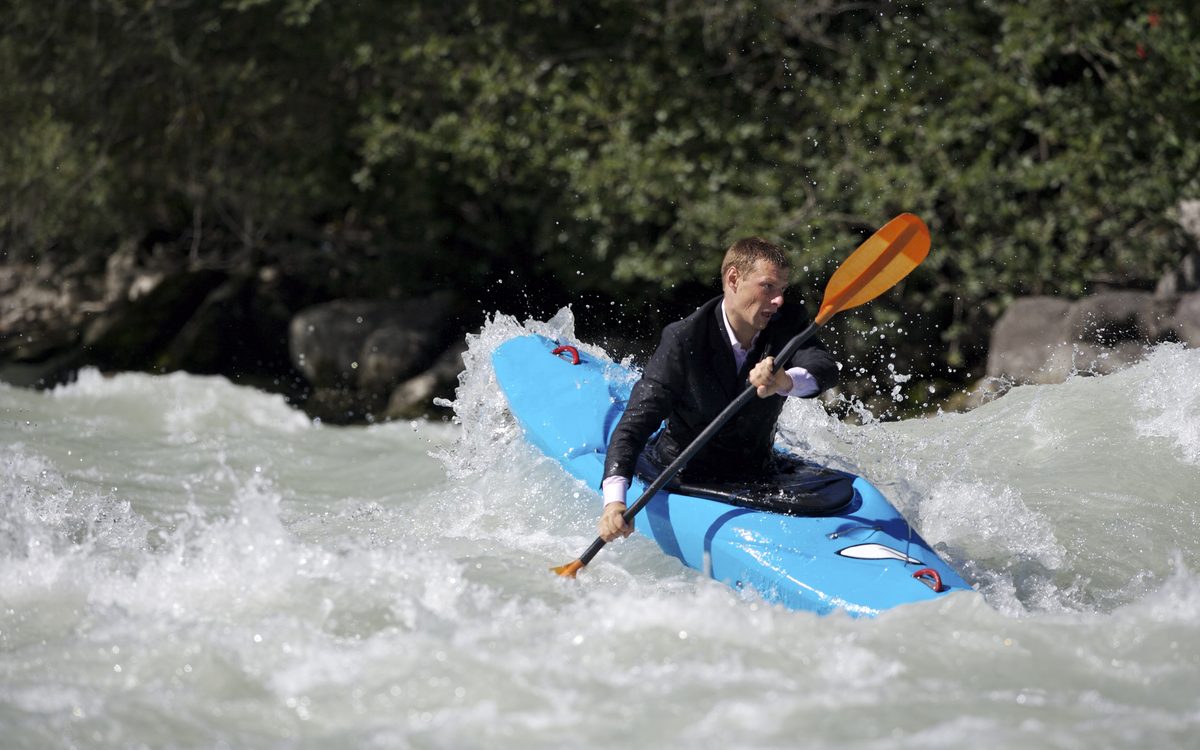
The boat drops into the hole a little sideways, the paddle catches, and for half a second your shoulder is taking the whole river. You hold on, roll up and finish the run. The shoulder is sore that night. Injury prevention in canoe slalom means the habits that make that kind of moment less likely or less costly: a warm-up, sound technique, sensible training load, the right kit and good river judgment. Nothing removes the risk; this page explains what is known. For what injuries look like once they happen, see injuries and rehabilitation. Back to the canoe slalom overview and the canoeing hub.
Quick answer: Wear a whitewater helmet and snug life jacket, dress for cold water, protect your shoulders with good technique and gradual training, and paddle with others on water that fits your skill. Slalom had one of the lowest injury rates at the Rio 2016 Olympics, but recreational whitewater studies show shoulders and impacts with objects are the main risks. See a sports medicine doctor or physical therapist for pain that persists, and call 911 after a head injury with danger signs.
The risk picture
At the Rio 2016 Olympics, canoe slalom was among the sports with the lowest injury incidence, 0 to 3 percent of athletes injured, in a study of 11,274 athletes (Soligard et al.), though illness was relatively high at 11 percent. Elite competition on a controlled course is not the same as a river day. A survey of 392 whitewater kayakers found that the number of days paddled per season was the only independent predictor of injury; 87 percent of injuries happened while still in the boat, striking an object was the most common mechanism (44 percent), and the upper extremity, especially the shoulder, was the most often injured area (Fiore and Houston, 2001). Prevention therefore centres on impacts, shoulders and river judgment.
Warm-up
We found no named, tested warm-up program for canoe slalom, so the following is general practice, not a research finding. Many coaches use a few minutes of easy paddling or movement, then dynamic shoulder, trunk and hip movements, then a few easy gate runs before racing pace. Cold muscles and cold water together argue for a longer warm-up.
Technique that protects the shoulder
The American Canoe Association’s beginner guide says shoulder injuries are not uncommon in paddlesports and advises keeping your hands in front of your body, and turning to look at the blade when you place it behind you, rotating the shoulders into a safe position. It also says to use the big muscles of chest, back and stomach, with the torso doing the work. A coach can check these habits on video. Roll and brace technique is best learned with an instructor.
Progressive load
The IOC consensus on load and injury risk (Soligard et al. 2016) identifies poor load management, including rapid changes in training load, as a major injury risk factor, and recommends monitoring. For young paddlers the AAP advises one to two days off per week. No source gives a slalom-specific weekly increase percentage, so we do not offer one. A common-sense rule: change one thing at a time, such as hours, intensity or a new gym lift, not all three. Details are on the training page.
Strength, mobility and shoulder checks
A study of 19 British team paddlers (Powell et al., 2021) found that the Kerlan-Jobe Orthopaedic Clinic shoulder and elbow score (KJOC) separated paddlers with current or past shoulder pain from those without, and that a score below 88 was linked to higher risk of shoulder pain in the next four months. The authors suggest it as part of a risk-management routine. It is a screening tool for clinicians and teams, not a diagnosis. Rotator-cuff and shoulder-blade strength, trunk strength and hip mobility are standard parts of paddler conditioning, but we found no trial showing a specific program prevents slalom injuries.
Environment: cold water, strainers and rivers
- Cold: American Whitewater’s Safety Code advises a drysuit or wetsuit when the water is below 50 F, and warns that cold water drains strength and judgment.
- Strainers and hazards: trees and wood let water through but can pin a swimmer. Scout, and avoid them.
- Swimming: do not stand up in fast-moving water; swim to slow or knee-deep water. Practise defensive swimming with an instructor.
- Company: paddle with others, carry a whistle and a throw bag, and match the river to your skill. The kayaking survey noted injuries clustered on rivers paddlers judged to fit their ability, so familiarity is not protection.
- Alcohol and drugs: strongly discouraged by the Safety Code.
Protective equipment and what it can and cannot do
ACA slalom rule 16.B requires a fastened, commercially made helmet and a life jacket for every competitor, with the life jacket meeting USCG Type III or an equivalent such as ISO 12402-5 Level 50 or higher. American Whitewater recommends a snug, whitewater-specific life jacket (Performance Level 70, Type III or V) and a whitewater-specific helmet designed for multiple impacts. These are standards and recommendations from independent bodies. A maker saying a helmet is “whitewater-ready” is a marketing claim unless it points to a standard such as EN 1385.
Helmet standards are not a guarantee. A 2022 laboratory study of 126 impacts on whitewater helmets that met EN 1385:2012 (Duma et al.) found a very high predicted concussion risk for all impact locations at 4.9 m/s, with scores differing between helmets, and the authors called for better helmets. Wear one, fit it snugly, replace it after a hard hit and still avoid head contact. Fit and inspection are covered on our gear page.
Youth
ACA age groups run from U12 upward. For children, the ACA rule lets a child under 90 pounds wear a Coast Guard-approved life jacket rated for their weight in place of the adult buoyancy requirement. We did not find slalom-specific youth injury data. See also the ACA youth paddling program pages.
What prevention cannot do
Following every tip will not make injury impossible. Rivers are unpredictable, and paddlers in the surveys got hurt on water they considered suitable. Prevention reduces risk; it does not remove it.
When to see a professional
See a sports medicine doctor, physical therapist or athletic trainer for shoulder pain that returns each session, numbness, a shoulder that slips, or any injury that does not improve. After a blow to the head, the CDC HEADS UP guidance says to call 911 or go to an emergency department for danger signs such as repeated vomiting, a seizure, worsening headache, or increasing confusion.
Canoe slalom injury prevention FAQs
Is canoe slalom dangerous?
It depends on level and river. At Rio 2016, canoe slalom was in the lowest injury group (0 to 3 percent of athletes), but a survey of recreational whitewater kayakers found 219 of 392 respondents had been injured at some point.
What is the most common injury in whitewater paddling?
In the Fiore and Houston survey, the upper extremity, especially the shoulder, was most often injured. The most common injury types were abrasions, tendinitis, bruises and dislocations.
Does a helmet prevent concussion?
Not entirely. A helmet reduces risk but a 2022 test study found high predicted concussion risk even in helmets that met EN 1385 at 4.9 m/s. Wear one and see a clinician after any head hit.
Do I need a drysuit?
American Whitewater advises a drysuit or wetsuit when the water is below 50 F. In warmer water, a layer that you can swim in is still wise.
Can stretching alone prevent shoulder pain?
We found no evidence for that in slalom. Technique, load management, strength work and screening are the better-supported approaches, and a clinician can check your shoulder.
Sources
- Soligard et al. 2017, Rio 2016 injury and illness (PMID 28756389)
- Fiore and Houston 2001, injuries in whitewater kayaking (PMID 11477016)
- Powell et al. 2021, KJOC in canoe slalom (PMID 33857813)
- Duma et al. 2022, Whitewater Helmet STAR (PMID 36207617)
- Soligard et al. 2016, IOC consensus on load and injury (PMID 27535989)
- American Whitewater Safety Code 2024
- ACA Canoe Slalom Competition Rules 2025 (PDF)
- ACA Beginner's Guide (PDF)
- AAP, overuse injuries in young athletes (Brenner 2016, PMID 27573090)
- CDC HEADS UP, signs and symptoms
General information for education only, not medical advice. It does not diagnose, treat or replace care from a sports medicine doctor, physical therapist or athletic trainer. See our editorial policy for how we research and write.