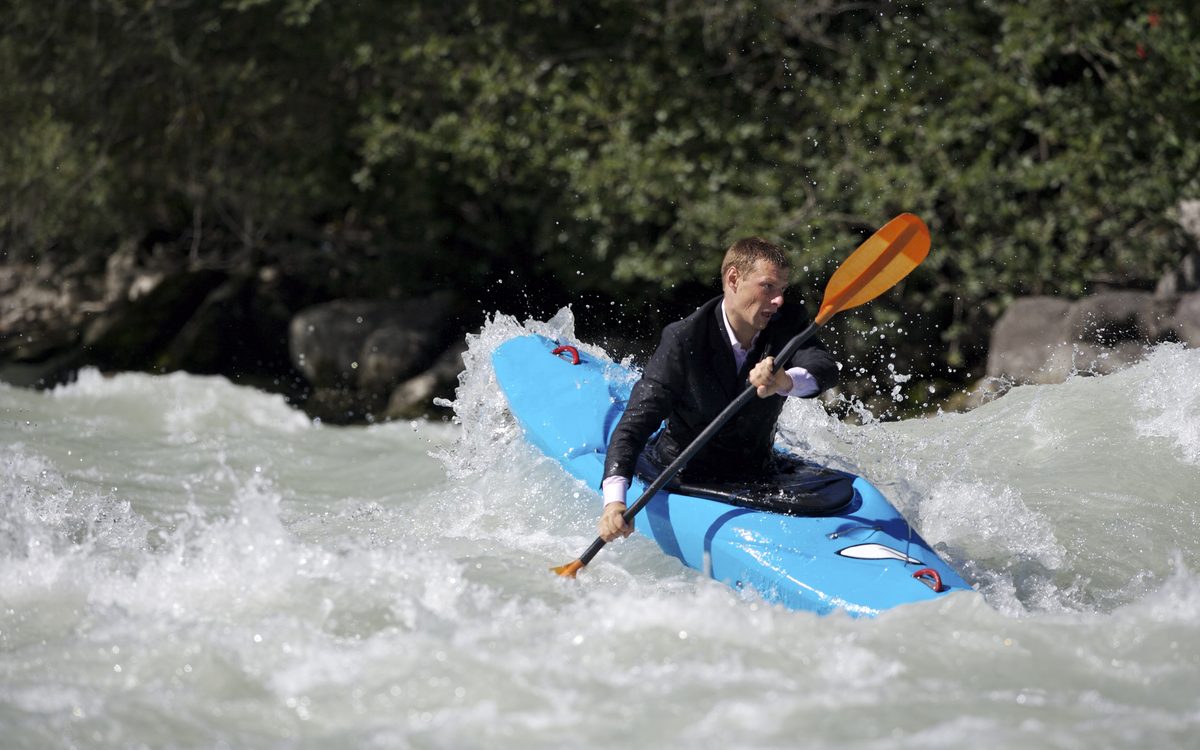
The run was good until the last upstream gate, when the boat flipped and the paddle hit the bottom as the blade swung under. The roll came up fine, but the shoulder aches on the ride home. Canoe slalom injuries are mostly what you would expect from an overhead, repetitive sport that happens in moving water with rocks: sore or unstable shoulders, bumps and scrapes, and occasionally head hits. This page names the studies behind those patterns and explains general rehabilitation ideas. It cannot diagnose anything. To lower your risk first, read injury prevention. The overview is on the canoe slalom page and the canoeing hub.
Quick answer: In surveys of whitewater paddlers, the shoulder is the most commonly injured area, and many injuries come from striking an object. Head hits need care: the CDC says to call 911 for danger signs. Rehab generally means protecting the joint, then restoring motion and strength with a physical therapist. See a sports medicine doctor for any dislocation, persistent pain or a head injury.
What the numbers show
- Olympic Games, Rio 2016: in a study of 11,274 athletes, canoe slalom was among the sports with the lowest injury incidence, 0 to 3 percent of athletes injured, while 11 percent reported an illness (Soligard et al., 2017).
- Recreational whitewater kayakers: in a survey of 392 paddlers, 219 had 282 injury events. Eighty-seven percent happened while still in the boat. Striking an object caused 44 percent, and traumatic stress and overuse 25 percent each. The most common injuries were abrasions (25 percent), tendinitis (25 percent), contusions (22 percent) and dislocations (17 percent). Half sought medical care, almost a third missed more than a month of paddling, and 96 percent reported complete or good recovery (Fiore and Houston, 2001). These were mostly recreational paddlers, not racers.
- Another whitewater survey (2002): 319 hard-shell whitewater canoe and kayak paddlers reported 388 acute and 285 chronic/overuse injuries; the shoulder, wrist/hand and elbow/forearm were the most common sites, tendinitis was the most common chronic diagnosis (44 percent), and sprain/strain the most common acute one (26 percent) (Schoen and Stano).
- Flat-water comparison: a 2025 survey of 140 elite adolescent flat-water kayak and canoe athletes in China (not slalom) found the lower back and shoulder were the most common sites; the rate for female canoeists was 1.51 injuries per 1,000 training hours versus 0.47 for males (Gao et al.).
No injury surveillance study specific to slalom racers appeared in our searches, so these numbers describe nearby groups. An online clinical overview mentions a figure for shoulder dislocations in elite whitewater paddlers but gives no source, so we do not repeat it.
Shoulder and arm problems
Paddling is overhead, repetitive work. In a study of 19 British slalom team athletes (Powell et al., 2021) a shoulder questionnaire (KJOC) identified paddlers with current or past shoulder pain, and a score below 88 was associated with higher risk of future shoulder pain. Common conditions that surveys list include tendinitis and dislocation. The American Academy of Orthopaedic Surgeons (AAOS) calls a shoulder dislocation an emergency injury; normal alignment is usually restored by medical staff, a sling follows, and physical therapy restores motion and strength. People who have dislocated before are at higher risk of repeat dislocations, and a doctor discusses options that can include bracing or surgery.
For a sore, aching shoulder without a dislocation, the AAOS page on rotator cuff problems suggests limiting overhead activity, avoiding activities that cause pain, and doing strengthening and flexibility exercises with the guidance of a doctor or physical therapist; it says non-surgical treatment improves about 80 to 85 percent of patients. That figure is for rotator cuff tears in general, not paddlers.
Head injury and concussion
Rocks, boats and paddles are all hard. A 2022 laboratory study of whitewater helmets (Duma et al.) predicted a very high concussion risk at 4.9 m/s impacts even for helmets meeting EN 1385. After any bump, blow or jolt to the head, the CDC HEADS UP guidance says to call 911 or go to an emergency department for danger signs: seizures, repeated vomiting, loss of consciousness or increasing drowsiness, a headache that gets worse, slurred speech or weakness, unusual confusion or a pupil larger than the other. Otherwise, monitor and bring symptoms to a healthcare provider, who decides when someone can return to sport.
Cuts, scrapes, cold and swims
Abrasions top the list of injury types in the whitewater survey, which fits long days in contact with rock, boat edges and rough hands. Wash and cover wounds, and ask a doctor about deep cuts or tetanus status. Cold-water immersion is also a risk: the American Whitewater Safety Code says cold water drains strength and judgment. Shivering that does not stop, confusion or clumsiness are reasons to get warm and seek help.
General rehabilitation principles
We cannot say how long any injury takes, and nobody can without an examination. The principles in the AAOS pages are common across shoulder problems:
- Get a diagnosis first. Pain, swelling and instability can come from different problems.
- Protect the injured area at the start, then restore range of motion, then strength, with a physical therapist adjusting the plan.
- Keep fit in other ways while the shoulder heals, if your clinician agrees.
- Return gradually. Only a healthcare provider can clear you after a head injury, and a clinician or athletic trainer should guide return to racing after a shoulder injury.
Weight on a recovering joint is added gradually; AAOS says weight training can be added later in dislocation rehab. See recovery and mobility for sleep and load management.
When to see a professional
- A shoulder that slips out or feels loose.
- Pain at night or pain that does not settle after a few days of reduced paddling.
- Numbness, tingling or weakness in the arm or hand.
- Any head injury with symptoms.
- A deep cut, swelling that is getting worse, or fever.
Canoe slalom injuries FAQs
What is the most common injury in canoe slalom?
We found no slalom-only surveillance study. In recreational whitewater kayaking, the upper extremity, especially the shoulder, was most often injured, and the most common injury types were abrasions and tendinitis.
How often do slalom racers get hurt at the Olympics?
At Rio 2016, canoe slalom was among the sports with 0 to 3 percent of athletes injured, though 11 percent had an illness.
How long does a shoulder dislocation take to heal?
There is no universal time. The AAOS says outcomes vary, that physical therapy is a key part of rehab, and that recurrences are possible. Your doctor sets the plan.
Can I paddle after a concussion?
Not until a healthcare provider says so. The CDC HEADS UP guidance says to monitor symptoms and to see a provider; we cannot clear anyone.
Do I need to see a doctor for a sore shoulder?
If it persists, returns every session, wakes you at night or comes with weakness or numbness, yes. A sports medicine doctor or physical therapist can examine it.
Sources
- Soligard et al. 2017, Rio 2016 (PMID 28756389)
- Fiore and Houston 2001, injuries in whitewater kayaking (PMID 11477016)
- Schoen and Stano 2002, Year 2000 Whitewater Injury Survey (PMID 12092963)
- Gao et al. 2025, adolescent flat-water kayak and canoe injuries (PMID 40959622)
- Powell et al. 2021, KJOC in canoe slalom (PMID 33857813)
- Duma et al. 2022, Whitewater Helmet STAR (PMID 36207617)
- AAOS OrthoInfo, dislocated shoulder
- AAOS OrthoInfo, rotator cuff tears
- CDC HEADS UP, signs and symptoms
- American Whitewater Safety Code 2024
General information for education only, not medical advice. It does not diagnose, treat or replace care from a sports medicine doctor, physical therapist or athletic trainer. See our editorial policy for how we research and write.