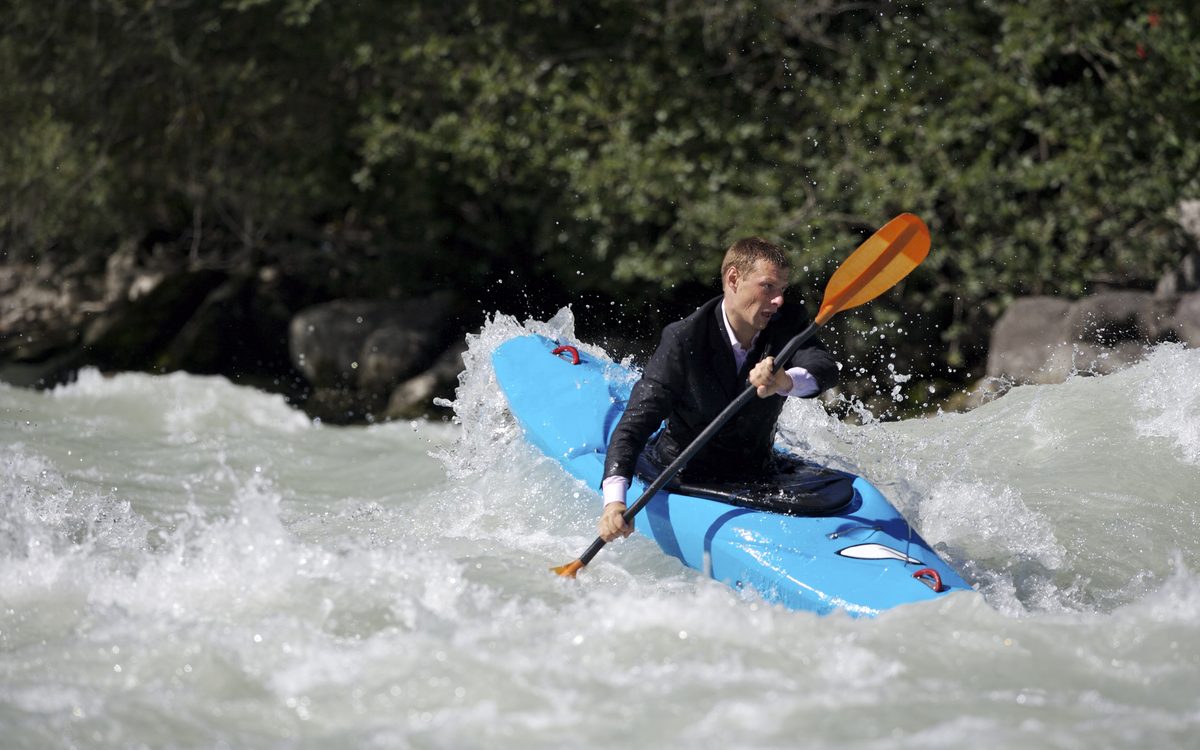
You sit at the top of the course, the starter counts you in, and the first gate is just a few strokes away. Your hands are cold, your heart is fast, and you have run this line fifty times. Mental training in canoe slalom means practising the skills that help you do what you already know under pressure: a routine, a focus, a picture of the run, and a plan for when it goes wrong. This page covers those skills, what research says and does not say, and the difference between performance and mental health. Race rules are on the rules page; logistics and the overview are on the canoe slalom page and canoeing hub.
Quick answer: Mental skills such as a fixed pre-run routine, imagery, one or two cue words and a plan for resetting after an error are standard practice in sport, but the evidence is moderate and not stable, and there is little slalom-specific research. Nerves are normal. Persistent anxiety, low mood, disordered eating or burnout are health matters for a qualified professional; in the US, call or text 988.
Why slalom is a particular mental test
A slalom run is short and exact. A paddler has about 90 to 110 seconds at the top level (Paddle Worldwide), up to 25 gates, and a penalty system where one touch costs 2 seconds and one miss costs 50. The two-run format, where the better run counts, means a second chance in many races, and kayak cross adds head-to-head tactics. On top of that, the water is moving, so a plan has to bend with a boat that does not do exactly what you asked. That mix of precision, speed and risk of a capsize is the mental task.
What the research shows
A 2024 systematic review and meta-analysis (Reinebo et al.) pooled studies of psychological interventions in competitive athletes. Psychological skills training (g = 0.83), mindfulness and acceptance-based approaches (g = 0.67) and imagery (g = 0.75) outperformed controls with moderate effects, but when non-randomised trials and subjective outcomes were removed, none of the effects remained significant. The authors say the effects are not stable and call for better trials. In plain words: these skills are widely used and plausible, but they are not proven to work, and none guarantees a better time.
For slalom specifically we found only a few studies. A 2002 study of canoe-slalom athletes (19 elite, 12 intermediate) found that the controllability of mental imagery, measured with a mental rotation test, correlated with race rank among the elite group (rs = 0.42) but did not separate elite from intermediate (MacIntyre et al.). A qualitative interview study of elite canoe-slalom competitors, as summarised in a research database, found that they used imagery of realistic behaviours rather than perfect performance. A 2013 set of experiments on slalom-based tasks (driving simulation, running and ski slalom, not canoeing) found internal visual imagery, the first-person view, produced quicker times than external imagery (Callow et al.). That is suggestive, not proof for paddling.
Confidence and goals
General practice, not slalom research: set goals you control, such as clean upstream moves, a calm start and a consistent line, rather than only a placing. Track them in a training log. Confidence comes from preparation you can point to: runs completed, rolls landed, moves you have made many times on moving water.
Imagery and course reading
Where the organisers allow it, athletes look over the course before racing; ACA rule 14 says training runs on the completed course are at the organiser’s discretion at races not required to follow ICF rules. Imagery can be done on the bank: see the water, feel the boat and paddle, and run the sequence at real speed, including the hard moves. Because the athletes in the qualitative study imagined realistic behaviours, it can also help to rehearse how you will handle a small error. Try both first-person and watching-yourself views, and see what your coach thinks.
A pre-run routine
A routine is a short, repeatable sequence that gets you to the start line in the same state each time. A simple coaching template (general practice, not from a study) is: a breath cycle, one cue for the first section such as “strong and early,” a quick check of equipment, then go. It should fit in the time you actually have at the start. Practise it in training so it is automatic on race day.
Focus between gates
Many coaches teach one cue per phase of the run, for example “edge” for a turn and “reach” for a stroke, and a gate-by-gate focus: finish this gate, then look to the next. This is common coaching practice. Avoid trying to steer the entire run in your head at once.
Handling pressure and nerves
Nerves are expected. If nerves rise in a boat, slow breathing is a common technique. Check your life jacket, helmet and skirt: preparation of kit is a mental job too, and it is covered on the gear page.
Fear of whitewater and swims
Fear of capsizing or of a hard swim is common in new paddlers. We found no study of it in canoeists. A review of anxiety in recreational scuba divers (Morgan, 1995) shows that anxiety in water sports can be significant, but scuba is a different activity. Coaches typically build skills in small steps: roll in a pool, then easy moving water, then harder features, with an instructor. The American Whitewater Safety Code stresses self-rescue and paddling with others, which also helps confidence.
After a penalty or capsize
One missed gate costs 50 seconds, which can end a run’s chances, and a capsize at the finish is a DNF under ACA rules. A reset plan (general practice) can be: breathe, name the next gate, and paddle it cleanly. In a two-run race, treat the second run as separate. Afterwards, review the run with a coach, with video if you have it, and write one thing to change.
Team and tactics
Kayak cross is a tactical race: four racers, contact allowed, and Paddle Worldwide notes that tactics often favour not leading early. Ramp starts and the roll mean practice of race scenarios helps. In team events, agree signals on shore.
Youth
We found no research on mental skills in youth slalom paddlers. For children, keep it playful and process-focused, and let the coach and parent talk about effort rather than results. Age groups start at U12 in ACA rules.
Mental performance versus mental health
Mental training is about performance skills. It is not treatment. The IOC’s 2026 consensus on mental health in elite athletes says mental health symptoms and disorders are common among elite athletes, may have sport-related causes and can affect performance. A 2024 survey of elite female paddlers in Spain found about a third had moderate or high anxiety risk, with higher eating-disorder risk in those with more anxiety. Persistent worry, low mood, panic, loss of interest, disordered eating, or burnout should be taken to a doctor or a mental health professional. In the US, the 988 Suicide & Crisis Lifeline is reachable by call or text to 988. Our nutrition page explains RED-S warning signs.
Canoe slalom mental training FAQs
Does imagery help canoe slalom paddlers?
Imagery is widely used and a 2024 meta-analysis found moderate effects, but the effects were not stable under stricter criteria. A 2002 study found imagery controllability related to race rank in elite canoe-slalom athletes. Try it with your coach; it is no guarantee.
How do I stop shaking at the start?
Nerves are normal. Slow breathing, a fixed routine and one cue word are common techniques. If anxiety is constant or disabling, speak to a doctor or mental health professional.
What should I do after a 50-second penalty?
A common coaching approach is to reset quickly: breathe, name the next gate and paddle it cleanly, then review the run afterwards. This is general practice, not a research finding.
Is a sport psychologist worth it?
Many athletes find one useful for routines and pressure. Credentials vary by country, so check qualifications. For a mental health concern, see a licensed clinician.
Where can I get help right now?
In the US call or text 988. If you are in danger, call 911 or your local emergency number.
Sources
- Paddle Worldwide (ICF), canoe slalom
- ACA Canoe Slalom Competition Rules 2025 (PDF)
- Reinebo et al. 2024, psychological interventions meta-analysis (PMID 37812334)
- MacIntyre, Moran and Jennings 2002, imagery controllability in canoe-slalom (PMID 12186246)
- Qualitative study of imagery among elite canoe-slalom competitors (record)
- Callow et al. 2013, internal visual imagery and slalom tasks (PMID 24155710)
- Morgan 1995, anxiety and panic in recreational scuba divers (PMID 8614760)
- IOC consensus on mental health in elite athletes, 2026 (PMID 42580854)
- Anxiety, eating disorders and menstrual disturbance risk in Spanish elite female paddlers (PMID 38956353)
- American Whitewater Safety Code 2024
- 988 Suicide and Crisis Lifeline
General information for education only, not medical advice. It does not diagnose, treat or replace care from a sports medicine doctor, physical therapist or athletic trainer. See our editorial policy for how we research and write.