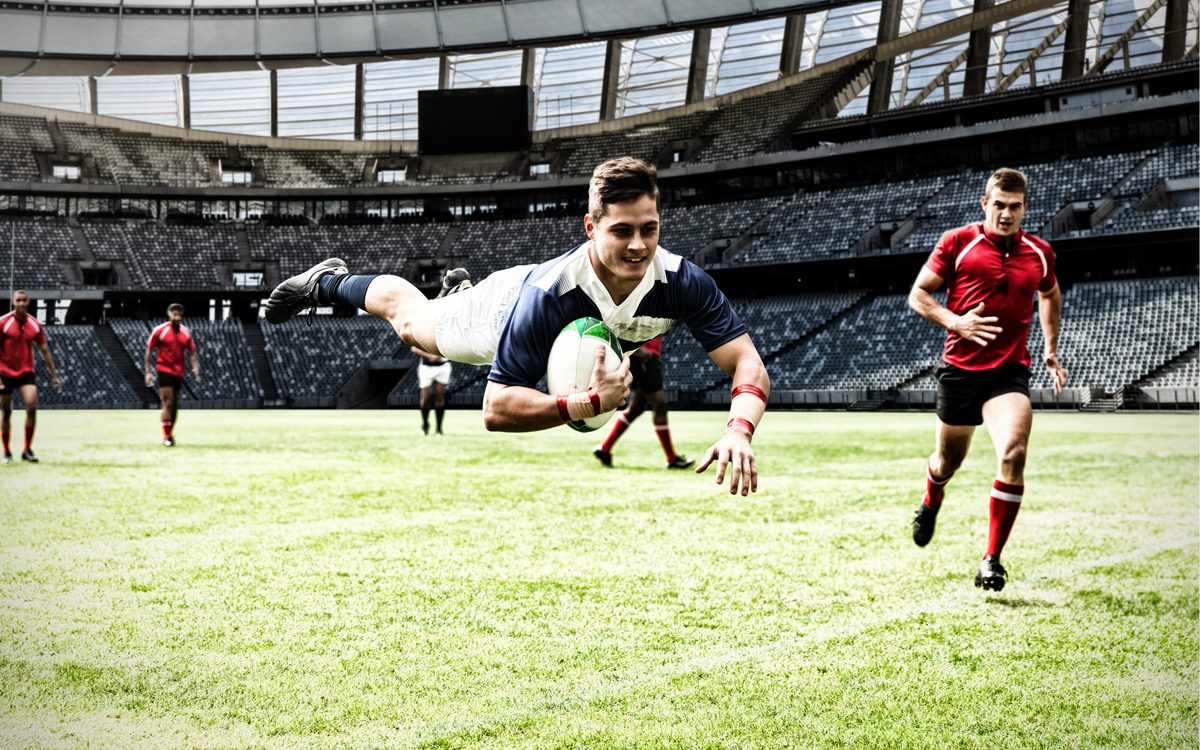
A sevens player is tackled at pace in the last minute of a match, gets up, and feels his knee “go” a moment later. This is the pattern the research keeps finding: acute injuries, mostly to the lower limb, mostly from being tackled. Rugby sevens injuries are the sprains, strains, joint injuries and head injuries that come with fast running and hard contact in a collision sport. This page explains what the surveillance studies report, what concussion rules say, and the general principles of rehabilitation. It cannot diagnose anything or clear a player to return. Reducing risk is on our injury prevention page.
Quick answer: Surveillance studies of international sevens report about 108 to 125 injuries per 1,000 player-match-hours for men and 71 to 109 for women, most often acute, in the lower limb, and caused by tackles. Any suspected concussion means the player is removed and assessed by a health care provider. See a sports medicine doctor, physical therapist or athletic trainer for any injury that does not settle, and call emergency services for the danger signs listed below.
How often and where: what the numbers say
A 2017 prospective cohort study of the 2014/15 and 2015/16 men’s and women’s World Series and the 2016 Rio Olympics (PMID 28137789) reported 107.7 and 109.7 injuries per 1,000 player-match-hours in the men’s series and 124.5 at Rio. The women’s figures were 88.5, 109.4 and 71.1. The differences between men and women were not statistically significant, and the study concluded that Rio fell in the normal range for international sevens tournaments.
The 2024 meta-analysis of 20 studies (Behardien and colleagues, PMID 38935238) estimated 108.5 injuries per 1,000 player-hours for men and 76.1 for women, with mean severity of 33.9 days for men and 44.2 for women. Injuries were significantly more likely to occur in the second half, to be acute, to affect the lower limb, to be joint or ligament injuries, and to result from being tackled. A 2026 review of women’s sevens (Braga and colleagues, PMID 41745675) of 15 studies reported 40.5 to 153.6 injuries per 1,000 match hours at the elite level and 26.5 to 46.3 in the community game, with elite injuries lasting 45.6 to 124 days. Evidence is limited and varies in quality.
Rates differ because studies count different things. A 2019 two-year study of 90 Australian international players (PMID 30779880) counted every injury needing medical attention, in training as well as matches, and found 43.2 per 1,000 player-hours overall. Women had a lower rate than men (rate ratio 0.91), more trunk injuries (relative risk 1.75) and fewer head and neck injuries (0.58). Compare numbers only within the same study.
Concussion
Concussion is a brain injury, and the CDC’s HEADS UP guidance is simple: recognise the signs, remove the player, and let a health care provider decide when they may return. Signs include headache, dizziness, confusion, nausea and trouble with balance or memory. Danger signs that need emergency care include a headache that gets worse, repeated vomiting, seizures, unusual drowsiness or loss of consciousness.
- Community rugby. World Rugby says a suspected concussion means immediate removal and no return that day, with a minimum stand-down of 21 days in community rugby (the day of injury is day 0) and a graduated return in steps that typically last at least 24 hours each, supervised by a medical or approved health professional.
- US youth and high school. USA Youth & High School Rugby says removal is immediate with no exceptions, and a player must be symptom-free for 14 full days before a graduated return, with evaluation by a physician trained in concussion.
- Elite matches. World Rugby’s head injury assessment protocol uses a fixed 12-minute assessment (HIA1) by independent doctors, with later assessments. Smart mouthguards have been used in the elite HIA process since January 2024.
If a player in your team has had a head knock, follow your league’s protocol, not a page like this one. If anything is unclear, the player sits out.
Other injury patterns
- Knee and ankle ligaments. In a review of Women’s Rugby World Cups 2010 to 2025 (PMID 42577447), concussion, knee ligament and ankle ligament injuries were the most common. These are rugby-wide figures, not sevens only.
- Shoulder. A 2026 meta-analysis of 37 rugby studies (PMID 42527622) pooled 11.02 shoulder injuries per 1,000 match hours, mostly from tackling and most often to the tackler. The American Academy of Orthopaedic Surgeons says a dislocated shoulder, with visible deformity, swelling, numbness or pain, is an emergency.
- Hamstrings and thigh. Sprinting injuries are common in team sports; see our training page for hamstring work.
- Neck. Burning or tingling that does not clear, or neck pain after a tackle or scrum, needs a medical check; if a neck injury is suspected, do not move the player.
General rehabilitation principles
Rehabilitation depends on the injury and the person; a physical therapist or sports medicine doctor builds it. The general principles, from standard sports medicine guidance such as the AAOS, are: get a diagnosis first, protect the injured area early, restore motion, then rebuild strength, balance and sport-specific skills in stages, and return only when the practitioner is satisfied. The AAOS lists no pain, no swelling, full motion and normal strength as basic readiness checks for a return to play, though a clinician sets the actual decision. Recovery times vary widely: the sevens meta-analysis reports average times lost of 33.9 and 44.2 days, but a mild sprain and a ligament rupture are very different. Do not use an average as your own timeline.
Rushing back is the common trap. The 2019 Australian study found the number of days, playing time and distance before the next injury tended to fall after each successive injury. A cautious return, with a plan from a professional, is the best evidence-based advice we can offer. Sleep, food and recovery support rehab; see our recovery page.
When to see a professional
- Any suspected concussion, or head knock with symptoms.
- Pain that is severe, stays more than a few days or wakes you at night.
- A joint that swells quickly, locks, gives way or looks out of place.
- Numbness, weakness or tingling in an arm or leg.
- A previous injury that keeps coming back.
Rugby sevens injuries FAQs
What is the most common injury in rugby sevens?
The 2024 meta-analysis found injuries were most often acute, at the lower limb, joint or ligament, and caused by being tackled. Concussion, knee and ankle ligament injuries are also commonly reported in rugby research.
Are women’s sevens injury rates lower than men’s?
In several studies they are lower or similar: the 2024 meta-analysis found 76.1 versus 108.5 per 1,000 player-hours, and the 2017 cohort found no significant difference. Women’s injuries lasted longer on average (44.2 versus 33.9 days in the meta-analysis).
How long does a concussion take to heal in rugby?
It varies by person. World Rugby sets a minimum stand-down of 21 days in community rugby and USA Youth & High School Rugby 14 full days symptom-free, but a health care provider decides on return, not a calendar.
Can I play through a minor injury in a tournament?
Not if it is a head injury or a joint injury. Tell the medical team, who can tape, assess or rule you out. Playing on can turn a short problem into a long one.
Do braces or tape prevent injuries?
We found no sevens-specific evidence. One trial of lace-up ankle braces was in high school football. Ask a physical therapist or athletic trainer about your own history.
Sources
- 2014/15 to 2016 Rio sevens injury cohort (PMID 28137789)
- Behardien et al. 2024 meta-analysis (PMID 38935238)
- Braga et al. 2026 women’s sevens (PMID 41745675)
- Australian sevens 2-year study (PMID 30779880)
- Women’s Rugby World Cups injuries (PMID 42577447)
- Shoulder injuries in rugby, meta-analysis (PMID 42527622)
- CDC HEADS UP signs and symptoms
- World Rugby concussion, general public principles
- World Rugby HIA protocol
- USA Youth & High School Rugby, player welfare
- AAOS OrthoInfo, dislocated shoulder
General information for education only, not medical advice. See a sports medicine doctor, physical therapist or athletic trainer about any injury or health concern. How we write these pages is in our editorial policy.