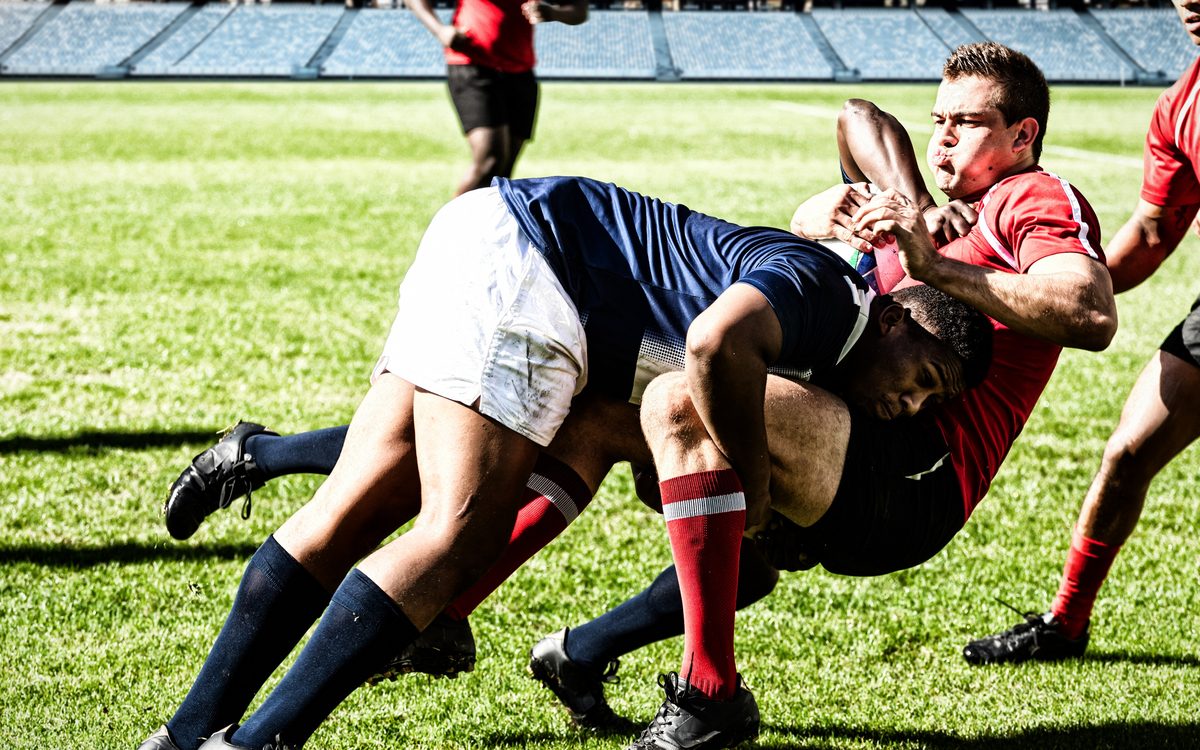
Wet Saturday morning, under-16s, the third tackle of the set. A defender slides in high on the ball carrier’s shoulder, both players’ heads end up too close, and play stops while the coach jogs on. Rugby league injury prevention is the set of habits, from warm-ups to tackle technique to load, that aim to lower the chance of getting hurt in a collision sport. It cannot remove the chance entirely.
Quick answer: The best-supported steps are a movement-control warm-up done regularly (the evidence is from rugby union), tackling with the head beside the ball carrier and not high, building training load gradually, strength and balance work, a fitted mouthguard, and heat planning. See a sports medicine doctor, physical therapist or athletic trainer for pain that does not settle, and get urgent care for any danger sign after a head knock. Prevention lowers risk; it does not guarantee safety.
General information, not medical advice. This page is about lowering risk. What each injury looks like is on our rugby league injuries page, so we do not repeat it here. For the sport as a whole, start at the rugby league hub.
Warm up like a team that wants to stay on the field
The best-studied warm-up for rugby is World Rugby’s Activate programme, built from single-leg balance, whole-body resistance work, landing and take-off plyometrics, and change-of-direction drills. It was tested in rugby union, not league, so treat the results as a promising indication for league.
- Schoolboys (union). In a cluster randomised trial of 3,188 players aged 14 to 18 in 40 schools (Hislop and colleagues, British Journal of Sports Medicine, 2017), overall match injury rates did not differ clearly between groups (rate ratio 0.85). Teams that completed three or more sessions a week on average had a rate ratio of 0.28 for overall injury and 0.41 for concussion.
- Adult community players (union). In a cluster randomised trial across 81 clubs (Attwood and colleagues, 2018), overall injury rates did not differ clearly, but the programme showed a likely beneficial 40 percent reduction in lower-limb injuries and a 60 percent reduction in concussion, with higher compliance linked to larger benefits.
Two caveats: clubs that volunteered for the adult trial may differ from clubs that did not, and we did not find a rugby league trial of a warm-up programme. A few minutes of general movement before contact is still sensible.
Tackle technique: where the evidence points
League rules already target the risky tackles. Under the International Laws 2026 (Section 15), contact with the head or neck that is intentional, reckless or careless is misconduct, as are shoulder charges and dangerous throws; any defender joining a tackle on an upright player must make first contact above the knees (Section 11). Research on video of NRL games adds detail:
- In two NRL seasons (Gardner and colleagues, Sports Medicine – Open, 2021), tackle head-injury propensity was 1.56 per 1,000 tackles overall, higher for tacklers (0.99) than ball carriers (0.57). Upright tacklers had about 3.2 times the risk of tacklers bent at the waist, and head-to-head contact was far riskier than head-to-torso contact (10.31 against 0.03 per 1,000).
- In the first three NRLW seasons (McLeod and colleagues, 2023), head contact above the sternum carried the highest risk (21.66 per 1,000 tackles), and shoulder and arm contact the lowest. In women’s games, tacklers and ball carriers were at similar risk. The study counted video-identified head impacts, not diagnosed concussions.
Both studies are observational, used one video coder and cannot prove that a coaching change prevents injury. Coaches commonly teach, as general practice: keep your head beside the ball carrier and not in front of the body, tackle below the sternum, stay bent at the waist and keep your feet moving.
Training load: build, don’t spike
Gabbett’s 2016 paper argues that sudden, large jumps in training load are more likely than hard training itself to cause non-contact soft-tissue injuries, and that under-training can increase risk too. A 2026 systematic review of rugby (Parmley and colleagues, 151 studies, 46 in league) found previous injury, physical characteristics, training and match load, and factors within contact events were the most common contributors to negative outcomes. A rule of thumb many coaches use, general practice and not a sourced limit: change load a little at a time, and be careful after injury, illness or time off.
Strength and conditioning
The Activate trials used resistance and balance work. See training and performance for lower-limb, trunk and shoulder strength and landing skills.
Environment: heat, wet fields and surfaces
The National Athletic Trainers’ Association position statement on exertional heat illness (Casa and colleagues, 2015) describes exertional heat stroke as one of the leading causes of sudden death in sport and recommends emergency action plans and good recognition and treatment. For league, that means acclimatising slowly to heat, having water available, and stopping a player with confusion, collapse or very high body temperature and calling emergency services.
Protective equipment and fit
The International Laws let players wear protective clothing as long as it contains nothing rigid or dangerous, and referees can order items removed (Section 4). Beyond that, separate the standards from the marketing:
- Mouthguards. A 2026 systematic review of rugby (Chaboussie and Baudet) reported orofacial injury prevalence of 40.4 percent and dental injury prevalence of 19.6 percent, noted mouthguards were worn mostly in matches and less in training, and rated the evidence certainty very low. A fitted guard is a sensible, low-cost step; see gear.
- Headgear. A 2026 observational study of Super Rugby (Brown and colleagues) found head injury assessments were higher, not lower, in headgear wearers after adjusting for tackles (incidence rate ratio 1.78). The authors point to the lack of protective effect found in earlier studies too. Do not count on soft headgear to prevent concussion.
- Shoulder pads. Rigid shoulder pads are named in the Laws as something referees may order off. We found no evidence that padding prevents shoulder injury.
Youth players
The Hislop trial involved players aged 14 to 18 in school rugby union. We did not find league-specific youth prevention trials, so follow your league’s age-group rules and ask about tackle teaching.
What prevention cannot do
A warm-up, good technique and careful load reduce risk, but league is a collision sport. A 2026 meta-analysis (Laaksonen and colleagues) pooled about 24.3 time-loss injuries per 1,000 player hours in league, and De Sousa-De Sousa and colleagues pooled about 10.45 concussions per 1,000 match hours. Better habits shift these odds; they do not remove them.
When to see a professional
See a sports medicine doctor, physical therapist or athletic trainer for pain that lasts, swelling, a joint that gives way, or numbness. After a head knock, CDC HEADS UP lists signs such as headache, dizziness, confusion and sleep changes, and says danger signs, including repeated vomiting, a worsening headache, seizures, slurred speech or growing drowsiness, need emergency care. Remove the player from play; a health care provider decides about return.
Frequently asked questions
Does a warm-up really reduce rugby injuries?
In two rugby union trials of Activate, concussion and some injury outcomes were lower, with the biggest effects when teams did it often. There is no league trial we could find, so it is promising, not proven for league.
What is the safest way to tackle in rugby league?
The Laws ban head and neck contact and dangerous throws, and NRL video studies link head-to-head contact and upright tackling to higher head injury propensity. Coaches teach tackling below the sternum with the head beside the ball carrier.
Should I wear a scrum cap?
Evidence for soft headgear is not supportive: a 2026 Super Rugby study found no protective effect on head injuries. It may still protect against scalp cuts, but check your league’s rules and ask a coach.
Do mouthguards prevent injury?
The 2026 review found high rates of dental and orofacial injury in rugby and rated evidence certainty very low. A fitted guard is widely recommended; ask your club what it requires.
Is training or the match riskier?
For concussion, matches are far higher: about 10.45 against 0.32 per 1,000 player hours in a 2026 meta-analysis. Match injury rates are higher than training across rugby formats.
How often should I do a warm-up programme?
There is no sourced league number. The schoolboy trial showed the biggest effects at three or more sessions a week; check with your coach.
Sources
- Hislop et al. 2017, Br J Sports Med, PMID 28515056
- Attwood et al. 2018, Br J Sports Med, PMID 29055883
- World Rugby, interventions to reduce risk (Activate)
- Gardner et al. 2021, tackle HIA risk factors in the NRL, Sports Med Open
- McLeod et al. 2023, tackle head impact events in the NRLW, Front Sports Act Living
- Gabbett 2016, training-injury prevention paradox, PMID 26758673
- Parmley et al. 2026, contributors to negative outcomes in rugby, PMID 41835331
- Casa et al. 2015, NATA position statement on exertional heat illnesses, PMID 26381473
- Chaboussie and Baudet 2026, orofacial and dental injuries in rugby, PMID 41871283
- Brown et al. 2026, soft-padded headgear and head injuries, PMID 41419445
- Laaksonen et al. 2026, PMID 41497830
- De Sousa-De Sousa et al. 2026, PMID 42128596
- CDC HEADS UP, signs and symptoms
- International Rugby League, Laws of the Game 2026
General information for education only, not medical advice. It does not replace a visit with a sports medicine doctor, physical therapist or athletic trainer. See how we research and write our pages in our editorial policy. More: mental training, gear, the rugby league hub and rugby.