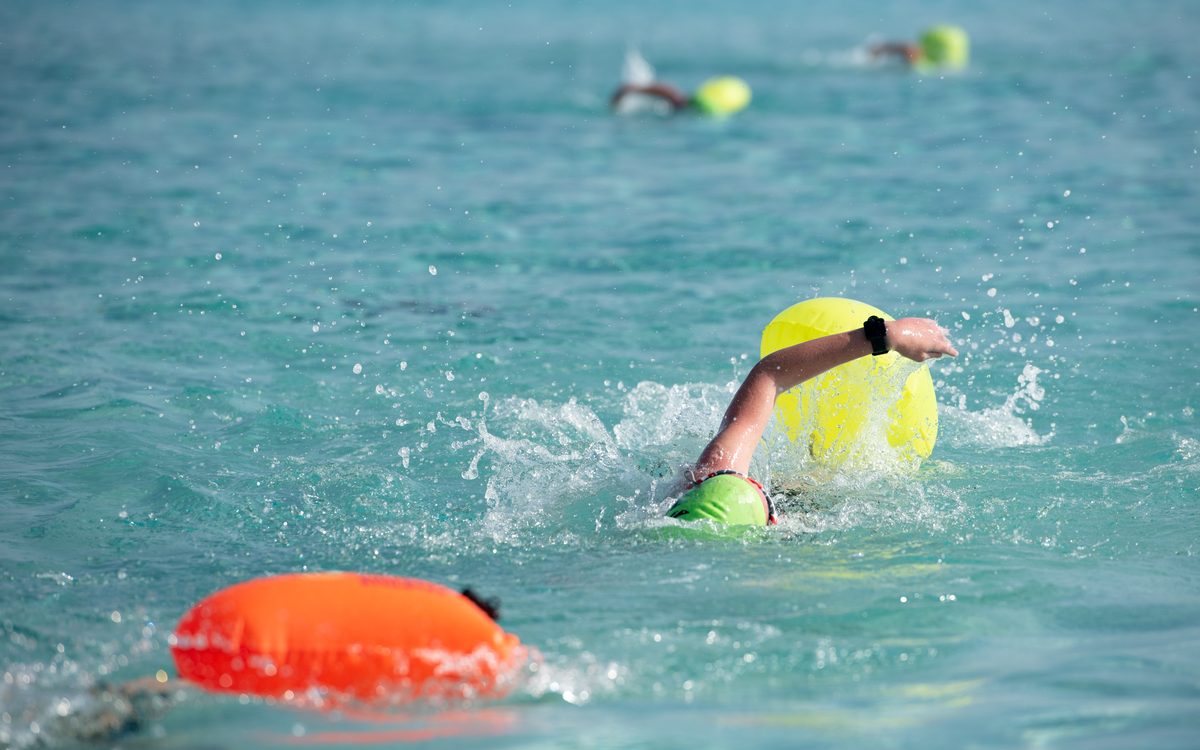
A good open-water swimmer does not look busy. In a 10 km race the leaders glide through the first lap at a pace that seems almost easy, then the pack thins out in the last hour. Open-water swim training is the plan that builds that kind of steady engine: lots of easy aerobic swimming, some work at threshold, a little speed, and practice in the messy conditions of real water.
Quick answer: A 2026 systematic review of 10 km open-water swimming found that elite training programmes were mostly low intensity, with about three quarters of the work in the easiest zone. Build a base in the pool, add practice for sighting, drafting and feeding, keep sessions at a level you can recover from, and talk to a coach before a big jump in weekly distance.
General information, not medical advice. See the open-water swimming hub for the whole picture and the swimming guide for the pool side. Injuries are on the injuries page; what to eat is on the nutrition page.
What the sport asks of the body
The 2026 International Journal of Sports Physiology and Performance review of elite 10 km open-water swimmers (16 studies from 2000 to 2024) reported high aerobic power (maximal oxygen uptake of 5.51 L/min in men and 5.05 L/min in women), lactate thresholds at roughly 89 to 94 percent, and a link between stroke index and finishing position. It also noted that swimmers peaked at about 29 years in men and 27 in women, which the authors tie to the experience needed in open water. These are findings about elite athletes, so they are a picture of the sport rather than a target for a recreational swimmer.
A study of nine male swimmers over a 5 x 1000 m lake session (Sports 2025) found stroke rate rose in the last 1000 m. In race terms, technique has to hold as fatigue builds.
Pacing
- In the 2023 World Championships men’s 10 km, a 2025 study of 65 swimmers found the top ten held about 92.7 percent of their pool-based critical speed from the first to the sixth lap, with longer strokes and lower stroke rates. Swimmers in the lower groups started at around 96 to 98 percent and slowed to about 85 to 88 percent by the end.
- The same review recommended raising stroke rate by up to 10 percent over the final 400 to 500 m to offset fatigue.
- In an exploratory GPS study of five elite swimmers, the winner delayed hard efforts until the finish. This is a small sample, so treat it as an idea to test, not a rule.
A sensible week (general coaching practice)
No published weekly plan fits every swimmer, so what follows is a common structure, not a sourced prescription. The review above found elite programmes put about 77 percent of work in zone 1 (easy), about 18 percent in zone 2 (threshold) and about 5 percent in zone 3 (fast); use it as a picture of balance rather than numbers to copy.
- 2 to 3 pool sessions with steady aerobic sets and one threshold set; include some swimming without walls (long repeats) to mimic the continuous effort.
- 1 open-water session when conditions are safe, with a buddy: sighting drills, drafting practice, entries and exits.
- 1 to 2 strength and mobility sessions for shoulders, upper back and trunk (see injury prevention).
- 1 rest or easy day. Recovery is on our recovery page.
Skills to add to pool fitness
- Sighting with minimal head lift, to save shoulders and legs.
- Drafting and moving between packs.
- Feeding while treading water or at a platform; try race drinks in training first.
- Cold and heat practice gradually, as described on the injury prevention page.
- Wetsuit swimming if your event allows it; practise in the suit you will wear.
Periodisation basics
Periodisation means organising the year into phases. A common pattern (general practice): a base phase of mostly easy volume, a build phase adding threshold work and open-water practice, a short taper before the target event, then an easy period. The 2026 review lists the performance factors (physical conditioning, biomechanics, race tactics and environment); the order of phases is the coach’s call. For the pool-swimming version see the swimming training page.
Gradual load
A 2023 systematic review in competitive swimmers (Scand J Med Sci Sports) found no strong evidence for most shoulder-injury risk factors, but its highest-quality study (201 swimmers) linked a high acute-to-chronic workload ratio and low posterior shoulder strength endurance with injury. A practical reading: raise distance in steps and take lighter weeks, rather than doubling your volume as an event approaches.
Open-water swim training FAQs
How do I train for open-water swimming in a pool?
Swim long, continuous repeats, practise sighting every few strokes with the lane lines as a stand-in for buoys, and swim in a group to practise drafting. Add open-water sessions when you can do so safely.
How long should my longest training swim be?
There is no published rule for recreational swimmers. Coaches often build the longest training swim toward the event distance in steps; ask a coach to set it for you.
Does stroke rate matter?
Stroke index was a strong predictor in the 2026 elite review, and elite swimmers raised stroke rate near the finish. For most swimmers, holding good technique when tired is the main aim.
Is high-intensity training useful?
Elite programmes in the review used some, about 5 percent of work in the fastest zone, with most work easy. Everyone responds differently, so a coach can tailor it.
Sources
- Characteristics of Elite 10-km Open-Water Swimmers: A Systematic Review, IJSPP 2026 (PMID 41344319)
- Pacing and trajectories in elite open-water swimming, J Sports Sci 2026 (PMID 41410548)
- Race pace and critical swimming speed in 10 km open-water competition, 2025 (PMID 40843832)
- Swimmers' kinematical and neuromuscular characterisation in 5 km swim, Sports 2025 (PMID 41150470)
- Shoulder pain and injury risk factors in competitive swimmers: systematic review, 2023 (PMID 37515375)
- World Aquatics Competition Regulations, Part Three (open water), Feb 2026
General information for education only, not medical advice. It does not replace a sports medicine doctor, physical therapist, athletic trainer or registered dietitian who knows you. See how we work in our editorial policy.