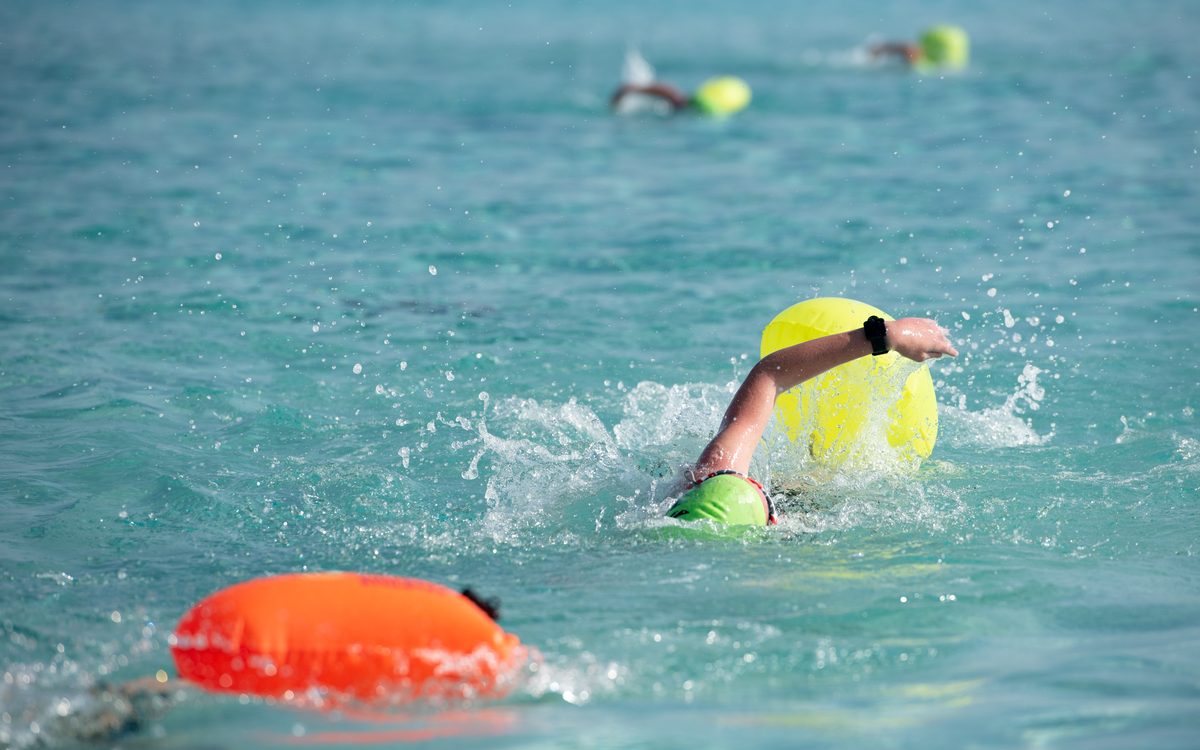
The horn goes, forty swimmers surge toward the first buoy, and somebody’s elbow lands on your goggles. In the pool you only see a black line. In open water you also meet cold water on your face, arms and legs, murky water, other bodies and a long way to the horizon. Open-water swimming mental training is the set of skills for staying calm, focused and decisive in that setting. It is separate from mental health, which is covered below.
Quick answer: Mental skills such as controlled breathing, a simple focus cue, a pre-race routine and practising the exact conditions you will race in are commonly taught to open-water swimmers. Research on imagery suggests it may help, but there is no proven protocol and nothing guarantees results. Anxiety, depression, disordered eating or burnout are health matters for a qualified professional; in the US you can call or text 988.
General information, not medical advice. Logistics for the day are on the swimming game day page; training is on our training page. See the open-water swimming hub for the whole picture and the swimming guide for the pool side.
Confidence comes from rehearsal
Confidence in open water usually comes from doing the thing: practising entries, sighting, swimming in a group and feeling cold water in training. This is common coaching practice. The 2026 interview study of 30 experienced channel swimmers described experience and community knowledge as a main way swimmers manage risk, with in-water decisions shaped by past swims. A 2026 Chest case-control study of swimming-induced pulmonary oedema found limited open-water swimming experience among the risk factors, which shows why gradual exposure matters for safety as well as confidence.
Focus: a simple cue
Many swimmers use a short cue (a word, a stroke count or a breathing pattern) to pull attention back from worry. Alternating focus between technique, the next buoy and the swimmer ahead is a common approach. These are widely taught sport psychology techniques; we do not claim they work for everyone. The Applied Sport Psychology (AASP) site lists certified professionals.
Goal setting and motivation
Process goals (hold the pace, sight every ten strokes, take the feed cleanly) are common practice in coaching because you control them, whereas finishing place depends on others and on the water. Pick a small next goal after each event; the channel swimmers in the 2026 study described emotional lows after finishing a defining goal, so a next step helps.
Imagery and visualisation
A 2026 systematic review of motor imagery and action observation (nine randomized studies, 339 participants) found significant improvements in speed, reaction time or strength in most studies, but said no optimal protocol is established. For a swimmer, imagery can mean walking through the course in your head: the start, the first buoy, a feed, the finish. Use it as one part of preparation, not a promise.
Handling panic and pressure
For panic in open water, USMS gives specific advice: roll onto your back and float until you are ready to continue. Our prevention page covers the safety side. Practical steps used by coaches (general practice): start at the edge or back of a pack, count strokes or breaths, slow the pace, look up at the horizon, and signal a kayaker if you need help. Anxiety, a fast heartbeat and a tight wetsuit also appeared among symptoms in the 2026 study of swimming-induced pulmonary oedema, so if you feel unusually breathless, do not assume it is just nerves; get out and get checked.
Pre-race routine and decisions
- A fixed routine (the same warm-up, the same breathing, the same words) reduces decisions on the day. This is general practice.
- Decide in advance what you will do if goggles flood, the pack splits or a feed is missed.
- Tactics: the elite pacing studies (2025 and 2026) suggest staying near the pack, saving efforts for the end and using drafting, but a recreational swimmer’s first aim is a steady, safe swim.
- For race logistics, see the swimming game day page; for event rules, see the rules page.
Youth
Young swimmers need adult supervision in open water, a short course and permission to stop. We did not find research on mental training specific to young open-water swimmers; see our youth swimming page.
Mental health is not the same as mental performance
Performance skills help with nerves and focus. They are not treatment. The 2019 IOC consensus statement on mental health in elite athletes says mental health symptoms and disorders are common in elite athletes, can impair performance and cannot be separated from physical health. Anxiety that will not settle, low mood, disordered eating, feeling flat for weeks after a big swim or burnout should go to a qualified professional such as your doctor or a licensed psychologist. In the US, call or text 988 (Suicide and Crisis Lifeline) for support at any time; ANAD runs an eating-disorders helpline. If you are outside the US, ask your doctor for local services.
Open-water swimming mental training FAQs
How do I stop panicking in open water?
USMS advises rolling onto your back and floating until you are ready to continue. Starting at the edge of the pack, slow breathing and practice in safe conditions help. If panic is frequent, a coach or sport psychology professional can help; if you feel unwell physically, get out and get checked.
Does visualisation work?
A 2026 review of nine trials found most reported benefits for speed, reaction time or strength, but no best protocol has been established. It is an aid, not a guarantee.
How do I deal with other swimmers touching me?
Contact is part of mass starts. Common coaching advice is to start wide or at the back until you are confident, and to practise in group swims.
What if I feel low after a big swim?
Some channel swimmers describe post-swim lows. If it lasts, tell your doctor; in the US call or text 988 if you are in crisis.
Can I do mental training on my own?
Yes, with simple routines and goals. A certified sport psychology professional can tailor them.
Sources
- IOC consensus statement on mental health in elite athletes, 2019 (PMID 31097450)
- Motor imagery and action observation in sport performance: systematic review, 2026 (PMID 40659534)
- Health, risk and adaptation in extreme open water swimming, 2026 (PMID 43013196)
- SIPE at moderate elevations, 2026 (PMID 42131935)
- SIPE risk factors, Chest 2026 (PMID 41903839)
- USMS: What to do in an open-water emergency
- AASP resources
- 988 Suicide and Crisis Lifeline
- ANAD eating disorders helpline
- Pacing and trajectories in elite open-water swimming, 2026 (PMID 41410548)
- Race pace in 10 km open-water competition, 2025 (PMID 40843832)
General information for education only, not medical advice. It does not replace a sports medicine doctor, physical therapist, athletic trainer or registered dietitian who knows you. See how we work in our editorial policy.