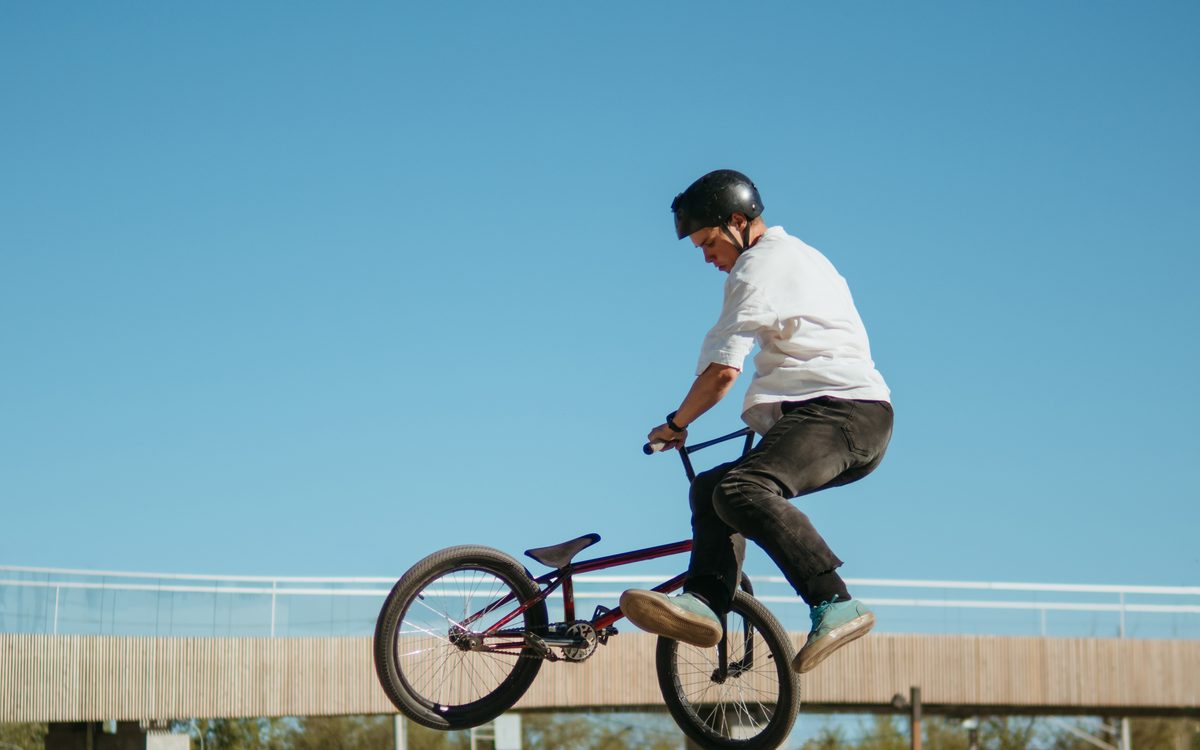
The rider rolls to the top of the quarterpipe, waits for the buzzer, and has one minute to show everything: speed, height, a flip, a whip, a line nobody has ridden before. Nobody races anybody. BMX freestyle rules are really a judging system: what the judges look for, how long a run lasts, and what the park allows. This page explains the basics for a rider, a parent or a new fan. For the bigger picture, see the BMX freestyle hub and the BMX parent page.
Quick answer: In BMX freestyle park, each rider gets a timed run of about one minute and judges score difficulty, execution, style, originality, flow, height and amplitude, according to the UCI. There are no required tricks. Beginners start at a local skatepark or BMX park with a helmet and the park’s own rules, and move to contests when they are ready. Check the federation’s current rulebook before entering any event.
How a park run works
The UCI describes a BMX freestyle park run as a timed performance, usually about one minute, on a course of quarterpipes, box jumps, spines, walls and step-ups. At UCI events the run is one minute for men and women, and the UCI says a good run ends just before the 60-second buzzer. Everything shown in that minute counts. Speed is a tool for getting height, not a goal on its own, and riders are judged on the creative lines they choose through the course as well as the tricks they do on it.
No tricks are required. Riders pick their own, and the UCI lists backflips, frontflips, tailwhips, barspins, 360s and flairs as common aerial moves. The UCI page does not give a points scale, the number of judges or tie-break rules, so those details belong to the current UCI regulations and each event’s guide.
At the Paris 2024 Olympic Games, the UCI reports that each rider had two 60-second runs and the better of the two scores counted. The men’s winner, Jose Torres Gil of Argentina, scored 94.82. That is how one Games was run; other events set their own formats, so read the schedule for the competition you are watching.
What the judges are looking at
- Difficulty and execution. A harder trick landed cleanly generally beats an easy one, and a crash or a sloppy landing hurts.
- Style and originality. Judges notice how a trick looks and whether it is new.
- Flow. Linking tricks smoothly, with a plan for how the whole run connects, rather than a pile of unrelated tricks.
- Height and amplitude. Going big off a quarterpipe or jump, with the trick done fully extended.
- Line choice. Using the whole park, including the features on both sides.
Those are the UCI’s listed criteria. How each one is weighted is for the judging panel to decide, so treat any single “formula” you read online with caution.
The other styles: flatland, street and dirt
Flatland is ridden on smooth flat concrete with no ramps. The UCI describes choreographed routines of linked tricks judged on difficulty, originality, control, flow, style and variety, with no clock race and no course. Riders in the UCI flatland categories must be at least 15 to compete at events on the UCI International Calendar. The bikes are light and compact, with steep forks, short top tubes and pegs on the axles; a chain is mandatory, and brakes are optional, with many riders going brakeless, according to the UCI.
Street uses stairs, rails and ledges, and dirt uses built jumps. Both appear at contests such as X Games, but as far as the sources we reviewed show, neither is on the Olympic programme. See the BMX freestyle hub for status by edition.
Skills a beginner learns first
The following is general coaching practice, not a federation requirement. Most coaches and park programs start with the same foundations, because tricks sit on top of them:
- Bike control. Riding position, braking if your bike has brakes, balance, looking where you want to go.
- Rolling in and out of ramps. Learning to roll down a small transition and come back up without panic.
- Pumping. Building speed from the shape of the ground rather than pedalling harder.
- Small airs and bunny hops. Getting the bike off the ground in a controlled way and landing both wheels together.
- Turning on a ramp. Early basic moves like a simple turn at the top of a quarterpipe. Spins and flips come later.
- Falling safely. Many coaches teach beginners how to bail, which is the skill you use most.
A coach, a skatepark session for beginners or a local BMX shop can point you to the right order for your age and bike. Go step by step and do not copy video clips of professionals.
How to start, and levels
- Find a park. Most riders begin at a public skatepark or BMX park. Read the posted rules, which often cover helmets, pads and when beginners and advanced riders ride. Mixed sessions get busy, so take turns and look before you drop in.
- Get the right bike and kit. A sturdy 20-inch BMX freestyle bike, a helmet and gloves are the usual start. Our gear page covers fit and inspection.
- Join a session or lesson. Many parks and shops run lessons or group sessions. Ask about age rules and insurance.
- Try a local contest. Local jams usually have beginner classes. National and international events sit higher up.
At the top, the UCI runs a BMX freestyle World Cup and the Urban Cycling World Championships, and USA Cycling holds national championships. A USA Cycling team document for the 2026 UCI BMX Freestyle World Championships lists elite men and women as age 15 and over, requires a valid UCI International License, and ties nominations to World Cup placings. USA BMX publishes its own rulebook and runs a separate amateur program; check usabmx.com and usacycling.org for current memberships, age classes and fees, which we have not confirmed. BMX freestyle is not an NCAA or NFHS sport.
Olympic status
BMX freestyle park first appeared at Tokyo 2020 (held in 2021), at Paris 2024 it was held at La Concorde, and the LA28 games plan lists BMX freestyle. The UCI says the LA28 BMX events are at the Sepulveda Basin Recreation Area. NBC Olympics lists the park qualification on 28 July and the final on 29 July 2028, with times subject to change. Flatland, street and dirt are not on that list. Check the official programme for the current Games before you plan.
Training for the rules is part of the picture: see our training page, and injury prevention before you try bigger features.
BMX freestyle rules FAQs
How long is a BMX freestyle run?
About one minute in UCI park competition, according to the UCI, and good runs end just before the buzzer. Flatland routines are longer and the UCI does not list a fixed length.
Do riders have to do certain tricks?
No. The UCI says no tricks are imposed in park. Riders choose their own and are judged on difficulty, execution, style, originality, flow, height and amplitude.
How old do you have to be to compete?
It depends on the event. UCI flatland events on the International Calendar require riders to be at least 15, and the 2026 USA Cycling world championships team document lists elite riders as 15 and over. Local contests have their own age classes.
Is there a special bike for BMX freestyle?
Yes. The UCI describes park bikes as very strong, with 20-inch wheels, a compact frame, a single gear and no suspension.
Where can I find the official rulebook?
The UCI regulations and event guides govern international events, and USA BMX and USA Cycling publish rulebooks for their own events. Rules are updated, so always check the current edition for the event you are entering.
Sources
- UCI: What is BMX Freestyle – Park?
- UCI: What is BMX Freestyle – Flatland?
- UCI: Paris 2024 BMX freestyle, gold for Argentina’s Jose Torres Gil
- LA28 games plan
- UCI: LA28 BMX racing and BMX freestyle at Sepulveda
- NBC Olympics: cycling at LA28 (schedule, times subject to change)
- USA Cycling: 2026 UCI BMX Freestyle World Championships team document
- USA BMX: official rulebook page
- USA Cycling nationals recap 2026 (BMX race and freestyle)
General information for education only, not medical advice. It does not replace a sports medicine doctor, physical therapist, athletic trainer or registered dietitian who knows you. See our editorial policy for how we write and source our pages.