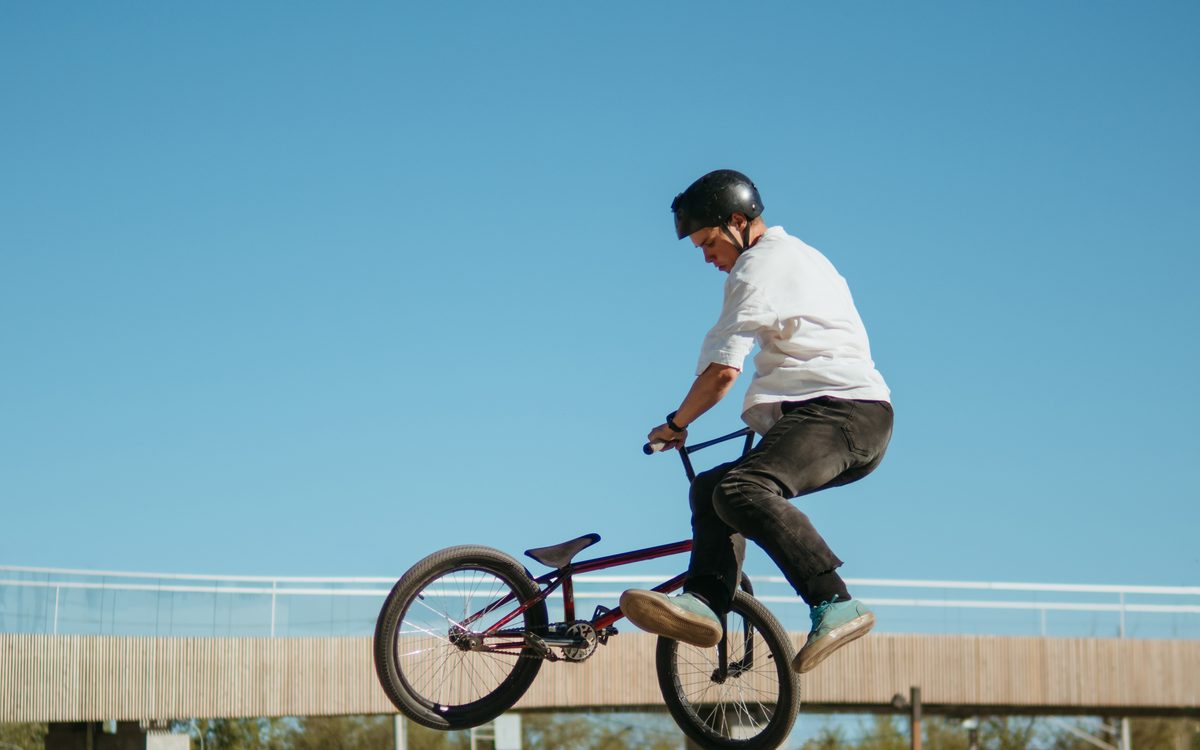
The rider lands a little short, the front wheel stops, and the hands take everything. A few seconds later he is on his back at the bottom of the ramp, holding a wrist. BMX freestyle injuries are mostly the result of falls from height onto hard surfaces, and they cluster in the hands, arms and shoulders. This page explains common patterns, what published studies show, concussion basics and the general principles of getting back to riding. It is general information; it does not diagnose anything. Prevention is on the injury prevention page.
Quick answer: Studies of BMX show high injury rates, mostly cuts, scrapes, fractures and bruises, with the upper limb most affected. Tokyo 2020 data put BMX freestyle at 22% of athletes injured. Any head blow means stop riding and see a healthcare provider. A sports medicine doctor, physical therapist or athletic trainer should diagnose injuries and decide when you can ride again.
What the numbers say
The British Journal of Sports Medicine report on Tokyo 2020 found 22% of BMX freestyle athletes were injured, versus 27% of BMX racers and 27% of boxers and 21% of skateboarders; across all athletes at the Games the figure was 9%. A 2025 meta-analysis in BMJ Open Sport & Exercise Medicine, covering 44 studies across competitive cycling, found BMX had the highest injury incidence of any discipline at 4.59 injuries per 365 days, that the upper limb made up 65.21% of BMX injuries, and that skin lacerations, abrasions and lesions were the most common types, with fractures second. Those BMX figures combine racing and freestyle, so use them as a guide to the family of sports.
A 2026 retrospective survey of 192 cyclists in BMC Sports Science, Medicine and Rehabilitation looked at injuries that cost three or more weeks of time. Hand fractures (14 injuries) and clavicle fractures (13) were the most common diagnoses overall, and hand fractures and shoulder dislocations were most frequent among BMX athletes. Mean time loss ranged from 6.5 weeks for hand fractures to 13.3 weeks for shoulder dislocations, and full return to pre-injury performance was reported by 85.7% after hand fractures and 28.6% after acromioclavicular (AC) joint separations. That is a small, self-reported survey of several cycling disciplines, so it shows what can happen, not what will happen to you.
A 2025 scoping review in Sports Health, covering 37 studies, found the most common injuries were contusions, lacerations and fractures, and that most studies came from elite events or emergency departments. It also warned that emergency data can miss minor injuries, and that rigorous studies of freestyle in community parks are still needed.
Common injury patterns
- Cuts, scrapes and bruises. The most common injury type in the cycling literature. Clean and cover wounds, and see a clinician if a cut is deep, will not stop bleeding, or is contaminated.
- Wrist and hand injuries. Hand fractures were among the most frequent diagnoses in the 2026 survey. The AAOS also names collarbone and wrist fractures as common bicycle injuries.
- Shoulder and collarbone injuries. Falls onto an outstretched arm or the point of the shoulder can cause collarbone fractures, shoulder dislocations and AC joint separations, per the 2026 survey.
- Knee and lower-limb injuries. The 2026 survey lists non-specific knee injuries among the most common diagnoses, more often in training.
- Head injury. See below.
This list is a summary of what the studies report, not a way to diagnose yourself. Many different problems can feel the same.
Concussion
Park riders crash from height onto hard surfaces. The CDC’s HEADS UP programme says signs and symptoms can include headache, dizziness, confusion, balance problems and feeling slowed down, and that a person with a suspected concussion should stop activity and be seen by a healthcare provider before returning. Call 911 for repeated vomiting, a seizure, worsening headache, slurred speech or one pupil larger than the other. The Consumer Product Safety Commission notes that no helmet has been proven to prevent concussion and that bike helmets are built for one impact. Return to riding after a head injury is a decision for a healthcare provider, not for a rider or friends.
Rehabilitation principles
Rehab depends on the injury, and a clinician sets it. Some general principles are widely used in sports medicine and are listed here for understanding only:
- Get a proper diagnosis first. A possible fracture, dislocation, head injury or deep cut needs a professional.
- Follow your clinician’s plan. Early gentle movement is often encouraged for some injuries and wrong for others, which is why the diagnosis comes first.
- Restore range, then strength, then skill. A typical sequence is movement, then strength, then sport-specific skills like landing and balance, then return to riding on small features before big ones. This is general practice.
- Return gradually. No source gives a universal timeline. The 2026 survey shows how widely time loss varied between injuries.
- Expect setbacks and confidence dips. Fear of re-injury is common. A coach or sports psychologist can help; see our mental training page.
When to see a professional
- Any head blow, dizziness, vomiting, confusion or memory gap.
- Severe pain, a visibly bent limb, numbness, or inability to put weight or grip.
- Swelling or bruising that grows over hours, or pain at the collarbone, wrist or shoulder that does not settle.
- A deep, dirty or bleeding wound.
- An injury that keeps coming back or limits riding.
For gradual recovery between sessions, see the recovery page. Parents can find family-oriented pages through the BMX hub.
BMX freestyle injuries FAQs
What is the most common BMX freestyle injury?
Studies group BMX together. Skin injuries (cuts and scrapes) and fractures are most common, and the upper limb accounts for 65.21% of BMX injuries in a 2025 meta-analysis. Hand fractures stood out among BMX athletes in a 2026 survey.
How long does it take to recover from a broken wrist or collarbone?
There is no universal answer, and it depends on the break and treatment. In a 2026 survey of cyclists, mean time loss was about 6.5 weeks for hand fractures. A clinician will give a timeline for your injury.
Do I need to see a doctor after a crash?
Yes after any head blow, severe pain, deformity, numbness or an injury that is not settling. If you are unsure, a sports medicine doctor, physical therapist or athletic trainer can assess you.
How do I know if I have a concussion?
You cannot tell reliably on your own. The CDC lists headache, dizziness, confusion, balance problems and feeling slowed down among the signs. Stop riding and see a healthcare provider.
Can I ride through pain?
Pain that changes how you ride, or that does not settle, is a sign to stop and get it checked. Riding on an injury can make it worse and raise crash risk.
Sources
- British Journal of Sports Medicine 2023: injuries and illnesses at Tokyo 2020 (PubMed)
- BMJ Open Sport & Exercise Medicine 2025: injury and illness across competitive cycling disciplines (PubMed)
- BMC Sports Science, Medicine and Rehabilitation 2026: severe injuries in competitive cycling over an Olympic cycle (PubMed)
- Sports Health 2025: injuries, risk factors and prevention in BMX, scoping review (PubMed)
- AAOS OrthoInfo: Bicycle Safety
- CPSC: Which Helmet for Which Activity?
- CDC HEADS UP: signs and symptoms of concussion
General information for education only, not medical advice. It does not replace a sports medicine doctor, physical therapist, athletic trainer or registered dietitian who knows you. See our editorial policy for how we write and source our pages.