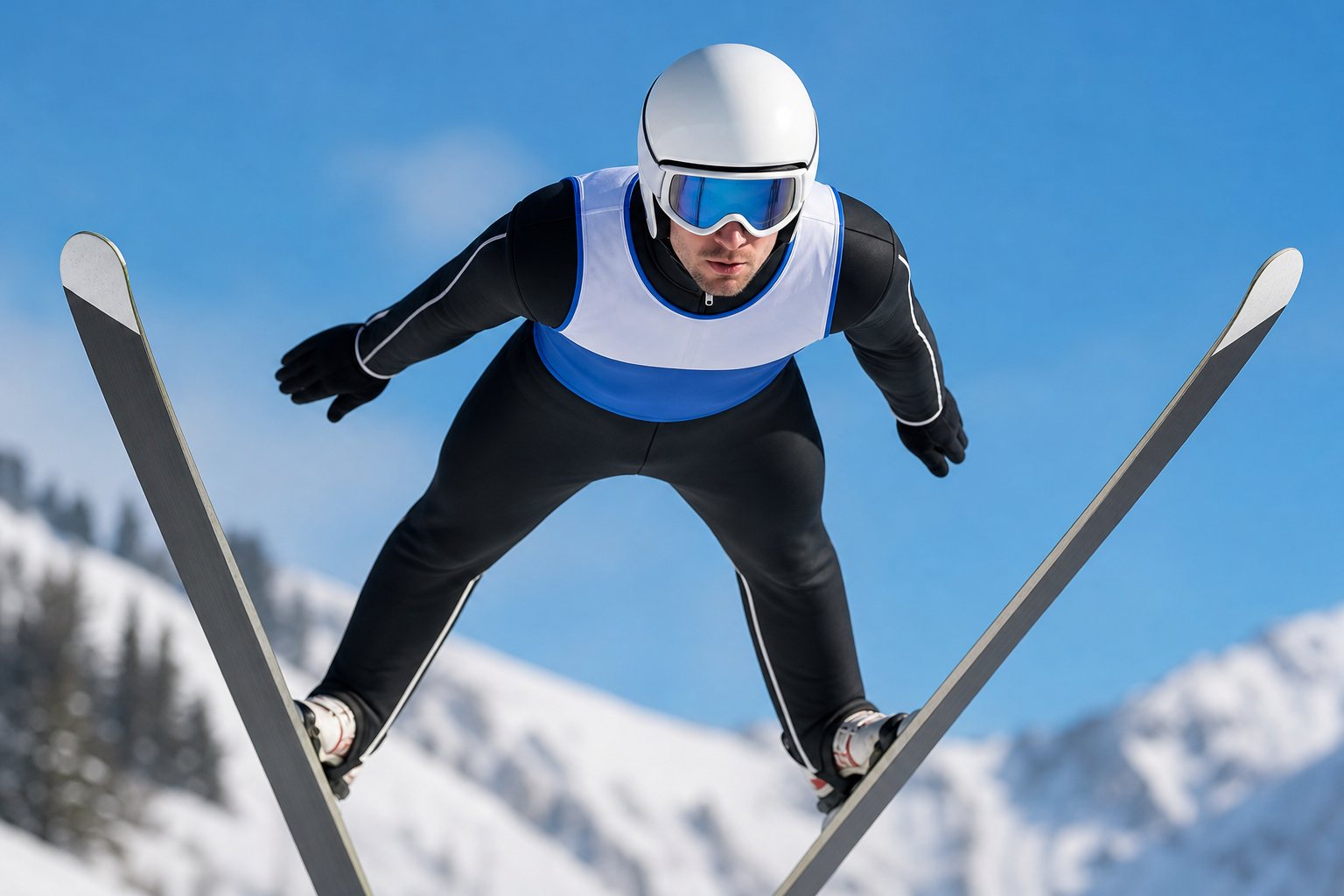
A jumper lands a little short of the flat, the skis catch and the tumble down the outrun looks worse than it feels, until the knee will not take weight. Ski jumping injuries are mostly landing injuries, and the knee is the joint that shows up again and again in the data. This page gathers the published numbers, explains general rehab principles and says when to get help. It does not diagnose anything. Prevention habits are on our injury prevention page.
Quick answer: In elite women’s World Cup jumping, 54 injuries were recorded over three seasons (26.3 per 100 athletes per season), most acute, and the knee was the most common site (33%). At the 2023 Nordic World Ski Championships, three concussions were recorded, all in ski jumping. See a sports medicine doctor, physical therapist or athletic trainer for any injury that does not settle, and call emergency services after a head injury with danger signs. Return to jumping is a decision for your care team.
What the numbers say
- Women’s World Cup, three seasons. Stenseth and colleagues (British Journal of Sports Medicine, 2022) followed 205 athlete-seasons from 19 nations and recorded 39 injury events and 54 injuries, 26.3 per 100 athletes per season. 83% were acute, 78% happened on the hill, 33% were at the knee, crash landings caused 70% of events and one third of injuries were severe, with 78% of those involving the knee.
- Nordic World Championships 2023. Kastner and colleagues (BMJ Open Sport & Exercise Medicine, 2025) recorded 24 injuries, 4.0 per 100 athletes, across cross-country, Nordic combined and ski jumping together. Lower limbs accounted for 58.3% of injuries, half of those at the knee; sprains and contusions were 25.0% each; three concussions (12.5%) all occurred in ski jumping.
- Hip complaints. A 2025 survey of 22 elite ski jumping and Nordic combined athletes found jumpers reported worse hip symptom scores than Nordic combined athletes (Vasavada and colleagues).
- Olympic Games. A search summary of the Sochi 2014 report placed ski jumping among sports with the lowest injury incidence at those Games; we did not read the primary report, so we do not give a figure.
These samples are small and cover elite athletes. Club-level data are scarce, so be careful about applying them to a beginner on a small hill.
Knee injuries and the ACL
The knee is the headline joint. AAOS OrthoInfo describes an ACL tear as a rupture of one of the four main knee ligaments that usually happens during pivoting, cutting or landing from a jump, often without contact, with symptoms such as a pop, swelling and the knee giving way. A retrospective study of 18 elite ski jumpers with ACL injuries (Oronowicz and colleagues, 2024) found all males and four females returned to competition, at a mean of 14.6 months (males) and 13.5 months (females). Only about 60% reached their pre-injury level and fewer than 15% reached a top-3 placement afterwards. These are averages from a small group, not a timeline for anyone, and return decisions are made with a surgeon, physical therapist or athletic trainer.
Concussion
The CDC’s HEADS UP program lists signs such as looking dazed or confused, trouble concentrating, clumsiness, vomiting right after the injury and mood changes, and says symptoms may take hours or days to appear. Call 911 or go to an emergency department for a seizure, repeated vomiting, loss of consciousness, a headache that worsens, slurred speech, or one pupil larger than the other. Anyone with a suspected concussion stops jumping and sees a healthcare provider, who decides when to return.
General rehab principles
Rehab is individual, so the points below are general ideas from the sources, not a plan:
- AAOS OrthoInfo says non-surgical ACL care focuses on reducing inflammation and physical therapy to rebuild quadriceps strength and confidence, and that surgery depends on injury severity, age, activity level and feelings of instability. The decision is made with an orthopaedic surgeon.
- OrthoInfo describes gradually rebuilding quadriceps strength as the main principle and warns that returning to normal activity with ongoing instability risks further knee damage.
- Hip strength and conditioning were suggested by the 2025 survey authors, a small study; ask a physical therapist if it fits your case.
- Rehab for other injuries (ankle, shoulder, back) follows the same idea: a professional assesses, loads are rebuilt in steps and pain guides the pace.
When to get help
- Pain that persists, appears at rest or wakes you at night.
- Swelling, a pop, or a joint that gives way or locks.
- Any head injury with symptoms, and any danger sign above.
- Anything you are unsure about: ask a sports medicine doctor, physical therapist or athletic trainer.
We do not give recovery times or return-to-jump clearance; both depend on the injury and the person. Recovery habits that support rehab are on our recovery page. For the sport as a whole, see the ski jumping hub.
Ski jumping FAQs
What is the most common ski jumping injury?
In the women’s World Cup study the knee was the most common site (33%), and crash landings caused 70% of injury events.
How long does an ACL injury take to recover from in a ski jumper?
In a study of 18 elite jumpers the mean return to competition was about 14.6 months (males) and 13.5 months (females). That is an average from a small group, not a promise; your care team decides.
Are concussions common in ski jumping?
Three concussions were recorded at the 2023 Nordic World Championships, all in ski jumping, which the authors named a priority. Overall counts are small.
Can a jumper return after a knee injury?
In the elite study, most did, though many did not reach their earlier level. A surgeon or physical therapist makes the call for each person.
Is ski jumping safer than other winter sports?
We could not confirm a direct comparison from a primary source. Data are limited, so we do not rank it.
Sources
- Stenseth et al., injuries in elite women’s ski jumping, Br J Sports Med 2022
- Kastner et al., injuries and illnesses at the Nordic World Ski Championships 2023
- Vasavada et al., hip, knee and ankle outcomes in elite Nordic jumping athletes, 2025
- Oronowicz et al., ACL injuries in elite ski jumping, KSSTA 2024
- AAOS OrthoInfo, ACL injuries
- CDC HEADS UP, concussion signs and symptoms
General information for education only, not medical advice. It does not replace a visit with a sports medicine doctor, physical therapist or athletic trainer. See how we write and check our pages in our editorial policy.