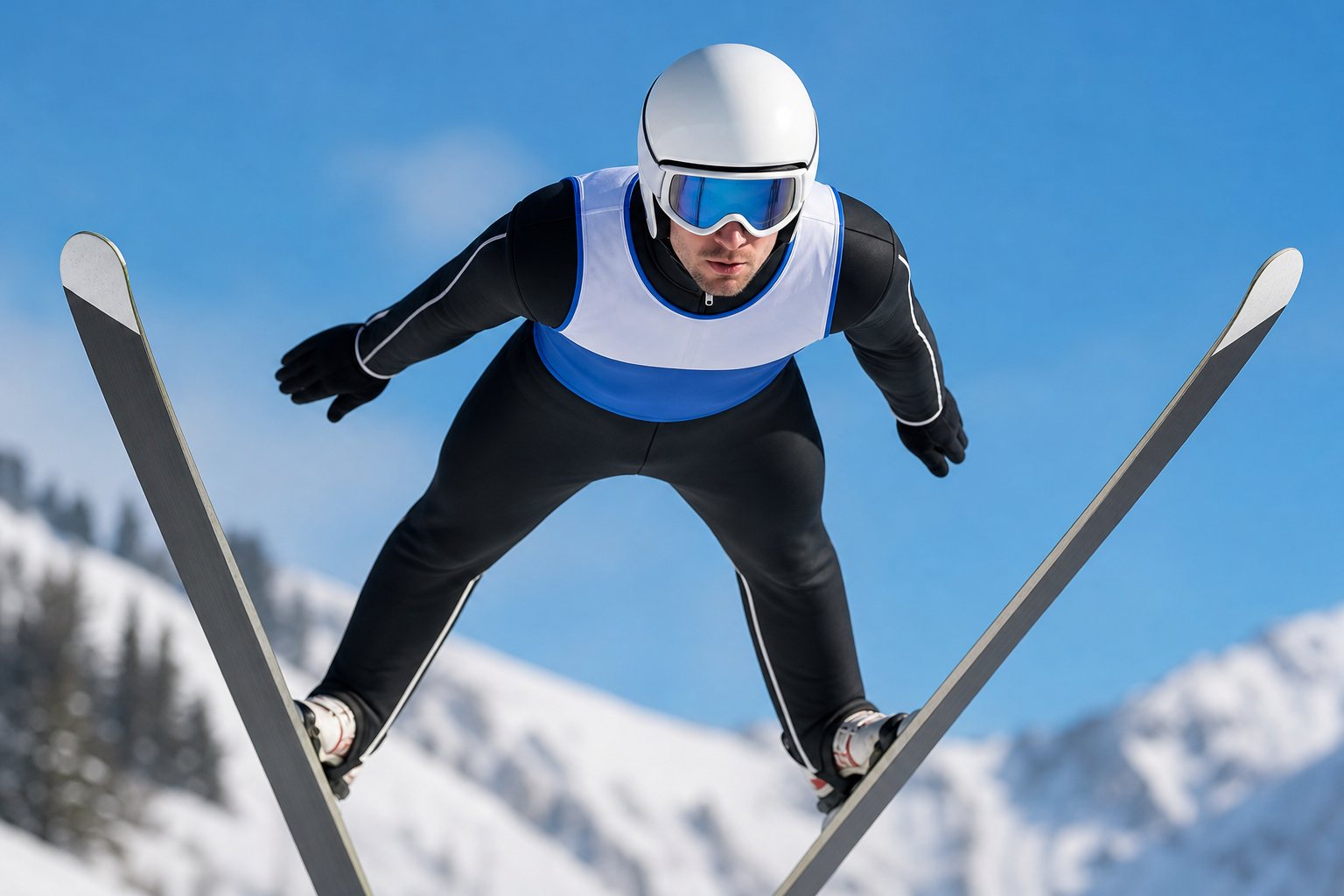
Top of the in-run, gate bar in hand, the starter’s light is red and the wind flag is twitching. A jumper has perhaps half a minute to settle, and then three seconds to do the thing practised ten thousand times. Mental training for ski jumpers is the set of skills for that half minute: focus, calm, routines, and the ability to bounce back after a bad jump or a scary one. It supports performance. It does not guarantee it.
Quick answer: Published research on the psychology of ski jumping is thin, so most of what follows is general sport-psychology practice adapted to the sport and labelled as such. Skills that coaches commonly teach are a short pre-jump routine, imagery, focus cues and a plan for resets after a bad jump. Worry that does not lift, low mood, disordered eating or burnout are health matters to take to a qualified professional, not a mindset problem to push through.
What the research offers
A 2026 study (Yan and colleagues, Brain Sciences) had 27 elite ski jumpers do action observation, motor imagery and the two combined while brain activity was measured with fNIRS. Only the combined task produced significant activation, mainly in movement-related and frontal areas, with no difference by athlete level; the authors said behavioural studies are still needed. It does not show that imagery improves jumping, but it is consistent with the common coaching practice of watching a jump and picturing it together. The 2026 review of Olympic snow sports lists psychological preparation among the discipline-specific training areas.
Routines and focus
General practice: build a short, repeatable pre-jump routine, such as a breath, a cue word and one technical thought for the take-off. A routine gives an anchor when the wind, the crowd or the weather changes. Keep it simple enough to repeat in the cold with gloves on.
Imagery
Many coaches use imagery, picturing a jump from the inside, with the speed, the push and the landing, as a way to rehearse technique when the hill is closed. Imagery adds to physical practice and does not replace it. It is general practice, and the ski-jumper-specific evidence is thin.
Handling pressure and uncertainty
Ski jumping is a sport of conditions. Gate changes, wind holds and delays are part of the competition, which scores for wind and gate in the points (NBC Olympics). Good habits include controlling what you can (your routine, your breathing, your warm-up) and letting go of what you cannot. The 2026 super team final at the Olympics was shortened because of heavy snow and wind (NBC Olympics), a reminder that conditions can change the plan.
Confidence, fear and setbacks
A hard fall or a long layoff after injury can make the top of a hill feel different. General practice is graded exposure under a coach: smaller hills, shorter jumps and a slow build back, with no pressure to hurry. A sports psychologist or a doctor can help with fear that does not ease. The elite ACL study found that many jumpers returned to competition (Oronowicz and colleagues, 2024), but they often did not reach earlier levels; that is a reason for patience, not alarm.
Goal setting and motivation
Process goals, such as the quality of a take-off or a landing, are within a jumper’s control; distance and ranking are not. General practice is to set small weekly targets, review them with a coach and celebrate the process.
Competition preparation
A calm competition day starts the day before: check equipment, sleep, food and travel. Equipment control is part of the event, so jumpers should know the rules; see our rules page and gear page.
Mental health is not mental performance
The IOC consensus statement on mental health in elite athletes (Reardon and colleagues, 2019) notes mental health problems are common in elite athletes, can affect performance, and can raise injury risk and slow recovery. Anxiety that interferes with daily life, depression, disordered eating, burnout or thoughts of self-harm need a qualified professional, such as a doctor, psychologist or counsellor. In the US the 988 Suicide and Crisis Lifeline offers free support by call or text at 988. Outside the US, see local services. See also our nutrition and athlete health page for weight and food concerns.
Back to the ski jumping hub or the skiing hub.
Ski jumping FAQs
Does visualisation really help ski jumpers?
The evidence in ski jumpers is limited. A 2026 study of 27 elite jumpers looked at brain activity during imagery and observation but did not test jump results.
How do I handle a delay or wind hold at the top?
General practice is to stay warm, breathe and use your routine; coaches can help you plan.
What if I am afraid after a fall?
Fear after a fall is common. Tell your coach, return in small steps and ask a sports psychologist or doctor for support if it does not ease.
Is anxiety before a jump normal?
Some nerves are normal. If worry is constant or affects sleep, school or work, talk to a qualified professional.
Where can I get crisis help?
In the US, call or text 988. Elsewhere, contact local emergency or crisis services.
Sources
- Yan et al., action observation and motor imagery in elite ski jumpers (fNIRS), Brain Sci 2026
- Zoppirolli et al., Olympic snow sports review, 2026
- Reardon et al., IOC consensus statement on mental health in elite athletes, 2019
- NBC Olympics, Ski jumping 101: competition format
- NBC Olympics, Austria wins the first Olympic men’s super team
- Oronowicz et al., ACL injuries in elite ski jumping, KSSTA 2024
General information for education only, not medical advice. It does not replace a visit with a sports medicine doctor, physical therapist or athletic trainer. See how we write and check our pages in our editorial policy.