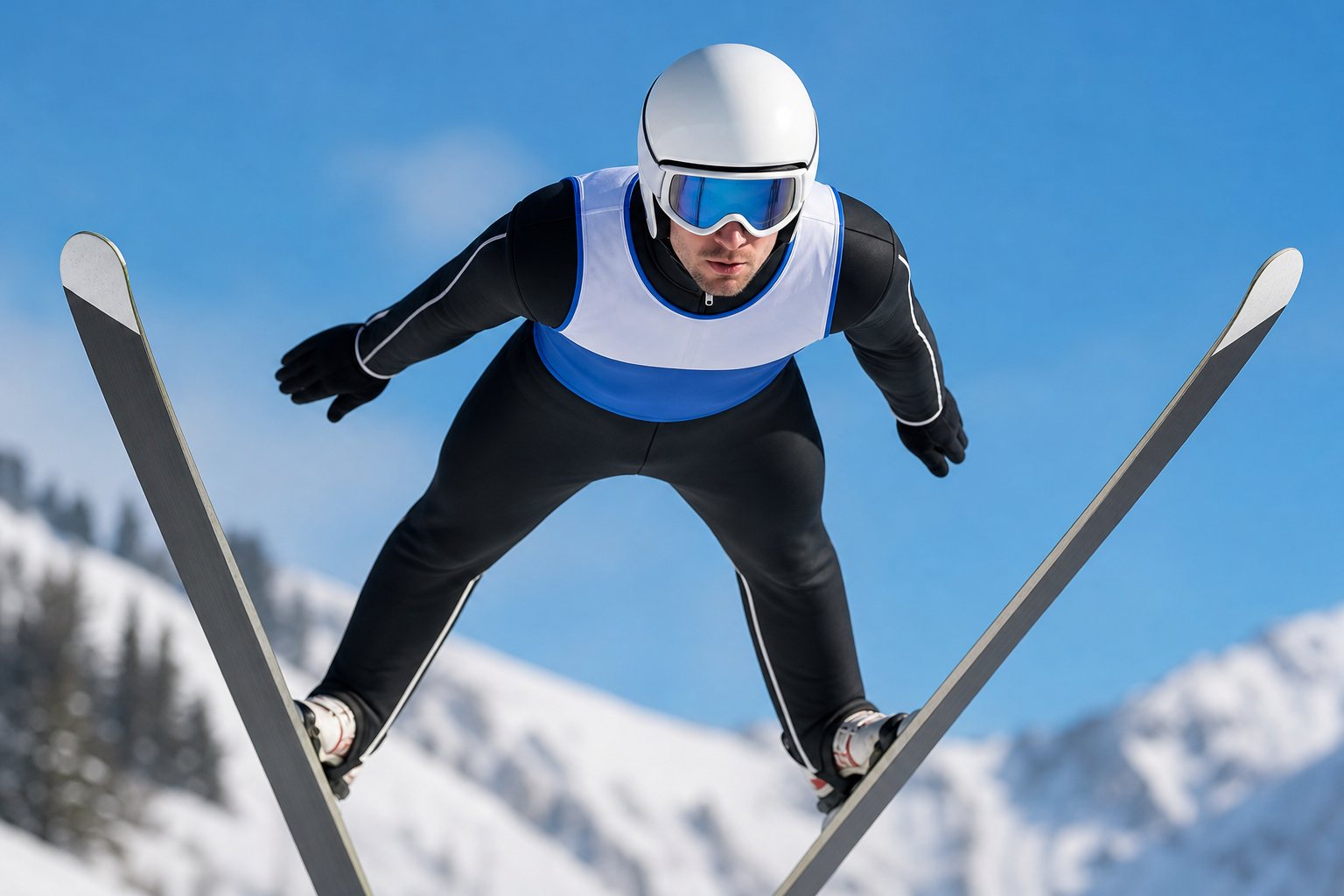
Weigh-in culture is not part of ski jumping, but the scale is never far away. Lighter jumpers fly farther, and the sport has a history of athletes trying to get lighter than was healthy, which is why the governing body wrote body weight into the equipment rules. Ski jumping nutrition is therefore as much about eating enough as about eating well. This page covers fuel and hydration, the weight rules and Relative Energy Deficiency in Sport (REDs), and supplements under the site’s cautious rules.
Quick answer: Eat enough to fuel training: the IOC’s 2023 consensus statement on REDs describes health and performance problems when energy intake is too low for what the body does. Ski jumping ties maximum ski length to body mass index (BMI) to discourage extreme weight loss. Supplements add only a small contribution for most athletes, can carry doping risk, and should be discussed with a doctor or a registered dietitian. Concerns about food, weight or fatigue belong with a qualified professional.
Why weight matters in this sport
According to NBC Olympics, skis may be at most 145% of the jumper’s height, based on a minimum BMI of 21, and lighter jumpers must use shorter skis. A sports biomechanics study (Virmavirta and Kivekas, 2021) says FIS tied ski length to BMI in 2004 to curb underweight problems, found the rule reduced but did not eliminate the advantage of being light, and concluded no further change was needed. An NBC Sports report (2022) quoted USA Nordic’s executive director calling ski jumping one of the most eating-disorder-plagued sports, describing underweight male jumpers in the early 2000s, and quoted a FIS official saying the rule has been effective. Those are individual statements, not research findings. A jumper who feels pressure to lose weight should speak to a doctor or registered dietitian, not just a coach.
REDs: what to know
The IOC consensus statement (Mountjoy and colleagues, British Journal of Sports Medicine, 2023) describes REDs as health and performance problems caused by low energy availability in female and male athletes, and provides a clinical assessment tool for detection and risk stratification. It is not just about eating disorders; it can happen when someone simply does not eat enough for the load. Signs worth taking to a professional include recurring injuries or illness, unusual fatigue, mood changes, missed or irregular periods and bone stress injuries. The 2026 Olympic snow sports review lists energy availability as a research gap in these sports.
Everyday fuel
The position of the Academy of Nutrition and Dietetics, Dietitians of Canada and the American College of Sports Medicine (2016) says well-chosen nutrition strategies enhance performance and recovery, and that athletes should be referred to a registered dietitian for a personalised plan. In practice (general guidance, not a plan) that means regular meals with carbohydrate, protein and fluids around training, and an energy-dense snack for long cold sessions. Individual needs vary a lot, so numbers are best set by a dietitian.
Cold weather and hydration
Winter hill days make it easy to forget to drink. General practice is to carry a warm drink, sip regularly, and eat between rounds when the wait is long. Cold hands and fatigue after a long wait can sneak up, so tell a coach if you feel unwell.
Supplements: a cautious view
The IOC consensus statement on dietary supplements (Maughan and colleagues, 2018) says nutrition contributes modestly to elite performance, supplements a minor contribution, some products can harm health or cause inadvertent doping, and only a few, including caffeine, creatine and some others, have good evidence. Products should be trialled in training, and expert advice is strongly recommended. Our rules:
- Talk first. Ask a doctor or registered dietitian, especially for minors, or anyone with a heart condition, pregnancy or medication.
- Prefer third-party tested products. NSF Certified for Sport and Informed Sport are examples. “Not third-party certified for sport” should mean caution.
- Be anti-doping aware. Competitive athletes are responsible for what is in their bodies; check with your federation or anti-doping agency before using anything.
- No dose advice here. Follow the label and your professional.
- Food first. A supplement does not fix too little food.
Youth
Young jumpers are still growing. We did not find sport-specific youth nutrition guidance for ski jumping. Please see a doctor or registered dietitian for individual advice.
Related: our recovery page, training page and the skiing hub; for general skiing nutrition see skiing nutrition and supplements.
Ski jumping FAQs
Why does ski jumping have a BMI rule?
FIS tied ski length to BMI in 2004 to curb underweight problems, per a 2021 sports biomechanics study. Jumpers below a BMI of 21 must use shorter skis, according to NBC Olympics.
What is REDs?
Relative Energy Deficiency in Sport: health and performance problems from low energy availability, described in the IOC’s 2023 consensus statement.
Do ski jumpers need supplements?
Not necessarily. The IOC says supplements make a minor contribution for most athletes and some carry risks. Ask a doctor or dietitian.
What should I look for on a supplement label?
Third-party certification for sport, such as NSF Certified for Sport or Informed Sport, and no banned substances; your anti-doping agency has guidance.
Where can I get help with food worries?
See a doctor or registered dietitian. In the US the 988 Lifeline also offers support for emotional distress.
Sources
- Mountjoy et al., IOC consensus statement on REDs, 2023
- Maughan et al., IOC consensus statement on dietary supplements, 2018
- Thomas, Erdman and Burke, position of the Academy of Nutrition and Dietetics, Dietitians of Canada and ACSM, 2016
- Virmavirta and Kivekas, is it still important to be light in ski jumping? Sports Biomech 2021
- NBC Olympics, ski jumping equipment
- NBC Sports On Her Turf, ski jumping and eating disorders (2022)
- Zoppirolli et al., Olympic snow sports review, 2026
General information for education only, not medical advice. It does not replace a visit with a sports medicine doctor, physical therapist or athletic trainer. See how we write and check our pages in our editorial policy.